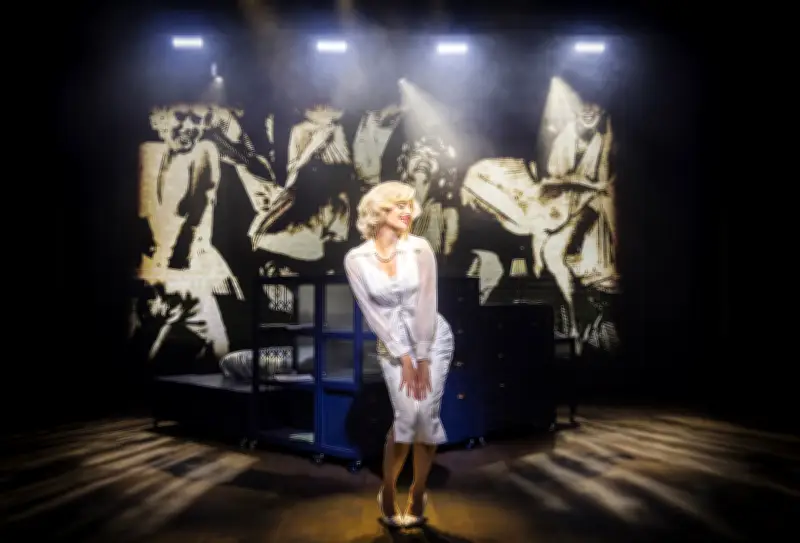
Pixie Lott stars as Marilyn Monroe in Who Killed Marilyn?, a conspiracy thriller now playing at the Emerald Theatre on Victoria Embankment, but the production has drawn sharp criticism from theatre critics for its stilted dialogue, lack of character depth, and an ending that presents its conspiracy theory as unironic fact.
Written by Sharleen Cooper Cohen and directed by Philip Wm McKinley, the play opened on 21 August 2026 and runs until 29 October 2026 at the Emerald Theatre, Waterloo Bridge, 8 Victoria Embankment, London WC2R 2AB. Tickets range from £22 to £157, and the runtime is 2 hours and 10 minutes.
A whirlwind tour that fails to illuminate
The play opens with Lott's Marilyn, described as extremely breathy and extremely blonde, hovering near the bed where her body was found. She tells the audience they don't really know the real her, then drops an F-bomb to prove it, before taking viewers on a whirlwind tour of her life.
According to Time Out's theatre editor Andrzej Lukowski, that tour is not very illuminating. Lott's limitations as an actor leave her stranded doing what amounts to a Monroe impression, while Cohen's writing shows a similar attitude to subtext as Garth Merenghi, resulting in no depth of character. A 'real' Marilyn is constantly alluded to, but her whole life still seems like a performance.
Everyone in the play talks in exposition. Lott's Marilyn never does anything casual or insignificant, and the stilted dialogue is simply a cavalcade of modestly interesting facts about her career, marriages and death.
The conspiracy ending draws criticism
The fact of Monroe's death is dropped at the start, but Cohen proceeds in a purely linear fashion, only revealing how she believes her subject died at the end. Rather than present it in a literary way, Cohen simply trundles through and says 'this is how it happened'—and then has Marilyn confirm it herself.
Lukowski notes there are several competing conspiracies of, as near as he can tell, equal credibility. He doesn't see a problem with a play that takes one as its premise, but having the ghost of Marilyn Monroe unironically tell the audience that this is all correct is at best gauche and at worst kind of gross.
Stylish direction but not a good drama
The production is reasonably stylishly directed by McKinley in a brooding, dark-hued production with nice sound design and an elegant midnight blue colour palette. However, Lukowski found the male actors' paint-spattered costumes a bit baffling.
The play is not too far from the vibes of a trashy true crime doc, and some people will doubtless enjoy it on those terms. But, as Lukowski concludes, it's simply not a good drama.