The Fear of 13 Review: A Sturdy but Safe Broadway Transfer
If the high ticket prices of classic Broadway productions like Death of a Salesman are prohibitive, theatergoers can find a more affordable alternative just a few blocks away. The Fear of 13, written by Lindsey Ferrentino and directed by David Cromer, presents an earnest and accessible fact-based story at the James Earl Jones theatre in New York. This play, which transfers from London, is so straightforward and dependable that it could almost be mistaken for a filmed biopic aiming for awards season attention. However, while it has a strong emotional pull, its polite execution prevents it from truly soaring on stage.
Based on a Harrowing True Story
The play dramatizes the real-life case of Nick Yarris, a man who endured a troubled youth marked by drug addiction and car theft before being wrongfully convicted of murder and sentenced to death. Yarris spent 22 years on death row, steadfastly maintaining his innocence with the help of lawyers and a volunteer named Jackie Schaffer, whom he married while incarcerated. Eventually exonerated through DNA evidence, Yarris turned his ordeal into a memoir and documentary, which form the narrative backbone of Ferrentino's play.
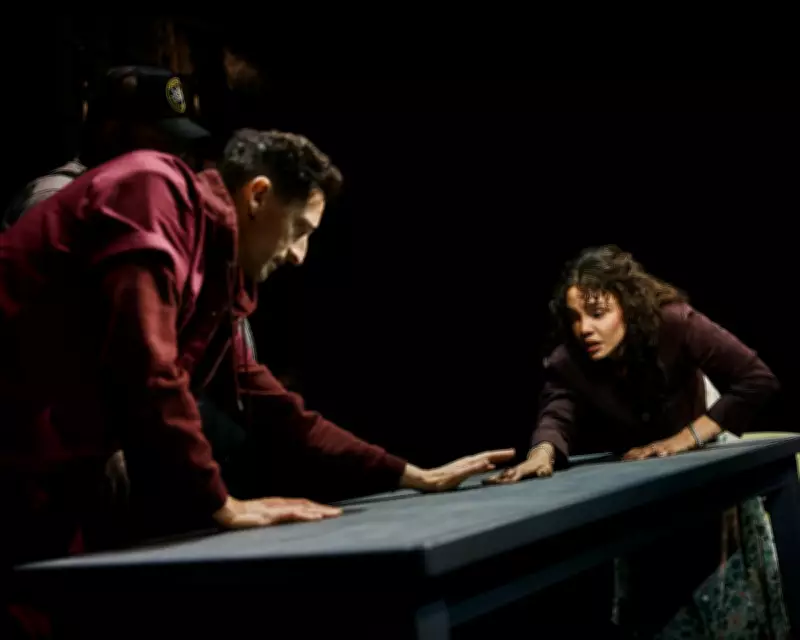
Ferrentino and Cromer strive to elevate this linear, prison-confined story into grand theater. Cromer, known for his stunning productions like The Adding Machine and Our Town, employs a midcentury modernist style here. Characters often stand in isolated pools of light, directly addressing the audience, while busier scenes are presented in tableaux. This approach creates a nearly Brechtian theatricality, emphasizing the play as an idea as much as a story.
Conventional Text and Lopsided Structure
Despite this innovative staging, the text itself remains fairly conventional. It maps Yarris's prison years in a straightforward manner, focusing heavily on his exchanges with Schaffer, referred to as Jacki in the play. These dialogues recount the timeline of events, with only brief pauses for moments of sublimity, such as a musical interlude where two prisoners in love sing to each other. Ferrentino's writing is crisp and propulsive at its best, but when it attempts lyricism—particularly in an over-egged final monologue—it falls into vagueness and cliché.
The play also suffers from a lopsided structure. A significant amount of time is spent on table-setting and preamble before Nick and Jacki's relationship begins, after which their connection feels rushed, likely to keep the runtime at an intermissionless 110 minutes. As a result, while the despondency and brutal constraints of prison life are palpable, the enduring passion between Yarris and Jacki—which helped lift him from despair—feels underdeveloped. Jacki becomes more of a plot device than an equal partner, which is a disservice to her character.
Strong Performances from Brody and Thompson
Tessa Thompson delivers a warm and understated performance as Jacki, proving that the stage might be her ideal setting. She effortlessly fills the theater's volume, casting a glow across Arnulfo Maldonado's imposing set. Adrien Brody, reprising his role from the London run, brings a hammy, stringy energy to Yarris, speaking in an unspecific New York-ese accent that contrasts with the real Yarris's softer Delaware county dialect. Despite this, Brody and Thompson complement each other well, with Brody's most affecting moments occurring in scenes of intimacy between Yarris and Jacki.
However, when the play reaches its climax with a rain-soaked finale, Brody swells to fit the hokey staginess, flattening Yarris's specific story into a general meditation on life's quotidian beauty. This sentiment, while worthy, is more wrenchingly rendered in works like Our Town. Ultimately, The Fear of 13 leaves audiences horrified by the injustice done to Yarris and moved by his journey to freedom, but these feelings are fleeting. Ferrentino and Brody have not burrowed deep enough to make the play stick; it is polite theater that soothes rather than sears, offering a sturdy but safe experience on Broadway.