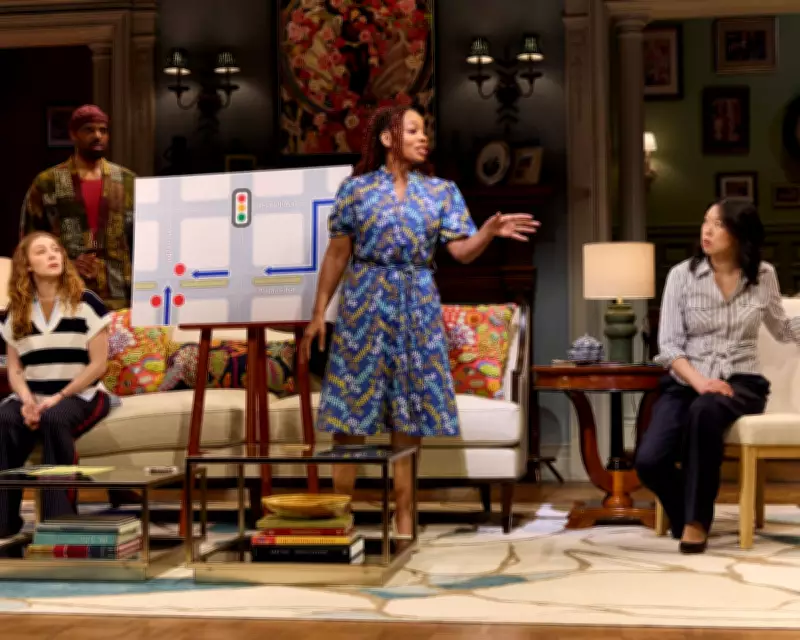
The Balusters Review: A Pulitzer-Winning Playwright Returns with Mixed Results
Playwright David Lindsay-Abaire, celebrated for his Pulitzer prize-winning drama Rabbit Hole and Tony-winning musical Kimberly Akimbo, returns to the stage with his new comedy The Balusters at New York's Samuel J Friedman Theatre. This production showcases the writer's impressively eclectic bibliography, which also includes providing book and lyrics for a singing and dancing adaptation of Shrek. While The Balusters doesn't fully integrate all of Lindsay-Abaire's diverse talents into a cohesive masterpiece, it demonstrates remarkable versatility in assembling the nine-member Vernon Point Neighborhood Association.
Neighborhood Dynamics and Modern Conflicts
The play centers around a neighborhood association that exists somewhere between an officious homeowners' association and a benevolent community gathering. The group convenes to address various issues affecting the safety, sanctity, and aesthetic qualities of their unnamed suburban American neighborhood, with subtle references suggesting a location near Washington DC. Remarkably polite and even friendly despite underlying tensions, these characters navigate complex interpersonal dynamics that sometimes blur the line between genuine camaraderie and passive-aggressive behavior.
The newest association member is Kyra, portrayed by Anika Noni Rose, who has recently relocated from a Baltimore-area neighborhood where her family's departure was hastened by an incident with a previous community group. As a well-to-do Black woman firmly grounded in her convictions, Kyra remains acutely aware of potential reactions from her affluent white neighbors. Her primary concern addresses a dangerous corner outside her home where speeding drivers have been diverted following the installation of a new traffic light elsewhere in the neighborhood. While Kyra advocates for additional safety measures, association president Elliot, played by Richard Thomas, insists that further changes would blight what he calls the "esplanade."
Multiple Conflicts and Social Commentary
The play's title originates from a dispute concerning an unseen neighbor who has rebuilt her porch railing using historically incorrect balusters to accommodate a newly necessary wheelchair ramp. This conflict divides association members between those advocating for leniency and those demanding stricter enforcement. Lindsay-Abaire cleverly refracts myriad contemporary issues through this single community group, including stolen Amazon packages, misplaced dog excrement, interpersonal annoyances, and broader social concerns.
The narrative introduces various partners, children, and other important figures through reference rather than direct appearance, with the sole exception being Luz, Kyra's housekeeper portrayed by Maria-Christina Oliveras. Luz previously worked for Elliot under mysterious circumstances that remain unexplained until a later monologue. This structural choice creates a somewhat schematic dynamic that pits a high-achieving Black mother against a patrician white grandfather who may prioritize historical preservation over child safety.
Character Dynamics and Performances
The production features strong performances from its ensemble cast, including Kayli Carter as vegan activist Willow, Carl Clemons-Hopkins as gay Black man Brooks, and Jeena Yi as sardonic Melissa. Stage and screen veteran Marylouise Burke delivers particularly memorable work as Penny, the slightly addled but still with-it octogenarian who dutifully takes meeting minutes while asking after Melissa's nonexistent husband. Margaret Colin portrays Ruth, whose decision to wear a rabbit-fur coat to annoy vegan Willow exemplifies the production's sometimes questionable approach to interpersonal dynamics.
Lindsay-Abaire demonstrates particular intelligence in depicting a softer form of conservatism through Elliot's character—a perspective that would never flirt with direct Trumpism yet maintains a clear sense of social order. The play also thoughtfully explores the complex order of operations that characters like Brooks must navigate when evaluating possible prejudices against them. However, the dialogue's riffs on genuine biases and verbal sensitivities often lack the cleverness and unpredictability needed for truly effective social satire.
Strengths and Limitations
The Balusters succeeds as entertainment despite its limitations, with the cast delivering lines with impeccable timing that often earns laughs even when the material feels predictable. In one particularly effective scene, Penny emerges as an unexpected voice of reason and grace, prompting audiences to wonder if she serves as the playwright's stealth mouthpiece for navigating a complicated world of biases, pettiness, and human frailties.
Less successful are the emotional turns that depend on offstage action revealed through on-stage unveilings that feel like cheap dramatic tricks. Rather than allowing audiences to genuinely consider and challenge different perspectives, the play often provides opportunities to feel righteously correct from multiple angles. This approach makes The Balusters both more fun and less resonant than it potentially could be, leaving audiences to question whether they're witnessing a multifaceted discussion or a series of clever writer's tricks.
Ultimately, The Balusters represents an ambitious attempt to explore modern American conflicts through the microcosm of neighborhood association meetings. While it delivers entertainment value and thoughtful moments, the production feels underdeveloped in its execution of social satire, leaning toward writerly cleverness over genuine dramatic resonance.