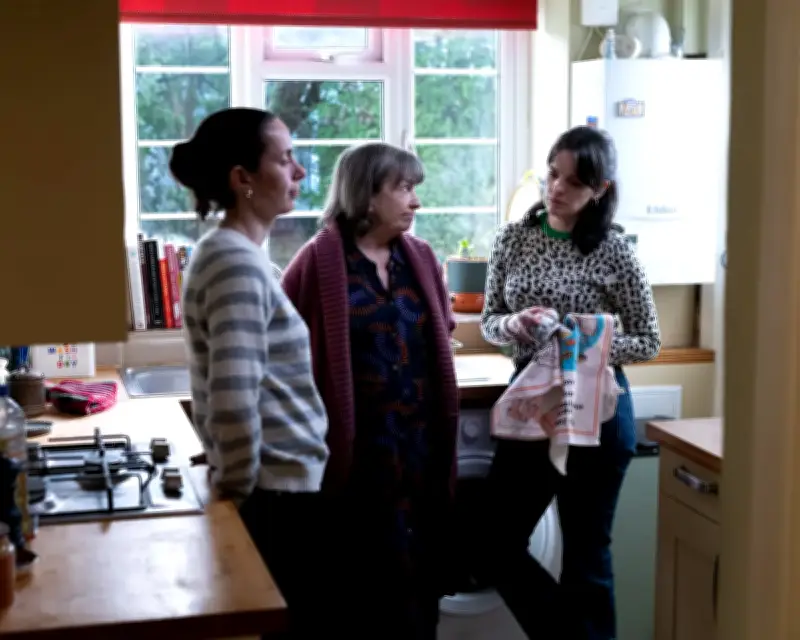
Mike Leigh's new film, possibly his last, is a poignant, intergenerational drama that explores the happy-sad acceptance that life goes on, until it doesn't. The film, which screened at the Telluride film festival, focuses on the mortality of elderly parents and the end that awaits everyone. The decency and clarity of the film are a tonic, according to the review.
A Title That Mirrors Leigh's Dual Tone
The title Tender Loving Care is one of Leigh's overtly positive and even sugary titles, like Life Is Sweet (1990) or Happy-Go-Lucky (2008), as distinct from his darker ones: Secrets & Lies (1996) or Hard Truths (2024). However, the review notes that his sweet titles are not simply satirical and intended to mean the opposite; it is more complicated and elusive. Even the contrast between the two heroines' private and professional lives isn't straightforwardly a matter of irony.
As often with Leigh, the dialogue has that unique cartoonish quality that isn't caricature. The characters often speak with an almost wartime chirpiness in a world of peckers kept up and noses kept clean. This perkiness is something the thirtysomethings have unexpectedly inherited and modified from their old mum and dad, and Leigh leaves it to the audience to judge the consequent tone of the drama and the appropriate tone of their response.
Setting and Characters in Ealing
The setting is Ealing, west London, where people work all day and get half drunk at night, opening up the white wine that's been in the fridge while worrying about themselves and their family. Rosie (Alice Bailey Johnson) is a single woman and social worker who has started dating a fireman. She stays calm and polite in the face of aggressive behaviour from clients; her first scene is with an impassive old man in hospital who, asked for his address, recites only a number. The review suggests he is perhaps a kind of choric spirit in the film, like the homeless man in Jack Rosenthal's The Chain.
Rosie, as caring in private as she is at work, has welcomed her best friend back into the spare room in her flat. This is Amy (Kate O'Flynn), a fellow social worker who cares specifically for vulnerable young people. She needs a place to stay as she has just split up with an odious boyfriend. The two women are deliriously happy to have each other's company again: they drink, sing daft songs and tell goofy jokes together. Another type of movie would suggest that each woman is the love of the other's life, and that they are in denial. Not this film. Rosie and Amy are just best pals and the tension and the unresolved issues lie elsewhere.
Family Dynamics and Heartbreaking Performances
In a way, Amy's only other mates are her mum and dad, for which there are excellent and heartbreaking performances from Leigh stalwarts Marion Bailey and Paul Jesson, who was Turner's elderly father in Mr Turner (2014). Rosie and Amy go round to see them together for cups of tea, and Amy's mum unselfconsciously calls Rosie her "second daughter". But there are problems. Amy can't bring herself to confess to her parents that her relationship (from which they were hoping for grandchildren) is over, and her mum is uneasy about the way "Pops" zones out in the middle of conversation and seems forgetful. Like Amy and Rosie, the old couple love songs; they sing Daisy Bell and Boiled Beef and Carrots in private and the simplicity and innocence of these moments is almost unbearable.
As ever, the buoyant and exuberant dialogue passages show that the speaker is not a clever-clever person intent on impressing anyone, and for all the exaggeration, there is a realness in these moments. Bailey's mum figure waxes lyrical about her husband and how wonderful it was, 50 years ago, to have met him: "He was one in a million … a needle in a haystack!" Of course, a needle in a haystack doesn't exactly connote what she's saying but the truth of it is plain enough, and if the audience laughs, it is with her, not at her.
Work, Care, and the Weight of Sadness
At work, Rosie and Amy are impeccably conscientious in the face of the most challenging people, though perhaps Amy is marginally the more successful of the two; we see her being able to connect with troubled teens. Rosie is as well-meaning, but often meets a blank wall. Leigh also shows us one moment when one woman appears to have a legitimate complaint against her; Rosie urges this woman, who has lost her children to the system and is now living in what are clearly squalid and chaotic conditions, to talk and open up – but the woman angrily replies that her words will just be held against her in court. She has a point; if she were under arrest, she would at least be warned that she had the right to remain silent. As for Amy's mum, she is the caring friend and neighbour to a recently widowed woman painfully estranged from her son.
Leigh shows us a world without cynicism, without malice, a world in which people do care, but in which they have a lot to care about. There is a lot of unhappiness here, an ocean of sadness which almost, but not quite, capsizes the boat – yet the mood, underscored by Gary Yershon's music, is more ruminative than melancholy. The film's structure is theatrically controlled, and the succession of scenes moves smoothly from Amy and Rosie's lives at home and at work, to their parents' lives and to their interaction with clients. There is no screenwriting-seminar character development or narrative arc here – except perhaps one which leads to a heart-wrenching moment in a bedroom from which the camera retreats sadly and tactfully on to the landing. We are not approaching a big monologue moment of explosive emotional catharsis. The storm, as so often with Leigh, rumbles towards us and then rumbles back over the horizon. And yet the sadness and the love stayed with me long after the closing credits.