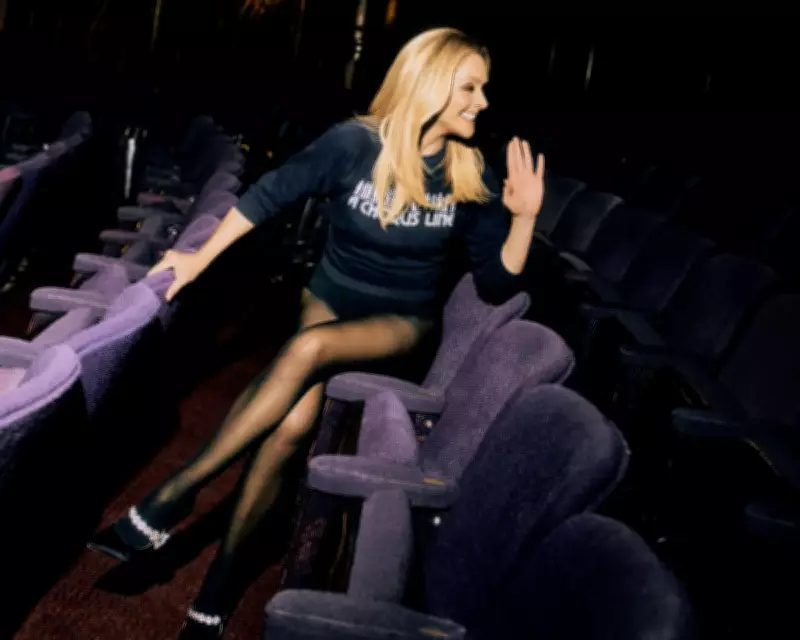
Jane Krakowski: The Unforgettable Force Behind Television's Most Memorable Characters
Jane Krakowski, the acclaimed actress known for her scene-stealing performances, has carved a unique path through television and theater. With a career spanning decades, she reflects on the roles that defined her, from Ally McBeal to 30 Rock, and her unwavering passion for the stage.
A Television Legacy That Moved the Needle
"I've been on three television shows that moved the needle a little bit," Krakowski says with characteristic humility. Her breakthrough came with Ally McBeal (1997-2002), where she played Elaine Vassal, a brassy, eccentric counterpoint to Calista Flockhart's neurotic lead. The show sparked debates about feminism and postmodernism, with Krakowski's character embodying an unconventional career woman.
This was followed by 30 Rock (2006-2013), where her Jenna Maroney served as the perfect foil to Tina Fey's Liz Lemon. Krakowski's performance, devoid of self-awareness, contrasted sharply with Fey's perpetually self-conscious character. Then came Unbreakable Kimmy Schmidt (2015), where she played Jacqueline White, a magnetically unlikable socialite in a surreal world only this cast could navigate.
The Art of Creating Unforgettable Characters
Krakowski possesses a rare ability to bring characters to life in ways that feel both instinctive and meticulously crafted. Her performances explode with energy and precision, making dialogue and action seem inseparable. This talent has earned her numerous Emmy, Golden Globe, and Actor award nominations throughout her career.
Despite her screen success, Krakowski's heart belongs to the theater. At 57, she rarely goes two years without appearing in a play, most recently in Broadway's Oh, Mary! which she describes as having an "incredibly loyal and returning gay fanbase." She was recently in London for the Olivier Awards, nominated for Here We Are, Stephen Sondheim's final musical.
Roots in Stage Discipline
Krakowski grew up in New Jersey in a family "eccentrically in love with the stage." Her mother was a college theater teacher, and they would wait in TKTS lines for hours to see Broadway shows. Initially aspiring to be a ballet dancer, she realized early that the pursuit of perfection wasn't for her. "What makes people interesting is their quirks and flaws and singularities," she says, a philosophy that guides her character choices.
This background instilled a discipline she proudly maintains—the classic hoofer's grit of never missing a show. She attended the Professional Children's School, learning alongside Broadway dancers whose athleticism left a lasting impression. A childhood memory of Chita Rivera throwing a rose to her during Chicago remains more vivid than her early film career, which began at age 12 in National Lampoon's Vacation.
Breaking Boundaries in Television
Looking back, Krakowski recognizes Ally McBeal's originality wasn't just in featuring independent women, but in portraying them as imperfect and unconventional. Her character invented absurd products like a face bra and automatic toilet-seat warmer, a shtick that has since become common but was groundbreaking in 1997. "It became such a water-cooler show," she recalls, crediting creator David E. Kelley's genius.
Between Ally McBeal and 30 Rock, Krakowski starred in London's West End production of Guys and Dolls, winning an Olivier Award for her portrayal of Miss Adelaide. She found the role challenging initially, struggling to understand a character who says exactly what she means without subtext—a departure from the post-Sondheim musicals she was accustomed to.
Collaboration with Tina Fey
Krakowski credits Tina Fey with honing her comedic voice, describing her as "a genius writer but such a smart producer, such an incredible person." She remembers the excitement of receiving fresh 30 Rock scripts, still warm from the copier, with no idea what was coming next—mirroring the viewer's experience of the show's anti-formulaic approach.
During season five, both actresses became pregnant within three months of each other. Krakowski describes the environment as "loving and supportive," though the scripts began featuring caustic lines about motherhood that reflected their real-life experiences.
The Sondheim Connection
Krakowski's recent work in Here We Are presented unique challenges. Sondheim's final musical features a family moving between restaurants without being served, with music stopping abruptly in the second act. "It is tricky!" she concedes. "It is complicated." Yet her love for Sondheim helps her embrace its imperfections. "What always felt very emotional to me in act two," she says, "is that you feel Sondheim leave the room. We never want Sondheim to go away."
The Paradox of Performance
Krakowski once described her preference for "the wrong-but-right"—jokes you shouldn't laugh at, situations you can hardly bear to watch. Yet in person, she radiates gratitude and generosity toward her collaborators. The harder work of extracting gold from human nature's complexities she saves for stage and screen, embodying the discipline of a true grafter who believes only a broken leg should keep her from performing.