There are few more masterly portraits of 1980s caveman capitalism than David Mamet's drama about fast-talking Chicago real estate salesmen. Mamet is arguably the premier playwright for capturing American masculinity of this era, so it is surprising to learn that the idea to stage an all-female version came from him.
This new production has the same director as last year's all-male Broadway revival, Patrick Marber. The wardrobe underlines that the female ensemble are playing at being men, pitted against each other with unequal sales leads and driven to ever more unprincipled acts in the hope to come out on top.
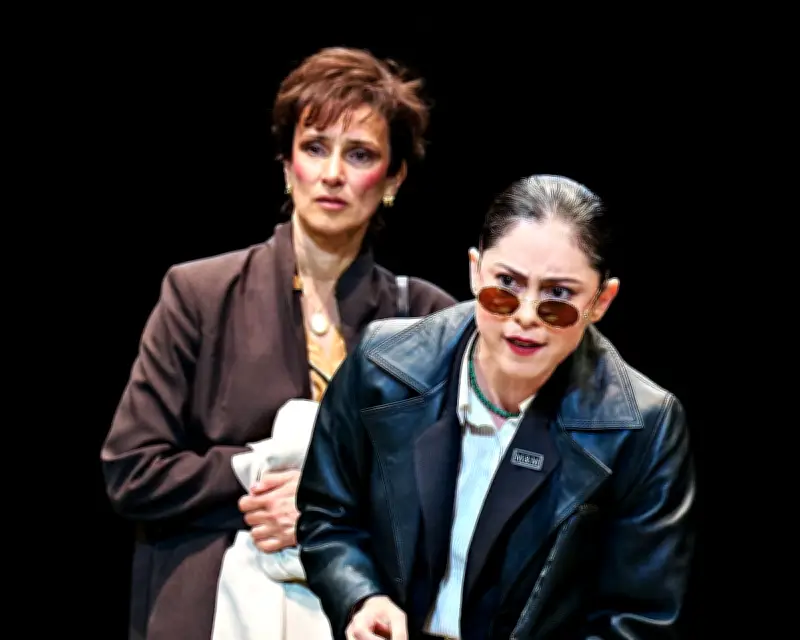
Some wear trouser suits such as Levene (Indira Varma), others appear feminine in skirts and high heels, including office manager Williamson (Dorothea Myer-Bennett). It creates a distance between character and actor, despite the intimacy of the in-the-round staging, perhaps so we can see the cast “performing” masculinity with Mamet's linguistic punch-ups.
Originally a dark comedy (or funny tragedy?), the play is all the more humorous in this send-up, although at times it is rather Bugsy Malone – an exaggerated, dress-up version. More importantly, the darkness is missing. Mamet's whip-smart patter is there but the high energy and volume come to feel relentless and tonally flattening.
Levene, the elder salesman on a losing streak, is the picture of angrily failing manhood, full of shouty invective. Unlike Jack Lemmon, who gave him the compassionate dimensions of a latterday Willy Loman in the 1992 film, Varma plays him like an apoplectic fool with great relish, surfing what seems like a perennial caffeine high. You do not feel the tragedy in his failure to realise the American dream on this rigged playing field because the focus is on making fun of these men.
Office alpha Roma (Rosa Salazar) is better put-together, partly because he does not demand empathy as a character. Salazar makes a smooth wheeler-dealer, pumped up on his selling powers, and becomes the highlight of the production.
The other two salesmen are less defined: the meek, weary Aaronow (Nancy Crane) and chippy Moss (Niky Wardley) in a pencil skirt, heels and gigantic blonde wig. Williamson, meanwhile, seems rather functional – a quiet controller but with no real menace.
The production does not contemporise its corporate world, maybe for good reason: TV series such as Industry have shown us that women are just as capable of aggressive power-play and rapacious ruthlessness. But you wonder why these women are playing at being men rather than performing as female versions of Mamet's capitalists, especially in the era of Margaret Thatcher. Didn't that time show us that women entering a masculine lair can feel forced into aping the men?
Is it in fact capitalism (crossed with patriarchy) that turns these characters into venal desperados? They are cogs in the capitalist machine rather than masters (even Williamson), and ultimately chewed up by it. But this is not quite felt here, because the focus is on the magnification of masculinity.
Gender-switched productions are motivated by different reasons, as outgoing artistic director Matthew Warchus points out in the programme. Some are done for gender parity, some are political and others simply arbitrary, he says. For all its promise, the purpose of the gender reversal here feels unresolved. At the Old Vic theatre, London, until 18 July.