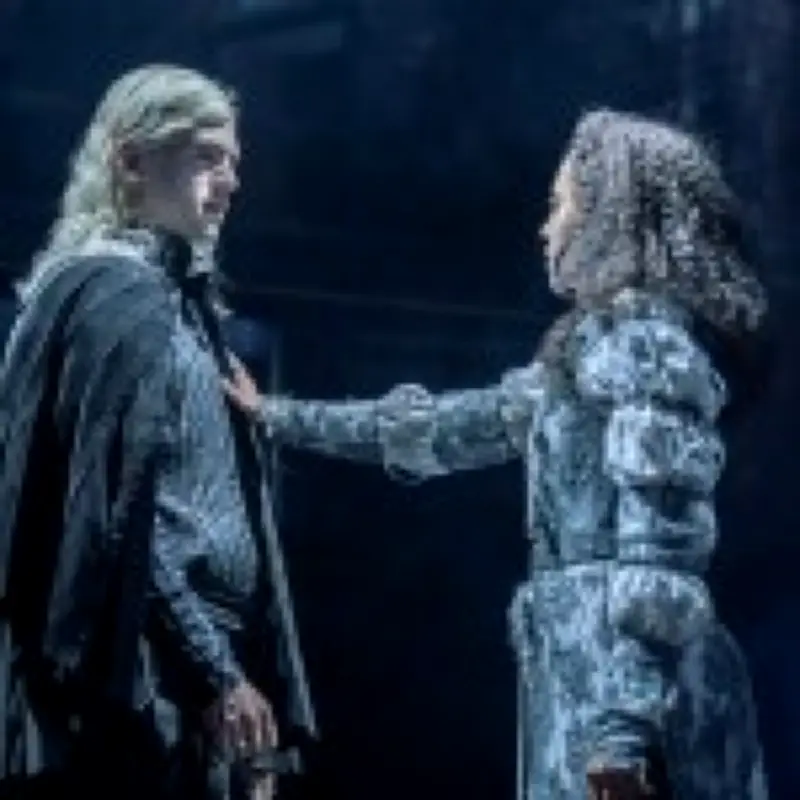
The Royal Shakespeare Company's stage adaptation of Game of Thrones, titled The Mad King, delivers an epic spectacle that fans will relish, but its three-hour-45-minute runtime and cartoonish villain prevent it from being a masterpiece. Directed by Dominic Cooke, with a script by Duncan Macmillan and George RR Martin serving as creator and executive producer, the production imagines the events leading to the fall of King Aerys II Targaryen, the so-called Mad King, set 17 to 18 years before the TV series. While it offers a new story that is now considered canon, it suffers from pacing issues and a lack of surprise for those familiar with the saga.
Plot and Setting: A New Chapter in Westeros Lore
The narrative begins with a woodland skirmish where a young Howland Reed (Islam Bouakkaz) is rescued from a mugging by a boisterous Lyanna Stark (Harmony Rose-Bremner) and her clan, including a young Eddard 'Ned' Stark (Michael Abubakar). This seemingly minor incident leads to The Great Tourney of Harrenhal during the False Spring, a key event in Game of Thrones lore that was never depicted on screen or page. At the tournament, Prince Rhaegar Targaryen (Noah Ritter) and his associates hatch an audacious plot to unite rival houses and overthrow his increasingly paranoid father, King Aerys (Michael Shaeffer).
The Tourney's Twist: Rhaegar's Bold Move
The plot is thrown into disarray when Rhaegar, having won the tournament, refuses to crown his wife, Princess Elia Martell (Elizabeth Ayodele), as Queen of Love and Beauty. Instead, he bestows the honour on the independently minded Lyanna, who is already betrothed to Lord Robert Baratheon (Callum Woodhouse), a plain-talking, hard-drinking, grief-stricken man of action. This act sets off a chain of events: princesses imprisoned, armies assembled, messenger ravens despatched, deals made, bets hedged, dragons imagined, babies born, lives lost, and a new king declared.
Production Details and Creative Team
The Mad King's journey to the stage has been a decade in the planning, with previews mysteriously cancelled as the production was refined. The final runtime, including an interval, is three hours and 45 minutes. While the cast delivers solid performances, the King's madness feels too superficial and cartoon-like, and some of the slo-mo and blackout battle sequences could be tightened. The political machinations of the conclusion are also too speedily tucked away.
Strengths and Weaknesses: A Balanced Review
As a prequel, it suffers from the fact that audiences know exactly where things are heading, so there's no real surprise when the mad monarch is finally deposed and a new ruler is revealed. However, The Mad King is less about the conclusion and more about the journey. Macmillan and Cooke do a decent job of juggling the sizeable number of characters, ensuring the sprawling narrative is largely well-paced, with enough sub-plots and spectacle to keep both hardcore and lesser-engaged fans entertained. The emergence of the iconic Iron Throne in Act II earns a scene-stealing cheer from the audience.
Audience Reception and Future Prospects
As a stand-alone piece of theatre, The Mad King scrapes through. But as an extension of the Game of Thrones world, it scores well, shifting the narrative to the stage with suitably theatrical thrust. A swift sell-out as soon as it was announced, further performances are pretty well guaranteed, and it's hard to imagine HBO and Warner Bros executives not discussing how they could eventually bring the story to the screen.
For all its flaws, this is one Mad King whose reign is set to continue unopposed. The show is currently playing at the Royal Shakespeare Company in Stratford-upon-Avon.