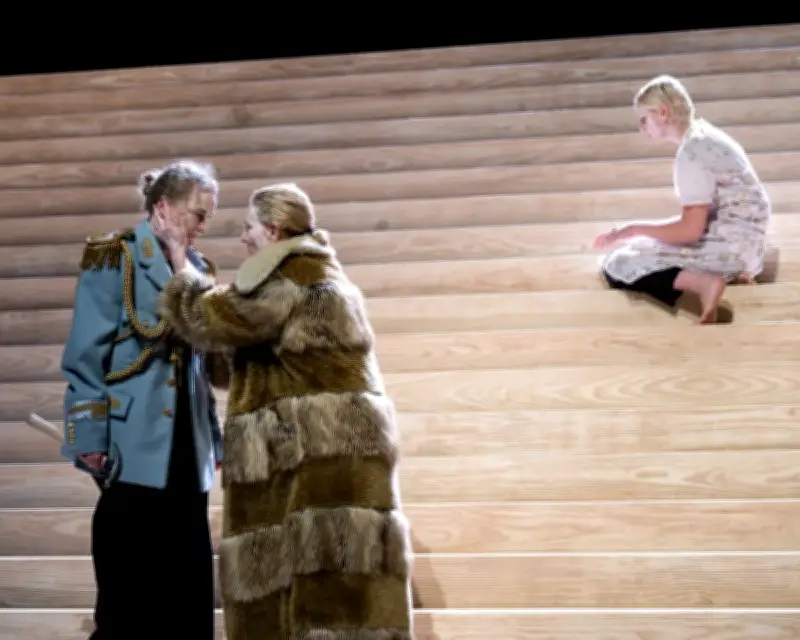
The National Theatre's Electra/Persona, Benedict Andrews' intense, interval-free mashup of Sophocles' tragedy and Ingmar Bergman's 1966 film, is a show of two halves, with the ancient half far more successful than the modernist one. The production, running until 10 October, features Cate Blanchett and Nina Hoss sharing the roles of Electra and Clytemnestra, as well as Bergman's silent actor Elisabeth and her nurse Alma, with the casting decided by a coin toss before each performance.
Coin toss decides roles each night
Before each show, Blanchett asks Hoss, 'Heads or tails?' and an audience member tosses the coin. On the night reviewed, Blanchett won, so she played Clytemnestra and Alma, while Hoss played Electra and Elisabeth. This clever twist, perhaps too clever, aims to eke out mother-daughter friction from each drama, exploring ideas about performance, how actors assume roles, and who they become off-stage.
The production is quite literally a game of two halves, with Andrews' overhaul of the ancient drama much more successful than his strangely sterile take on Bergman's classic. Blanchett and Hoss are thrown into a series of gladiatorial face-offs, and they shine even when the awkwardness of Persona reveals its cracks.
Ancient half delivers searing performances
The ancient half comes first, with a searing performance from Hoss, who previously appeared in Andrews' shimmering production of The Cherry Orchard. She plays a spittingly angry adolescent, ominously brandishing a hammer, with an edge of the comic grotesque. She hates her mother but, it is clear, loves her too.
Blanchett is commanding but less imperious than Stockard Channing's Clytemnestra in the West End's kooky Elektra. Beneath the hauteur, and occasional comic touches, she is beseeching, convincing us of her right to seek vengeance for the death of her daughter Iphigenia, sacrificed by her father Agamemnon to appease the gods. Mother and daughter seemed justified in their thirsty violence.
The production features overt theatricality, with face paint rubbed on, costumes donned, and characters role-playing parts of their family story. Electra assumes the part of Agamemnon or her brother Orestes by putting on their jackets, while her more obedient sister Chrysothemis, played by Ella Lily Hyland, trembles in the virgin white dress of Iphigenia. The murder of Clytemnestra's lover Aegisthus, played by Patrick Robinson, consists of blood spat across his face. It is stark and effective on Magda Willi's ascending staircase set, where the drama looks like an act of conjuring. Brendan Aanes's sound design pumps an electric heartbeat that raises the adrenaline without tipping into frenzy.
Persona half struggles on stage
If only Andrews had left it at that. Bergman's film, regarded as the apex of psychological experimentalism on screen, is trickier to pull off on stage. Andrews introduces a screen and a handheld camera, briefly reflecting the audience but mostly showing us Elisabeth in enigmatically silent closeup. Hoss holds the camera mostly, and the film's chase across the beach in a fight between the two women is re-enacted as a backstage walk with handheld camera. It is now an old trick, beloved of the likes of Ivo van Hove and Jamie Lloyd, which looks hackneyed here.
There is some clever overlay between the two parts, with same props and costumes turning up. But Alma's monologues seem like witterings against Elisabeth's silences. Bergman's film is said to have influenced David Lynch, among others, and the endeavour here ends up like a sixth-form imitation of both.
As a double bill, of sorts, the first half is the showcase, not only of its two central performers but the power of performance itself. The production runs at the National Theatre, London until 10 October.