Broadway's Dog Day Afternoon Revival Struggles to Capture Pacino's Magic
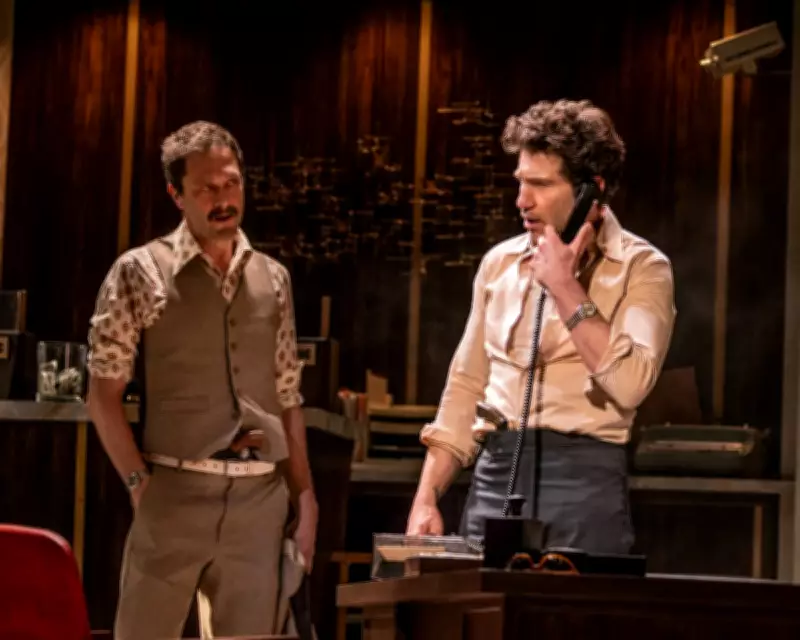
The legendary 1975 film Dog Day Afternoon, starring Al Pacino, has long been considered a cinematic masterpiece. Now, a splashy new Broadway production attempts to bring this iconic heist story to the stage at New York's August Wilson Theatre. However, this theatrical adaptation, featuring Jon Bernthal and Ebon Moss-Bachrach, ultimately fails to deliver the same punch as its silver-screen predecessor.
The Original Story's Enduring Legacy
Many fans might be surprised to learn that Dog Day Afternoon wasn't based on a beloved play or novel. Instead, the film drew inspiration from a real-life 1972 bank robbery in Brooklyn, documented in a Life magazine article. The actual incident involved two robbers who discovered most of the bank's cash had already been collected by an armored car, leading to a tense hostage situation. Adding to the drama, one robber sought funds for his lover's gender-affirming surgery.
The film version, which won the Academy Award for Best Original Screenplay in 1975, took creative liberties with names and details while capturing a specific moment in New York City history. Its blend of timeless themes and historical relevance seemed to make it perfect for Broadway adaptation.
Staging Challenges and Historical Hindsight
Playwright Stephen Adly Guirgis's production faces the unintended obstacle of historical perspective. Details that felt like authentic 1970s snapshots in the film now appear self-conscious and even cutesy on stage. The play's attempts to recreate famous movie scenes with added retrospective context sometimes fall flat, with forced historical references that disrupt the narrative flow.
Guirgis does make some smart changes, particularly in expanding the roles of female bank tellers. The newly created character Colleen, played by Jessica Hecht, evolves from offering tart assessments to showing increasing sympathy for lead robber Sonny, portrayed by Jon Bernthal. Bernthal wisely avoids competing with Pacino's legendary performance, instead presenting Sonny as someone whose mouth moves faster than his brain can process.
Lost Urgency and Structural Issues
Despite these adjustments, the stage version loses much of the original story's urgency. Guirgis adds explanatory architecture that over-clarifies the action, limiting spontaneity. One of the film's most famous scenes—where Sonny whips the crowd into a frenzy with chants of "Attica!" referencing the recent prison riot—feels like a weak payoff rather than an authentic outburst in the play.
The production does capitalize on live theater's unique energy during this scene, with police lining the theater aisles and piped-in crowd noises blending with genuine audience enthusiasm for Bernthal's anti-police tirade. However, the impressive rotating set becomes a hindrance elsewhere, requiring constant shuffling between locations that highlights the original film's superior editing.
Character Development Shortcomings
On stage, characters often get lost in the elaborate staging. Ebon Moss-Bachrach delivers an appropriately menacing performance as Sal, Sonny's violent accomplice, but his character primarily serves to make Sonny appear more reasonable by comparison. Similarly, FBI agent Sheldon exists largely to make local detective Fucco seem friendlier, while an ongoing gag about mispronouncing Fucco's name feels forced.
The play also misses opportunities with Leon, Sonny's lover, who by contemporary standards would be considered transgender. While Sonny and Leon share a touching phone-call scene reminiscent of the film, the writing simplifies Sonny's sexuality in ways that create confusion within the 1972 setting. Sonny's contradictions—maintaining a traditional family while being devoted to Leon—are downplayed rather than explored, leaving characters feeling underdeveloped.
Period vs. Contemporary Sensibilities
Perhaps the production's fundamental issue lies in its awkward negotiation between 1970s period details and 2020s sensibilities. The repeated use of David Bowie songs, including several that postdate the 1972 setting, encapsulates this problem: they provide initial recognition pleasure but ultimately feel like they serve the audience rather than enhance the on-stage action.
This Dog Day Afternoon revival runs at the August Wilson Theatre in New York through July 12th, offering Broadway audiences a chance to revisit a classic story. However, those hoping to experience the film's legendary intensity will likely find this stage adaptation lacking in both spontaneity and emotional depth.