Simon Stephens' new play A Slow Fire, now running at Jermyn Street Theatre in St James's, offers an imaginative but messy take on post-apocalyptic survival. The four-hander, which debuted in Dublin, earns 3 out of 5 stars from Time Out critic Holly O'Mahony. The production runs from 26 August to 26 September 2026, with tickets priced at £40 (£35 concessions) and a running time of 2 hours 15 minutes.
A two-hander at heart inside a bunker
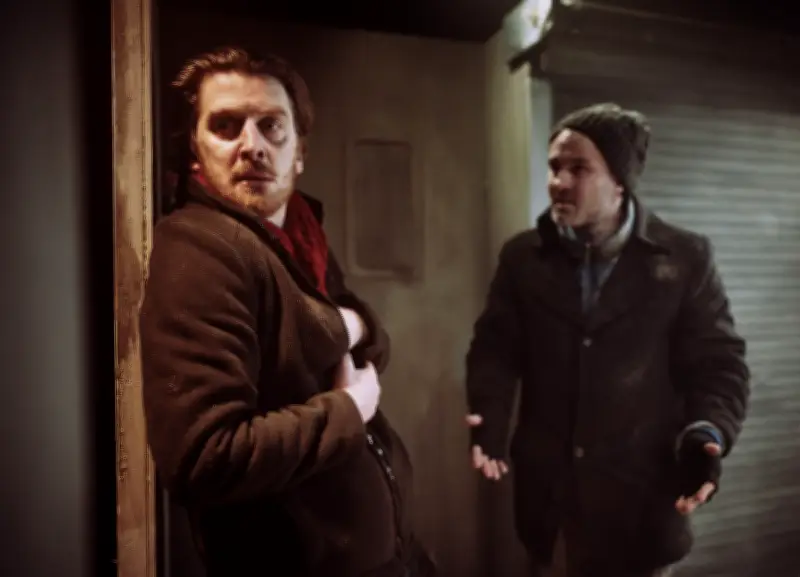
Although billed as a four-hander, the play mostly functions as a two-hander. Ashton (Ross Gaynor) and Reece (Ian Toner) are stuck together in a bunker while an apocalypse rages outside. Three years into their confinement, they know everything about each other and maintain hope by roleplaying key 'moments' from each other's lives, selecting treasured memories as one might choose a show on Netflix.
The conversation veers into philosophy at times, questioning whether hope is a blessing or a curse and debating whether to draw maps of the remembered land or venture out into whatever it has become. Mostly, it offers a frank, relatable look at what matters when everything else is stripped away. For Ashton, that means memories of a crush, a promotion and his mother; for Reece, it is his son.
Evocative moments and a climate warning
The 'trapped in a bunker' scenario is convenient for a production, avoiding tricky set changes, and the 'apocalypse outside' device is familiar. Yet Stephens gets the audience thinking about what any of us might do in similar circumstances. A fly appears, seemingly a precious sign of life, but the men haven't eaten fresh protein for so long that they swiftly smoosh it into a morsel of food.
Other evocative moments include a record played for the first time in years, an infected tooth yanked out with string in a horrifyingly convincing stunt (credit to director Rex Ryan), and the arrival of a stranger, Presley (Fionn Ó Loingsigh), which lets the men savour slivers of fresh meat. This is not a typical apocalypse: Reece's penchant for walks suggests leaving the bunker is feasible, and fresh tulips on the table of Andrew Clancy's set, a makeshift living space lined with baked bean tins repurposed as candle holders, indicate they do go outside occasionally.
Red herrings and untapped potential
The imminent danger is never explicitly stated, but the audience learns this is a world in climate chaos, ravaged by fires, floods and pandemics. The dismantling of railway tracks suggests there is no return, making it feel like a cry from the not-so-distant future. A fourth character, Mary (Holly Demaine), briefly appears to deliver a lyrical, terrifying speech about what the planet burning would involve in a micro sense, listing domestic cats, cancer, Italians, chocolate and more up in flames.
Despite the vivid world-building, red herrings and tangents could be tidied up. It is not yet a magnum opus, but as a climate drama with some tweaks, it holds great potential. Performances run at Jermyn Street Theatre, 16B Jermyn Street, London SW1Y 6ST, with the nearest Tube at Piccadilly Circus.