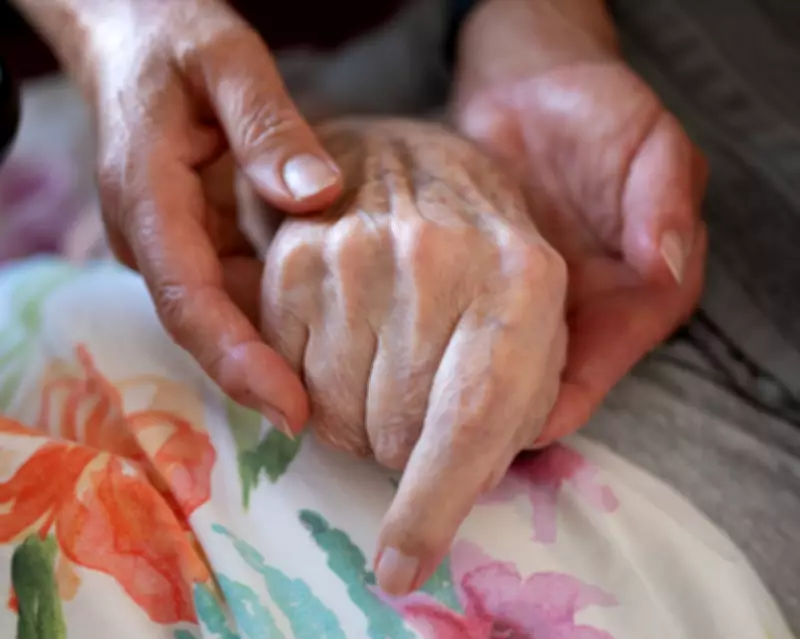
Renowned documentary photographer Sibylle Fendt has created a profoundly moving series of portraits that confront one of society's last great taboos: the final days of life. Her intimate photographs capture terminally ill patients spending their remaining time at home, surrounded by family, friends, and carers in familiar, comforting environments.
Personal Inspiration Behind the Lens
The project finds its emotional core in Fendt's own experience of loss. "In May 2024, after a long illness, my husband Hendrik passed away at home with his family by his side," she reveals. "After an odyssey of hospital visits and unsuccessful treatments, we reached a point when we realised it was ending. The moment we decided to stay at home brought relief, even though we knew what lay ahead."
Fendt describes accompanying her husband's departure in their beloved home, being present at his final moments, and saying goodbye in an environment where they felt safe despite the indescribable grief. This personal journey directly inspired her to create a visual space for openness, closeness, and compassion around a subject that remains largely hidden from public view.
Voices from the Threshold
The photographs are accompanied by powerful testimonies from both patients and carers, offering rare insights into this deeply personal territory.
Confronting Mortality
"I would like those around me to realise that my cancer frightens me no end," shares Mr Köhler from Berlin-Wilmersdorf. "The difference is that they will probably live on, live longer, be able to organise their lives differently. My time here is very, very limited. And my options are slipping away. And I realise that every day. The shittier life gets, the more attached I become to it."
Eighty-four-year-old Günther Stanzl approaches his situation with dark humour: "Now all I am waiting for is the ticket for my hearse. That's my dark sense of humour. It's more a sign of weakness than strength. You can pretend you are not afraid, but of course you are. You're scared and why shouldn't you be? We only have one life."
The Carer's Perspective
Christa, who cares for her husband at home with incredible devotion, finds unexpected positives in this challenging phase of life. She often sings old folk songs to her husband, recalling words from childhood, and is amazed how frequently they reference themes of farewell.
"Every night, Christa sleeps on a folded-down mattress at her husband's feet," Fendt notes. "She keeps emphasising how important it is for me to take these photos, insisting that the silence surrounding age and death needs to end. She longs for a society in which a willingness to help and care for others is valued much more highly."
Finding Meaning in Care
For some, the experience becomes an opportunity for profound connection and reciprocity. The daughter of Mr Schiller explains: "For me, this has a lot to do with giving back. The intergenerational contract is not a one-way street. My papa was always there for me, looked after me, cared for me and comforted me. It's a given that I can now repay him with all my love and the knowledge I have acquired. It's simply a tribute to him as a person."
Moments of Transition
Fendt captures not just the emotional landscape but the physical reality of this transition. Chris, photographed in her favourite armchair, recalls: "When the doctor at the hospital said: 'There's nothing more I can do for you,' we thought it was over, but it all turned out quite different. We came home to a much calmer place. I didn't have to die – not immediately. I could go on living for a moment."
The photographer also documents the complex mix of panic and peace that can accompany a loved one's final breath. "Hendrik suddenly stopped breathing," Fendt remembers. "As if out of nowhere. A sudden swallow or clearing of the throat and everything was silent. I panicked and didn't know what was happening or what I should do. At the same time, I was glad that there was no last gasp, that it was such a peaceful end."
Philosophical Questions
The project raises profound questions about the nature of dying itself. "I don't understand dying," Fendt admits. "I can't grasp it. Life, then suddenly death. I can't understand it at all. Was Hendrik aware it was happening? Did he realise he was dying? Or was he on a nice trip towards the end – one that he's maybe still on now? Because with his last breath time stretches into infinity?"
Despite the weight of these questions, moments of simple human connection persist. Mrs Schiller expresses a hope many carers share: "At some point, I just want to be able to look back on this time and say: 'We did a good job.' And that, actually, we maybe even had a good time."
A Visual Testament
Fendt's series, titled "Before the time comes," is available from Kehrer Verlag. Through her lens, she transforms private moments of vulnerability into a public conversation about how we approach life's inevitable conclusion. The photographs serve as both memorial and manifesto – honouring individual stories while challenging societal attitudes toward death, dying, and care.
By bringing these intimate scenes into public view, Fendt creates what many of her subjects explicitly request: an end to the silence surrounding age and death, replaced by a culture that values compassion, support, and honest conversation about our shared mortality.