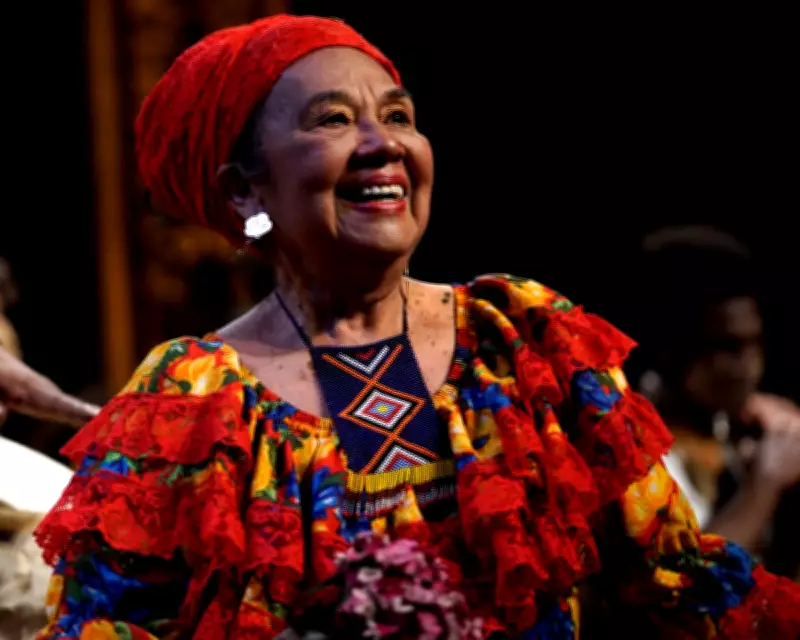
Totó la Momposina, one of the most celebrated musicians in Colombian history, has died at the age of 85. Her three children announced her death from a heart attack on Instagram, stating: 'Totó was a woman who, with her voice and extraordinary dedication, carried the culture and memory of the Colombian people to the far corners of the world.'
A Life Dedicated to Colombian Music
With a lilting voice charged with an edge of toughness, Totó brought various forms of Colombian folk music, including cumbia and porro, to broader international awareness. Her popularity endured, with younger generations of Latin artists sampling her songs. Among those paying tribute was Colombian President Gustavo Petro, who described her as 'my dear friend and a luminary of Colombian Caribbean art and culture … may she soar high to the stars.'
Early Life and Career
She was born Sonia Bazanta Vides in 1940 in the small town of Talaigua Nuevo in northern Colombia, to a family with multiple generations of musicians. After the family moved to Bogotá, she adopted the stage name Totó la Momposina—Totó being her childhood nickname and Momposina a reference to the Mompós region where she was raised. By the late 1960s, she was performing in her own band, Totó La Momposina y Sus Tambores, and her reputation in Colombia grew to the point where she was invited to perform a concert residency at New York’s Radio City Music Hall in 1974.

Exile and International Breakthrough
In 1979, she discovered she was blacklisted in Colombia for leftwing political leanings and became a refugee, fleeing to France and joining a musical collective there. 'I sang in the streets, in restaurants, on street corners, in markets, in the Métro, everywhere,' she said. She joined the cultural delegation accompanying Gabriel García Márquez as he accepted the Nobel Prize for Literature in 1982, and her recording career began the following year with her debut album Cantadora. However, it was through a partnership with Peter Gabriel’s label Real World Records that she found a broader international audience, starting with 1993’s La Candela Viva.
Musical Style and Legacy
Raised near the northern Colombian coast, Totó’s music featured a culturally rich blend rooted in African and Indigenous sources, with a huge rhythmic variety. She moved between sub-styles such as chandé, mapalé, fandango, puya, and bullerengue. Totó had an evangelistic fervour about Colombian music and dedicated her life to spreading it. 'It had to be done,' she told Songlines magazine in 2023. 'People need music to identify themselves; it dignifies them.' She added, 'While I respect the word “folklore”, to me it means something that’s dead – in a museum. Traditional music, or the music from the old days, is still alive: many people are working with it and it’s always evolving.'
Later Years and Honors
In later years, she spent time in the UK and returned to Colombia, but continued to tour the world. In 2013, she received a lifetime achievement award at the Latin Grammys, and in 2016, she was made Chevalier des Arts et des Lettres by the French government. The flute line from her song Curura became the heart of the 2003 track 'Indian Flute' by Timbaland and Magoo, and was later sampled by Major Lazer and many others. Her music was also sampled by Jay-Z, 50 Cent, Sevdaliza, and numerous other artists across hip-hop, dance, and beyond. She made a guest appearance with the popular Puerto Rican group Calle 13 on their 2011 track 'Latinoamérica.'