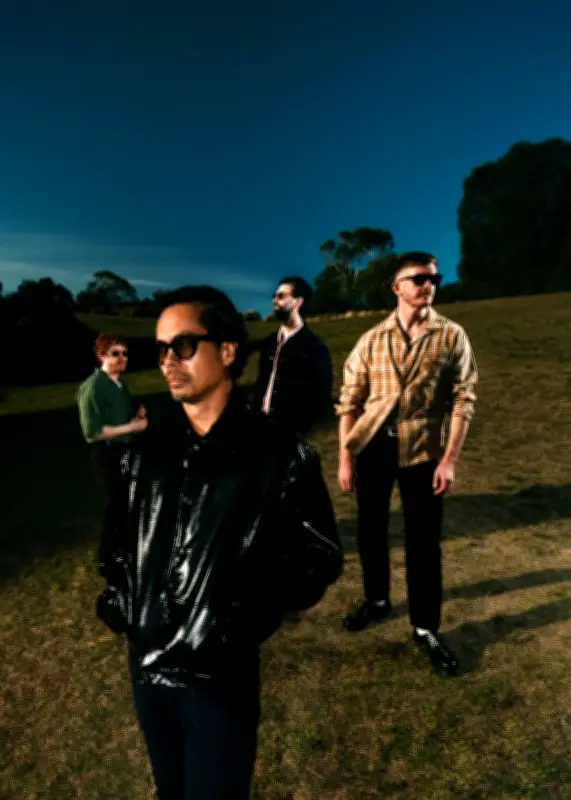
Since recording their breakout 2009 debut in a ‘dungeon basement’ in Hackney, the lives of the Melbourne band have transformed – and so has their industry. Sungazer, the fourth album by the Temper Trap, is out on 10 July, and the band are going back on the road.
Toby Dundas is a Melbourne Demons fan. The drummer for the Temper Trap was watching his AFL team beat the West Coast Eagles a few weeks ago when Harvey Langford scored a goal. Amid the roar of the crowd, he picked out a familiar voice. “When the Dees score a goal, they each have a song they play, at home games,” Dundas says. Langford’s is Love Lost, a mixtape cut by the late rapper Mac Miller based on a chunky sample of the Temper Trap song of the same name. “I’m like, ‘Hang on a minute. That’s Dougy singing!’” “Did it give you goose bumps, Toby?” teases frontman Dougy Mandagi, grinning into his webcam.
It may not be the Australian band’s biggest footy-related moment (they played at the Grand Final in 2012) but measuring the timeline in units of Harvey Langford underscores the longevity of their career. Langford was born in 2006, just a year or so after Mandagi and Dundas met working in retail and formed the Temper Trap with Jonathon Aherne and Lorenzo Sillitto. The original Love Lost was on their 2009 debut album Conditions, which also contained their breakout song Sweet Disposition; the Miller track is from around 2011. And now, after a lengthy hiatus that began in 2018, the Temper Trap are going back on tour to promote their fourth album, Sungazer.

The pressure of a hit
The recording of their debut, Conditions, began in Melbourne in late 2008 but finished in London the following year, where the band and entourage all lived together in a house with a “dungeon basement” in Hackney. It wasn’t the safest area; kids jumped the fence more than once wanting to fight them, “and our house, it got broken into, was it once or twice?” recalls Mandagi. “It was kind of fun, looking back, but Hackney was pretty spicy back in those days. It’s a lot more gentrified now.”
As they kept up the gig-heavy hustle, a local label rep who had taken their new single to UK radio multiple times to no avail decided to push it once more – and Sweet Disposition went from being a favourite on Australia’s national broadcaster to a legit international hit. The Temper Trap joined Hackney neighbours Florence + the Machine and Mumford & Sons on the BBC’s Sound of 2009 shortlist. The song became a top 10 hit in the UK and featured heavily in the era-codifying romcom (500) Days Of Summer.
Sweet Disposition has aged much better than many of the anthems of millennial optimism that followed. The overlapping ripples of delay in the intro still tingle like anticipation in your solar plexus; Mandagi’s choirboy falsetto hits like a sunbeam across your face. It sounds like when you’re young and you actually remember to remember being young.
The band took Conditions all over the world, playing it at Reading and Leeds, Glastonbury and Roskilde, as well as Splendour in the Grass and Big Day Out in Australia. They collected multiple prizes at the Arias and the Brits, and toured relentlessly into the cycle for their self-titled follow-up album in 2012. But the years it took to get LP number three, 2016’s Thick as Thieves, to a release felt like pulling teeth. Two years after that, the band announced a hiatus, broken only briefly by a handful of Australian dates around Conditions’ 10th birthday.
“I just really felt like I was hitting a creative wall,” Mandagi, the primary songwriter, explains. “People were trying to steer it in a direction to try and achieve the success of Conditions again. And that’s just tiring. That’s not a place where you want to be in creatively.” Sweet Disposition cast an enormous shadow – and while there are no mixed feelings about the song itself, Dundas says that not being able to produce another song that “connects with so many people” became like “a little weight that you carry around”.
“It takes the perfect storm to take a good song and turn it into a global success,” says Mandagi. “It’s not just based on the merit of the song itself. It’d be great if it was, but that’s not true. So people should stop kidding themselves.”

A new chapter with Sungazer
The rangy, optimistic Sungazer certainly feels more natural than their last record and more textured than the debut. Mandagi’s lyrics reference his faith more readily than ever, as well as reckoning with new fatherhood. In Halfway, Mandagi sings about the displacement and restlessness of touring; the clip for single Into the Wild – “the song that lit the spark” in the early writing sessions – traps a camera in a car with the four men (Sillitto left the band in 2013) and a ticking metronome, as they drive and sleep and scream at one another.
Standout track Giving Up Air, released late last year, aims for dancefloor catharsis, with throbs of that signature guitar delay begging to be filed somewhere between U2 and Underworld, and a video, filmed in London, that feels like a gorgeously grey love letter to their adopted city. That said, Dundas and Mandagi insist they have always been a Melbourne band at heart. Dundas is living back in the inner north; Mandagi, who was born in Indonesia, is building a house in Bali with his partner.
Moving into their industry-elder era, the weight of how the business has changed in 20 years – or even just the last decade – is not lost on them. Recorded music sales are racing radio listenership to the bottom, and the economics of the streaming era are devastatingly lopsided, as streamers make it harder than ever for Australian music to find its audience. Artists must become content creators for the algorithm. Dougy notes that the push to record and tour again came partially from the popularity of a Sweet Disposition cover on TikTok. Meanwhile, touring a continent so vast requires flights that cost more than ever, and there are fewer venues and festivals to play when you land. Unemployment benefits helped many young artists through their early years back in the day; today, they’re no longer livable.
Dundas worked with a lot of young artists during the band’s hiatus, “and seeing the amount of money that they were having to spend to get a little foothold, a little start in their careers … ” He shakes his head. Some of the bands he’s referencing, he says, have “given it away” in the years since, for purely financial reasons.
The stakes for even an established band are high, but ahead of their international tour, the pressure is also about making the time away from their families worth it. Dundas’ son is seven; Mandagi’s firstborn (who pops briefly into frame under his arm) is two. “I don’t know if I like it, to be honest,” says Mandagi, on travelling now as a parent. “When you come back from whatever, two weeks or a month, a lot changes in that short time span.”
Just as intractable is the reality that you’re not in your 20s any more. Mandagi’s voice, for example, cannot be taken for granted the way it once was; he’s started working with a vocal teacher for the first time. “At the height of our touring, I was smoking and not getting enough sleep and talking all night on the tour bus and just abusing my voice, basically,” he says. “So I’m definitely feeling it now, and I have to work twice as hard to be in the same form that I was in … I have this fear that I’m going to go on stage and just absolutely cook it.”
“The tour bus will be a lot different this time,” concludes Dundas. “It used to be a lot of late nights and parties – I think it’ll all be early morning yoga and qigong and whatnot, and herbal tea, this time around.” Sungazer is out on 10 July.