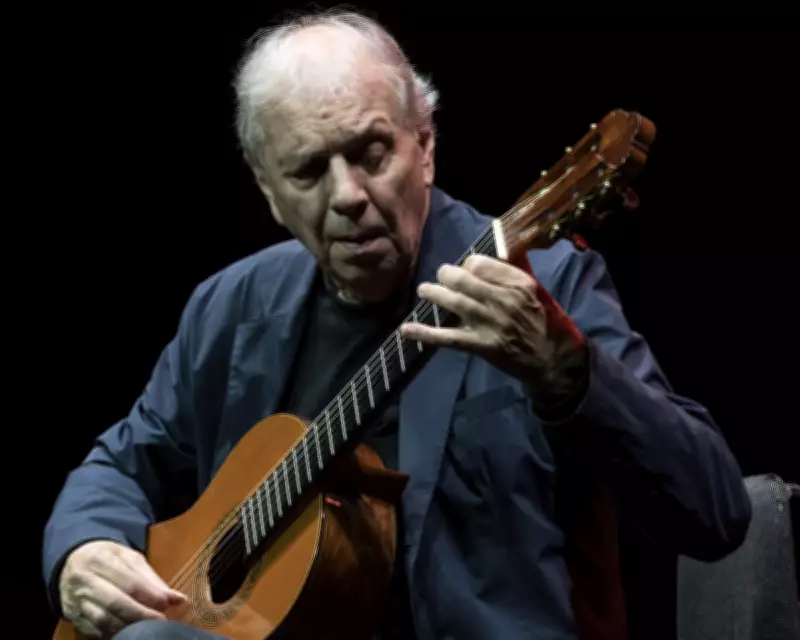
Ralph Towner: A Quiet Giant of Jazz Fusion Passes at 85
The world of contemporary music has lost one of its most distinctive and influential voices with the passing of Ralph Towner at the age of 85. The American multi-instrumentalist and composer, who described himself as a "raconteur of the abstract", was a central figure in the development of 1970s jazz fusion, most notably as a founding member of the pioneering ensemble Oregon.
From Piano Prodigy to Guitar Innovator
Towner's musical journey began in Chehalis, Washington, where he was born the youngest of five siblings. His early life was marked by tragedy when his father, Milo, a trumpet-playing timber-mill worker, died in the Second World War when Ralph was just three years old. His mother, Bernice, a church organist and piano teacher, became his first musical mentor, teaching him piano and nurturing his evident talent for improvisation.
His formal education took him to the University of Oregon, where he studied classical piano and composition. It was here that two fateful encounters would shape his artistic destiny: he began jamming with fellow student and self-taught double-bassist Glen Moore, and he first heard the classical acoustic guitar, an instrument whose sonorities captivated him completely.

European Discipline and American Innovation
Determined to master this new instrument, Towner followed a teacher's recommendation to study with Karl Scheit, a classical guitar and lute master at the Vienna Academy of Music. He relocated to Austria, living in austere conditions and dedicating himself to seven-day-a-week practice. This rigorous training gave him a formidable contrapuntal technique that would later allow him to fluidly incorporate influences as diverse as the Bill Evans piano trio and Brazilian samba rhythms into his playing.
Returning to the United States, Towner's career quickly gained momentum. He played New York jazz clubs as a pianist in the late 1960s and even performed at the iconic Woodstock festival on guitar with folk-blues singer-songwriter Tim Hardin. A significant turning point came when he joined the saxophonist Paul Winter's eclectic Winter Consort, a group that blended folk, jazz, and classical elements.
The Birth of Oregon and a New Musical Language
It was within the Winter Consort that Towner found his musical soulmates: bassist Glen Moore, reeds player Paul McCandless, and sitarist/percussionist Collin Walcott. Together, they formed Oregon in 1971, naming the group in tribute to the state where Towner and Moore were raised. The quartet created a unique hybrid sound—often described as "chamber-jazz"—that seamlessly wove together jazz, folk, classical, Asian, and Latin-American influences with a distinctive, spacious patience.
Oregon's impact was immediate and lasting. Albums like "Music of Another Present Era" (1973) and "Oregon in Concert" (1975) showcased their capacity for cinematic atmospherics and melodic collective improvisation. The band sustained this creative energy for decades, releasing their final album, "Lantern", in 2017.
A Prolific Solo Career and ECM Partnership
Parallel to his work with Oregon, Towner embarked on a remarkably prolific solo career. In 1973, he began a long and fruitful collaboration with producer Manfred Eicher, founder of the influential ECM Records. Under his own name, Towner led more than two dozen releases for the label, working with jazz luminaries including saxophonist Jan Garbarek, trumpeter Kenny Wheeler, and drummers Jack DeJohnette and Peter Erskine.
His compositions were celebrated for their expressive lyricism, so much so that vocalists like the subtle British singer Norma Winstone would compose lyrics for them. Notable solo and small-group recordings include the early standout "Diary" (1973), the European collaboration "Solstice" (1977), and the exquisite final solo guitar album "At First Light" (2023), which even included a rendition of his favourite melody, "Danny Boy".

Historic Contributions and Lasting Legacy
Towner's influence extended far beyond his own projects. He freely improvised the opening for Wayne Shorter's "The Moors" on Weather Report's seminal 1972 album "I Sing the Body Electric", creating a historic moment in the evolution of jazz-rock fusion. In a curious astronomical footnote, two of his compositions for the Winter Consort—"Icarus" and "Ghost Beads"—had craters on the moon named after them by the Apollo 15 crew, who had taken the band's album "Road" on their lunar mission.
In his personal life, Towner married Italian actor Mariella Lo Sardo in 1994, relocating first to Palermo in Sicily and then to Rome. This move inspired new musical connections, notably with Sardinian trumpeter Paolo Fresu. He is survived by Mariella and his daughter, Celeste, from his first marriage to Janet, which ended in divorce.
Ralph Towner's career was defined by a quiet obsessiveness and a profound confidence in his inner musical world. From the folk-infused stages of Woodstock to the refined studios of ECM, and through the genre-defying explorations of Oregon, he leaves behind a body of work that is hauntingly lyrical, technically masterful, and endlessly inventive. His passing marks the end of an era for a uniquely American musical visionary.