Ralph Lauren the brand turns 60 next year, with the designer himself now in his ninth decade. A new book, Ralph Lauren: Catwalk, written by veteran fashion journalist Bridget Foley, explores the history of the all-American label’s influential catwalk shows from 1972 to now. The book features a wealth of photographs, from the early days of the brand to its most recent collections.
The Early 80s: Going International
Bridget Foley notes that by the early 80s, Ralph Lauren was ‘a major star of American fashion, everyone wanted to be at his show’. The 1981 show – inspired by the golden age of Hollywood, and featuring suiting as well as classic knits – was the moment the brand went international. Joan Burstein, the retail maven who founded Browns in London, approached Lauren about opening a shop in the city. ‘Ralph’s aesthetic is so deeply influenced by British tropes, it made perfect sense,’ says Foley. The brand opened its first store outside the US on New Bond Street soon after.
Menswear Influencing Womenswear
If we now think of menswear influencing womenswear as par for the course, Lauren was a pioneer of the trend, which was partly inspired by his wife, Ricky, who struggled to find simple tailored women’s clothes. ‘He started his womenswear with the idea of transferring menswear concepts to women stylistically,’ says Foley. This worked for evening wear as well as more casual pieces, as seen in a look modelled by Iman in 1983. ‘We think of him as being the classicist,’ says Foley, ‘but to present women in austerely tailored men’s clothes for evening was bold and it was a renegade move.’

Leisure Activities on the Catwalk
Lauren also brought less formal aspects of fashion to the catwalk – as with a collection from 1990, titled Gone Fishing and featuring waders, anoraks, hoodies and fishing rods. Foley says this was in contrast with trends at the time, and showed where Lauren was heading. ‘Much of the runway [in the 80s] was dedicated to day clothes for what we Americans call ladies who lunch. Utilitarian clothes were not deemed runway worthy. [But] Ralph has always said, “I design for life. Living is my canvas.”’ Future collections referenced other leisure activities, including sailing and tennis.
The Polo Player Logo
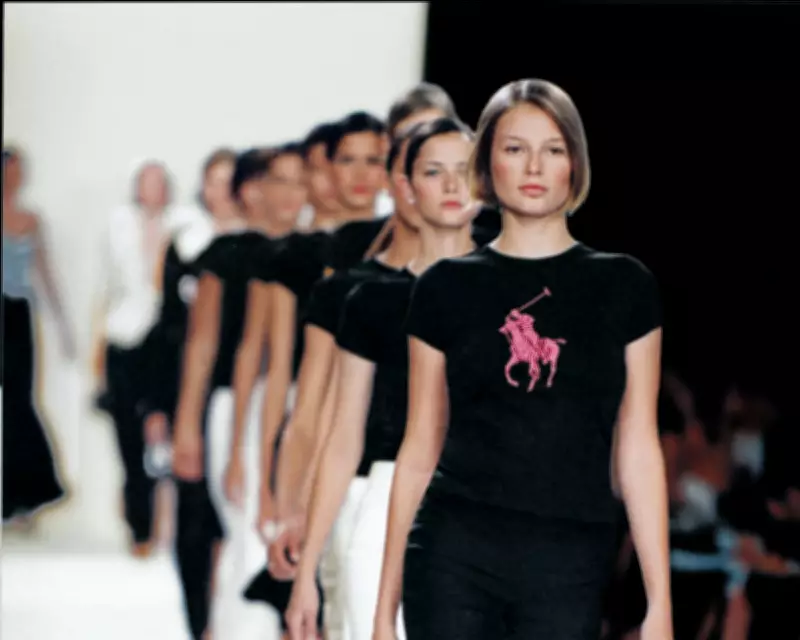
The polo player image, seen here in 2001, is synonymous with Lauren. It dates back to the very start – the tie brand Lauren founded first, in 1967, was called Polo. ‘He wanted something that would have an international ring, and a feel of excitement,’ says Foley. ‘He didn’t know anything about polo, but it had that image for him.’ The logo followed – first used on the cuff of a woman’s shirt, and not to a great reception. ‘A journalist writing in 1974 said, to the uninitiated, it looks like a smudge,’ says Foley. ‘It’s funny it became one of the most famous pieces of iconography in the world.’
Aspirational American Lifestyle
Lauren’s work also nods to the aspirational American lifestyle. The spring/summer 2006 collection had a naval theme and was inspired by Sara Murphy, the American socialite who, along with her husband, Gerald, was friends with F Scott Fitzgerald and inspired the character Nicole Diver in his novel Tender Is the Night. ‘Ralph approaches his runway from the point of view of a story that he wants to tell,’ says Foley. ‘What appealed to him was the importance of casual living that the Murphys had. They were at the centre of this artistic circle in France, there is a big leisure-time aspect to it.’
Engaging with Wider Issues
While Lauren is not typically a designer who engages with wider political issues on the runway, there have been exceptions. In 2010, a collection titled The Fabric of America featured a lot of denim and was partially inspired by workers in the 1930s – a reference that resonated with the recent global recession. ‘He said he wanted to celebrate the American spirit and the determination of the worker,’ says Foley. Denim, meanwhile, is a signature Lauren fabric. ‘He celebrates it in its traditional context and far beyond its traditional context.’

The Tuxedo and Last Catwalk Moment
Lauren’s love of the tuxedo has lasted decades – see Gigi Hadid here, nearly 40 years after Iman’s catwalk turn, in a show based on the dancing of Fred Astaire and Ginger Rogers, with Janelle Monáe performing. Shown in 2019, this was Lauren’s – and fashion’s – last catwalk moment for a while, because Covid-19 soon shut things down. ‘He could not possibly have foreseen the pandemic,’ says Foley. ‘Nevertheless, that Janelle sang, “Let’s face the music and dance while we still have the chance” is wild.’
A Who’s Who of Models
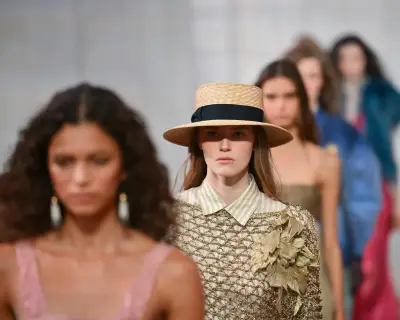
Lauren’s shows are a who’s who of models – from Hadid and Iman to Kate Moss and Naomi Campbell. In 2024, he chose to have bona fide supermodel Christy Turlington close his spring/summer show in New York, wearing an endlessly glamorous gold dress. Foley says moments like this showcase what Lauren has been doing for almost 60 years. ‘He has had a really consistent point of view, while moving it forward in a way that speaks across generations. Basically, we want what he gives us.’