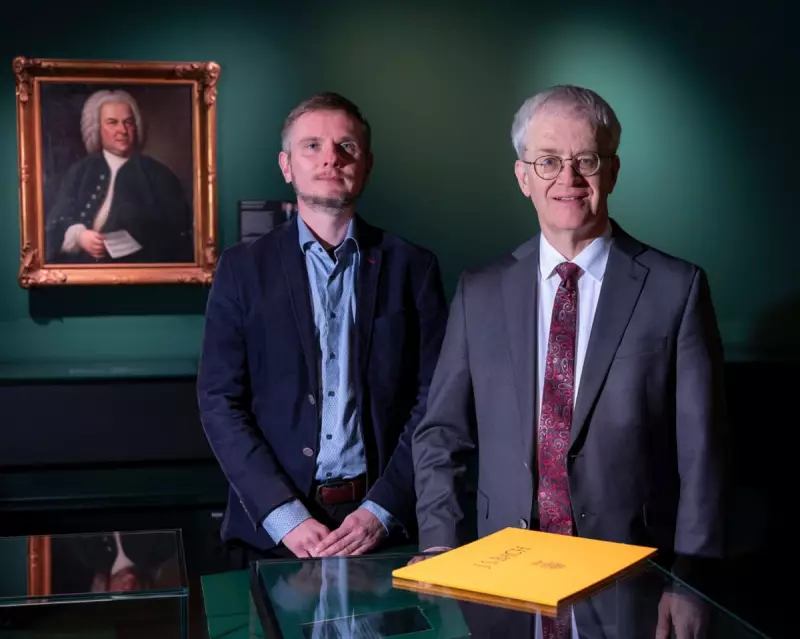
The 35-Year Musical Detective Story
When musicologist Peter Wollny first encountered two intriguing sheets of music in a Brussels library back in 1992, he had little idea he was beginning a quest that would consume half his lifetime. Now, after thirty-five years of meticulous research, the director of Leipzig's Bach Archive has successfully authenticated two previously unknown organ works by Johann Sebastian Bach.
The pieces, identified as Chaconne in D minor BWV 1178 and Chaconne in G minor BWV 1179, received their first performance in three centuries last week at Leipzig's historic St Thomas church, where Bach himself once worked as cantor. For Wollny, now 65, the breakthrough represents the culmination of a professional obsession that began during his graduate studies at Harvard University.
From Hunches to Hard Evidence
"I have to confess that I didn't even think these were works by Bach at the time," Wollny admitted during an interview following the landmark performance. "The handwriting of the score just fascinated me, and I had this vague feeling that these bits of paper could be interesting some day."

What began as academic curiosity transformed into what Wollny describes as an "inner duty" to identify the true author of the compositions. The German musicologist made photocopies of the original manuscripts he discovered in the Royal Library of Belgium and carried them with him for decades as his research progressed.
The musical pieces presented several unusual characteristics that immediately caught Wollny's trained eye. Both were chaconnes - a musical form originating from Spanish dance that became stylised around 1700. Their distinguishing feature involves a short bass line that repeats throughout the work, known as an ostinato.
What made these compositions extraordinary was their deviation from conventional patterns. In the Chaconne in D Minor, the composer had begun with a seven-bar ostinato bass before stretching the same motif to eight bars, then twelve, and finally sixteen - a bold compositional choice unheard of in mainstream works from that period.
Wollny identified these unique touches as musical equivalents of hapax legomena - terms that appear only once in a body of text. "These works didn't fit into the scheme of mainstream composition around the year 1703 at all," he explained.
The Handwriting Breakthrough
Wollny's particular talent for recognising handwriting features proved crucial to solving the mystery. He noticed that the person who had transcribed the documents used a distinctive method of drawing the C clef at the start of a staff, with a line at the bottom that curled backwards in a manner strikingly similar to Bach's own musical notations.
However, Wollny knew the Brussels scores couldn't have been written by Bach personally. During that era, composers commonly employed students as copyists to transcribe their works for practical dissemination or commercial purposes. In Bach's case, these copyists or their parents would have paid the composer for the privilege of working with him as a learning opportunity.
Over years of painstaking research, Wollny discovered twenty additional documents matching the handwriting of the original Brussels scores in archives across Leipzig, Berlin, and Winterthur, Switzerland. These documents covered the period from 1705 to 1715, gradually building a profile of the mysterious copyist.
The crucial breakthrough came in 2012 when Wollny's colleague and co-researcher Bernd Koska discovered a 1727 job application letter from a certain Salomon Günther John, who stated he had learned organ under a teacher in Arnstadt - the same small town where Bach had taken his first position as an organ instructor.
"Suddenly, things started to click together," Koska recalled. The handwriting matched perfectly with the documents in Wollny's collection.
Absolute Certainty After Decades
The final piece of evidence emerged in 2023 from archives in Thuringia. A court document written by John in 1716, which had been lost during the Second World War and recently restored, provided absolute confirmation that matched the handwriting of the Brussels chaconnes.

Wollny describes his reaction to the breakthrough with characteristic understatement. "I am not someone to punch the air in delight. I just sat there with a grin and contentedly turned the pages," he said.
Reflecting on his thirty-five year journey, Wollny acknowledged that artificial intelligence might accomplish similar authentication tasks in days or hours in the future. "Maybe it will be easier and give us even more certainty," he mused. "But that's OK."
The discovery adds significant new works to Bach's early compositional output and provides fresh insight into the development of one of classical music's most revered figures. For Wollny, it represents the satisfying conclusion to a professional journey that began with a graduate student's intuition in a Belgian library three decades earlier.