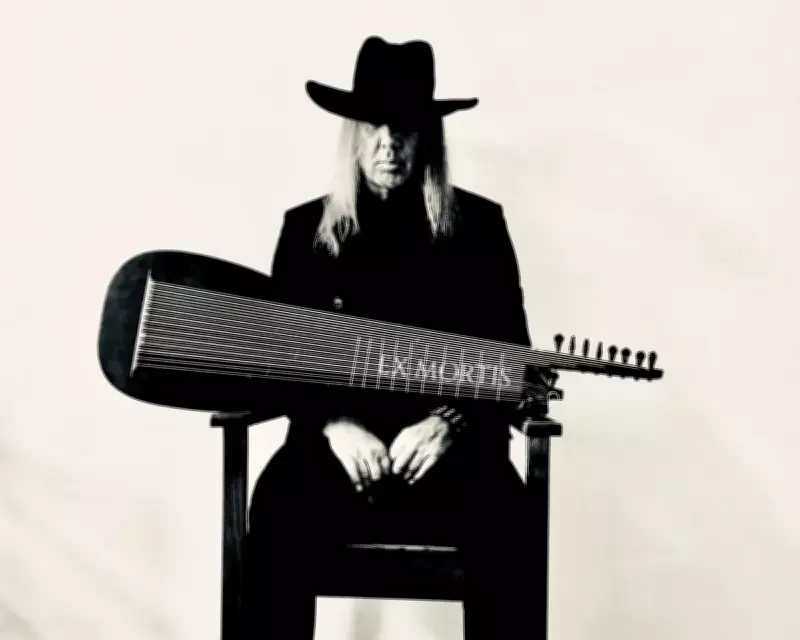
Dutch musician Jozef Van Wissem is on a one-man mission to make the lute rock again. Known as the world's most notorious contemporary lutenist, he owns eight custom-built lutes with remarkable features. His extensive discography includes nearly 50 albums, with his latest, This Is My Blood, set for release in May.
Each Easter, Van Wissem retreats to Warsaw to compose, finding the quiet city more conducive to work than noisy Rotterdam. He begins by repeating a traditional theme or melody, which he admits is a form of stealing. However, this repetition is far from copying, as the classical lute repertoire is vast and open to interpretation, especially given the instrument's many tunings. For instance, his black 14-course theorbo features reentrant tuning and has built-in microphones and a foldable neck.
Van Wissem is best known for his film scores, including collaborations with Jim Jarmusch's band SQÜRL on Only Lovers Left Alive. His new album features music composed for Joaquim Pujol's documentary Màquina, about using psychedelic trips to cure alcoholism. The album's first and last pieces are improvised slide compositions using a bottleneck, a technique that often drives away classical audiences but delights experimental music fans.

Van Wissem relishes his decades-long battle with academic orthodoxy. He believes that academic circles demean the lute and aims to make it a real pop instrument again. Before its 250-year disappearance, the lute was omnipresent, found in brothels and taverns as well as courts. He draws parallels between the lute's direct emotion and the sound of Coil. However, his innovations, such as amplifying the instrument, often lead to conflicts with traditionalists who resist change.
His nonconformity stems from his early 1980s Dutch punk scene experiences. He played in punk band Mort Subite in 1978 and later in new wave act Desert Corbusier, touring Yugoslavia and meeting Laibach, who influenced his approach to making music based on a single strong idea. After being evicted from a squat in 1979, he moved to Groningen, the squatting capital, where he owned a riotous bar called De Klok from 1988 to 1993. Bored by the mundane music scene, he quit bartending and moved to New York in 1993.
In New York, he studied under lutenist Patrick O'Brien, a Vietnam vet and open-minded teacher. However, when he tried to study lute in The Hague, he rebelled after one lesson, finding the strict adherence to notation ridiculous. He compares it to writing down a Jimi Hendrix solo for students.
Van Wissem cites Miguel Serdoura as a modern-thinking player and notes that many kids copy Metallica on the lute. However, he warns that studying lute requires six years of six-hour daily practice, and lute enthusiasts rarely listen to experimental artists like Nurse With Wound or Morton Feldman. This Is My Blood is released on 1 May.