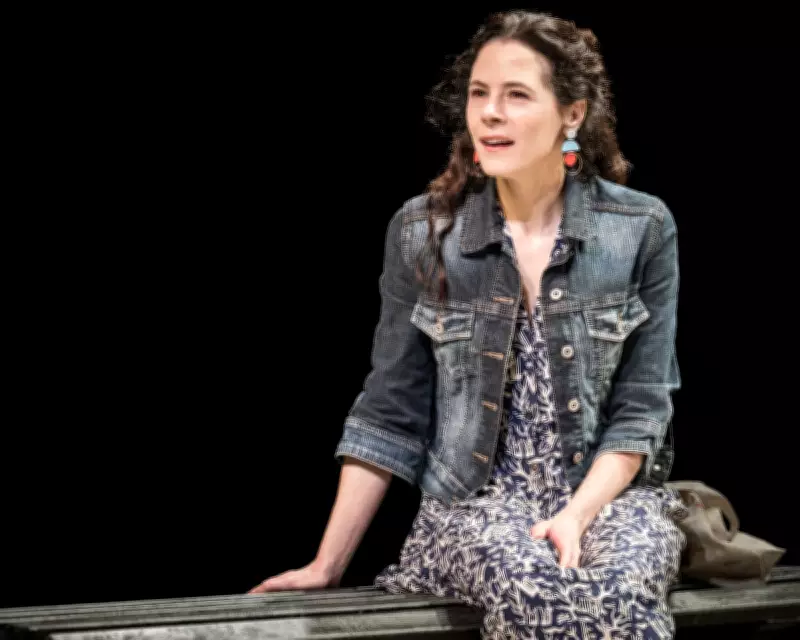
Lucid … Elaine Cassidy in Even These Things. Photograph: Marc Brenner/Courtesy of the Royal Exchange Theatre
Even These Things review – mapping Manchester’s history, from a Victorian fist fight to the IRA bomb
Royal Exchange, Manchester
Rory Mullarkey’s play, expertly directed by James Macdonald, is a bold attempt to encapsulate a whole city in decisive events from across three centuries

The theme of the Royal Exchange’s 50th anniversary season is “a homecoming”. But whose home do they mean? Who lives here? Who belongs?
Is it, for example, the heavily pregnant Annie Donovan, an Irish immigrant who, in the Manchester of 1846, brushes shoulders with Friedrich Engels on her way to a fist fight? Incomer or not, she acts as though the place of the fight, St Michael’s Flags and Angel Meadow Park, is hers to inhabit. The 40,000 people buried beneath the flagstones of this former cemetery would presumably have felt the same.
Or should you, like a bar-room loudmouth, define a Manchester pedigree so narrowly that almost nobody could say they were from this place? Must you, like your parents, be born and bred here? Must you have never have left?
These are the questions in Rory Mullarkey’s play, a bold attempt to encapsulate something beyond encapsulation: a city, with all its shared myths and contradictory identities.
Well drilled … the community cast in Even These Things. Photograph: Courtesy of the Royal Exchange theatre
It is built from three seemingly unrelated scenes. In James Macdonald’s assured production, it opens with Donovan’s monologue, performed by Elaine Cassidy, lucid and gutsy, evoking a 19th-century Manchester of poverty, lawlessness and Irish incomers.
Then a switch to Katherine Pearce as a cool-headed narrator, describing the city-centre life of an ordinary Saturday in June 1996. A well-drilled community cast play out a series of whimsical vignettes recalling the observational humour of Peter Handke’s The Hour We Knew Nothing of Each Other. The lives of the teenage goths, supermarket shoppers and massed Oasis fans have nothing in common until suddenly they do. An IRA bomb outside the Arndale Centre becomes their shared experience. For all the wrong reasons, the subsequent regeneration of the city centre has its roots in Ireland.
Another bomb has been detonated by the time of the final scene, a tender exchange between Cassidy and Pearce as strangers of Irish heritage meeting in the park some months after the attack on an Ariana Grande concert brought the city together. Their chat about miscarriage and childbirth suggests that, however difficult, a future is possible.
The connections are elliptical, the play’s cumulative meaning tricky to grasp, but as the scenes rub up against each other, what emerges is a thoughtful, rich and complex picture of home.
At Royal Exchange, Manchester, until 15 June
Explore more on these topics

- Theatre
- Royal Exchange
- Manchester
- Greater Manchester
- reviews