Toby Stephens delivers a superb performance in a powerfully intimate revival of Peter Shaffer's unsettling masterpiece Equus at the Menier Chocolate Factory. The production, directed by Lindsay Posner, runs until July 4 and offers a fresh take on the 1973 classic.
A Play That Still Shocks
Peter Shaffer's landmark 1973 play Equus has undoubtedly dated in some respects. It has transformed from a contemporary story into a period drama set in the 1970s. Its portrayal of psychiatry is simplistic, reflecting an era when the concept was still novel. Yet, it is difficult to imagine mainstream British theatre ever being more extreme, particularly psychologically, than Shaffer's work. The play is a seethingly sexual, deeply unsettling exploration of the Apollonian versus the Dionysian, centering on Alan Strang, a young man who has just brutally blinded six horses. The central question remains: why did he do it, and what should be done with him?
Shaffer's great achievement lies in his willingness to delve into such disturbing territory. Inspired by a real-life incident involving the blinding of 26 horses, the play succeeds because of the author's earnest approach to Alan's unimaginable actions and psychology. The naughty tittering from the tabloid press when Daniel Radcliffe took on the role nearly 20 years ago underscores how difficult this material is to handle sincerely. Interestingly, that 2007 revival sparked a modest renaissance for the play, which had not been performed for over 30 years after its original National Theatre run ended in 1975. Since then, there have been several productions, including an ultra-modern 2019 version at Stratford East and now this intimate staging at the Menier.

Intimacy Over Spectacle
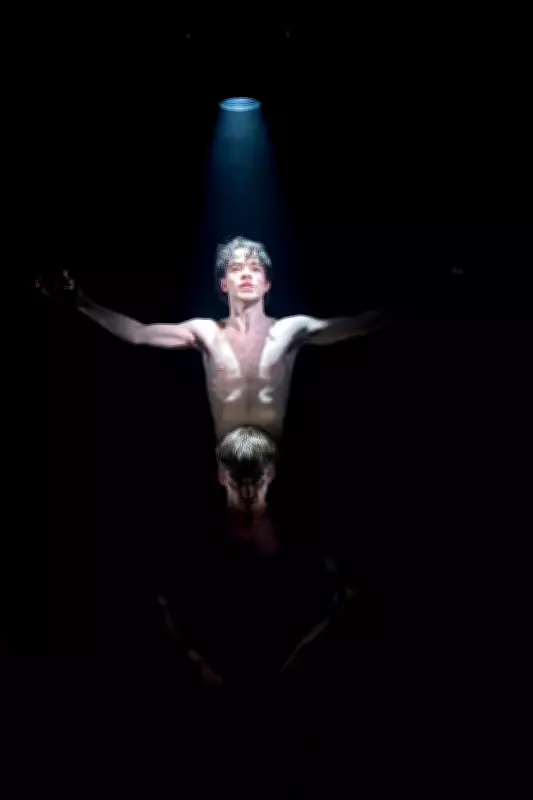
Historically, Equus has been known for its scale and spectacle, with six actor-dancers playing horses in elaborate mesh headpieces, cantering around a large stage in choreographed movements. However, director Lindsay Posner takes a different approach, leveraging the Menier's core strength of intimacy. There are no headpieces for the horses, but they are not needed. The audience is close enough to see the unnerving dead eyes of the horse actors. Choreographed by James Cousins, the horses wear only tight black trousers and smears of body paint, yet they are unnerving, sinuous presences with odd, inhuman movements. For most of the play, they sit at the back of the stage in a semicircle, but when deployed, they ooze out like a baleful, wordless chorus.
Toby Stephens excels as Martin Dysart, the broadminded regional psychiatrist who is the only person that careworn local magistrate Hesther (Amanda Abbington) feels can help 17-year-old Alan. With his matinee idol features obscured by glasses and a shaggy beard, Stephens portrays Dysart as a vulnerable, nervy man whose professional veneer conceals deep doubts from the start. His anxiety dream about being an Ancient Greek priest committing endless child sacrifices is just one example; Stephens gives him a palpable sense of fallibility as he cringes from a furious Alan during their first encounter.
Noah Valentine is a wonderful Alan, boyishly vulnerable yet possessing an elemental otherness that is often menacing but also pure and free. As the play progresses, Dysart becomes increasingly awed by Alan's strangeness and questions the ethics of 'curing' him to lead a drab life. The play is not an immaculately researched work of science; it is a fictional story about human nature, exploring how a strange emotional diet of religion, socialism, repressed sexuality, and a chance childhood encounter with a rider set Alan on a path to a shocking conclusion. The extremes Shaffer takes give the play weight, and Dysart's passionate defense of Alan's otherness carries wider meaning beyond this one case. It would be tricky to write today, as it might appear Shaffer was commenting on autism, which was little known in 1973.
Posner's intimate production magnifies all these elements, focusing Shaffer's meaning and burning away pedantic quibbles. There is little set, actors sit in the front row when not on stage, and the horses are omnipresent, inescapable, always sitting there, blank-eyed and judging. This revival is a must-see for theatre enthusiasts.