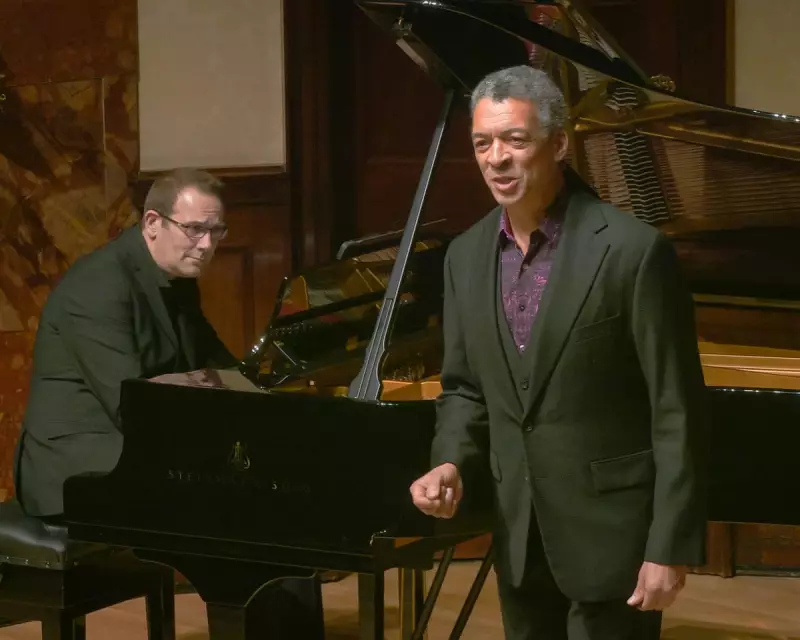
In a captivating concert at London's Wigmore Hall, baritone Roderick Williams, accompanied by pianist Christopher Glynn, presented a masterful and poignant reimagining of a classic. His programme, conceived as an English song equivalent to Franz Schubert's iconic Winterreise, proved to be an enthralling and intellectually satisfying journey.
A Decade in the Making
The genesis of this unique project occurred a decade ago when Williams was studying Schubert's seminal song cycle. He hit upon the idea of curating a parallel sequence using English art song. Over the years, he meticulously refined the playlist, adding and subtracting pieces until arriving at the final, intriguing selection performed. The result was a coherent and deeply moving narrative that held the audience rapt for over ninety minutes.
Musical Parallels and Poignant Discoveries
Williams drew both direct and subtle connections between the English repertoire and Schubert's original. Some parallels were beautifully straightforward. The dogged determination of Vaughan Williams' 'The Vagabond' mirrored the opening 'Good Night' from Winterreise. Similarly, the flurrying chords of Roger Quilter's 'Blow, Blow, Thou Winter Wind' echoed the frantic spinning of Schubert's 'Weathervane'.

Other links were more nuanced but equally powerful. The elusive 'Will-o-the-Wisp' from the German cycle found its counterpart in Ina Boyle's enchanting 'A Song of Enchantment', one of several delightful discoveries for the audience. The 19th-century mail coach of Winterreise was transposed into the solitary railway carriage of Benjamin Britten's 'Midnight on the Great Western'.
Perhaps the most striking thematic shift was in the perspective of loss. Where Schubert's protagonist grapples with a recent, raw heartbreak, Williams's curated cycle often reflects on long-lost loves and the irrevocable passage of time. This lent the English sequence a deeper, more reflective melancholy compared to the youthful turmoil of the original.
A Synergy of Voice and Piano
Roderick Williams proved to be the ideal interpreter for this material. His lithe, expressive baritone, combined with insightful phrasing and a compelling physicality, brought fresh layers of meaning to familiar works. He mined the loneliness of Gerald Finzi's 'At Middle-Field Gate in February' and revealed profound depths in his own setting of William Blake's 'The Angel'.
He was superbly supported throughout by Christopher Glynn's poised and poetic piano playing. The synergy between the two musicians was particularly penetrating in Britten's evocation of Thomas Hardy's 'listless lad' on his train journey, creating a chilling and unforgettable atmosphere.
This carefully constructed 'English Song Winterreise' was more than a clever conceit; it was a profound artistic statement. It celebrated the rich tradition of English song while engaging in a fascinating dialogue with one of the greatest works in the classical canon, offering the Wigmore Hall audience a truly unique and memorable experience.