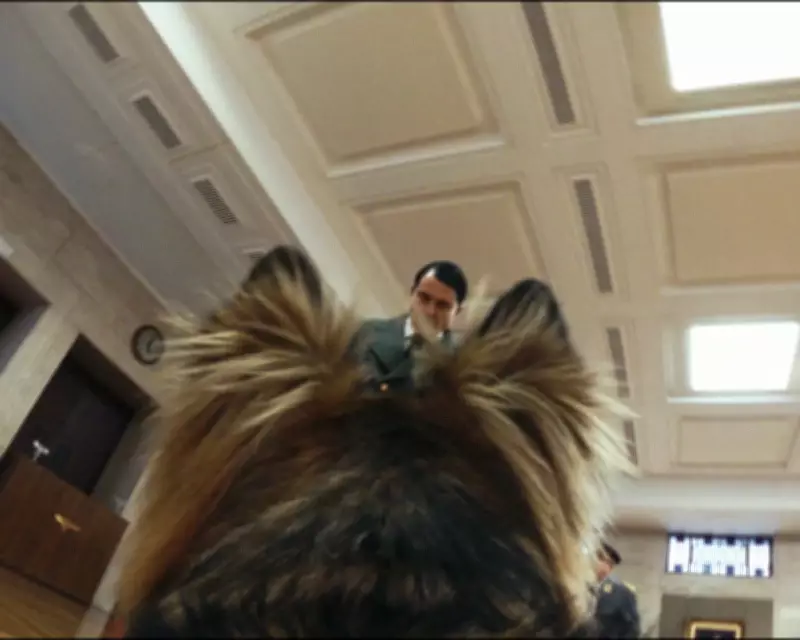
A new film, Blondi, offers a unique perspective on the final days of the Third Reich: through the eyes of Hitler's beloved German shepherd. The film, which premiered in Brixton, London, uses a seven-month-old dog named Lexie as its co-director of photography, or 'cinemadographer,' as the filmmakers call it.
An Unconventional Cinematic Approach
Benedict Morrison, who runs the London comedy festival, introduced the film at its premiere by comparing it to FW Murnau's 1924 film The Last Laugh, which revolutionized cinema by strapping a camera to a bicycle. For Blondi, the camera was strapped to a dog. Lexie, a German shepherd, both plays the title character and serves as the camera operator, capturing a shaky, gritty, and uncomfortable visual experience. 'Some things need to be made uncomfortable,' says producer Pablo Álvarez-Hornia, 'and, in a way, it needed to be dirtier and grittier and uglier for it to work.'
The image throughout is framed by Lexie's ears, since the camera is on her back. Co-director Jack Salvadori appreciates the unexpected elements, such as the shakiness, which he says provided 'a completely different creative input.' Salvadori, 29, originally from Italy, met Álvarez-Hornia, 27 and from Spain, in Cannes six years ago; both studied directing in London.

The Making of Blondi
The premiere of the short film was accompanied by a behind-the-scenes documentary, which is part caper, part descent into chaos. The crew did not obtain permission to shoot in many locations, so they had to quickly redress hotel rooms and London's Senate House as a 1940s office of state while avoiding security. Despite the chaotic production, the film itself is not funny.
Blondi was a propaganda tool from 1941, when she was given to Hitler by Nazi party secretary Martin Bormann. She was used to demonstrate Hitler's love of animals and to enforce loyalty among German citizens, who would keep dogs resembling Blondi to show their Nazi allegiance. The day before Hitler's death in April 1945, Blondi ate a cyanide pill to test its potency. Álvarez-Hornia notes, 'Blondi in the film is the truly innocent being, she has no conscience, no ideology, no capacity for any moral reckoning whatsoever.'
Script and Casting
The script was written by Peter Greenaway, a cinematic hero of Salvadori's. Greenaway had written a short story about Blondi, and Salvadori convinced him to adapt it into a script. Cinematographer Robert Richardson advised Salvadori to use a real dog rather than a professionally trained one, which proved to be the right decision.
Casting human roles was challenging because the actors were told they might not end up in the film, as that depended on where Lexie looked. This narrowed the pool of actors but also created a mood of insecurity that mirrored the film's setting. 'All of these generals of Hitler were chasing the dog for attention, because they knew whoever got the dog's attention got Hitler's attention,' says Álvarez-Hornia.
Finding an actor to play Hitler was also difficult. While many British actors wanted the role, German actors did not. The filmmakers eventually found Nicola Pedrozzi, who does not resemble Hitler but captures his frenetic, needy coldness, halfway up a Swiss mountain. The key requirement was that the actor 'really vibe with the dog.'
The Dog's Perspective
The entire film depends on Lexie's responsiveness to atmosphere. 'There are no jokes or pratfalls,' says Salvadori. 'The idea that you're watching something so horrible from this unique perspective was the humour that we were aiming for. But there is nothing to laugh at. They're down in the bunker, and nobody's happy, not even the dog. Dogs capture energies.' The crew's lack of permission to shoot in the bunker added to the anxiety and claustrophobia, which the dog could sense.
Salvadori and Álvarez-Hornia's next film is a full-length feature set in a colonial villa in South America, about a Nazi exile living in seclusion with maids and a dog. That film will be shot more conventionally. 'I could not have given up any more control than I did in giving the camera to a dog,' says Salvadori.