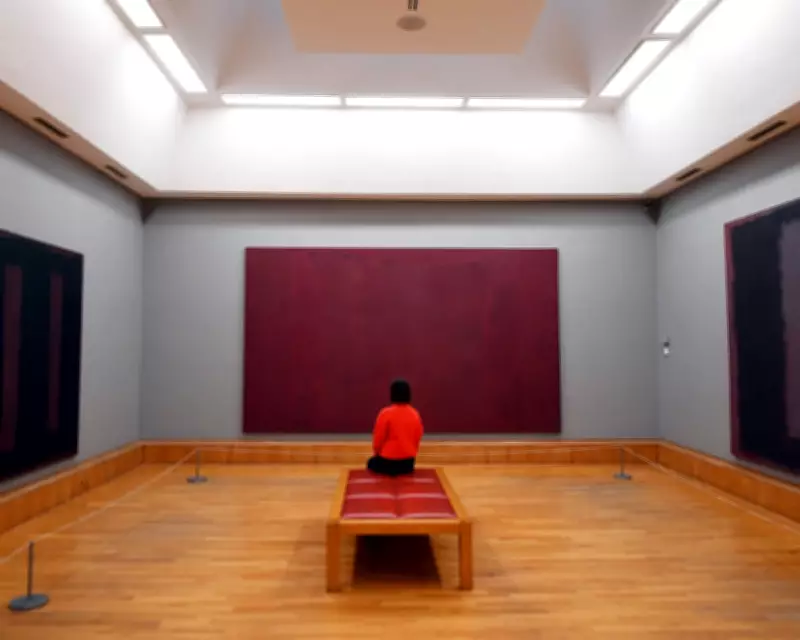
Mark Rothko's works have always divided opinion. Were his vast color field paintings a bold new direction for abstract art, or simply fuel for the 'my child could paint that' brigade? To detractors, Rothko's abstractions seem devoid of symbolism or message. Yet he is undergoing an unexpected cultural reappraisal, thanks to adoption by Gen Z art lovers.
Rothko's Social Media Renaissance
Across TikTok and Instagram, videos centered on Rothko's work are accumulating hundreds of thousands of views. One creator styles outfits inspired by individual Rothko canvases; another assigns Rothko works to personality archetypes, describing Untitled (Yellow and Blue) as a match for 'someone who wakes up early, drinks citrus water, and has their life together – or at least looks like it.' Elsewhere, users compare his atmospheric palettes to the hazy melancholy of the Cocteau Twins, a dream pop band also undergoing a Gen Z renaissance. As one young creator put it: 'Date idea: me, Rothko, and nobody saying I could have done these.'
Why Rothko Resonates with Gen Z
The question is why Rothko resonates so profoundly with Gen Z audiences. Perhaps because their era is characterized by relentless visual stimuli and inescapable ties to unsettling world events. Rothko's paintings, even on a social feed, function as aesthetic refuge from the bombardment of overstimulating content; his meditative swathes of color and discovery of depth in simplicity offer an antidote.
Houston, Texas, is home to the Rothko Chapel, commissioned in 1964 by John and Dominique de Menil. It consists of a windowless octagonal room with 14 large-scale paintings. There is nowhere else to be, nowhere to move on to if one plans to quickly glance and photograph. The space softly forces presence and elicits deep reactions. According to Carolyn King, the Chapel's visitor engagement specialist, 'when we're left with nothing, we're able to sit with mystery, to sit with confusion and discomfort; we're able to allow ourselves to be provoked by the sublime.'
King has noticed a wide array of visitors. 'I see some walking right in, turning away and leaving. They're not ready for the confrontation. But there are young folks who come in extremely curious and realize they need something like this. So they're open to interrogate the work and interrogate themselves.'
Digital Introductions and the Artist's Intent
Rothko once famously said: 'a painting is not a picture of an experience; it is an experience.' His works are now often first seen via digital mediums, without subtle textures, layers of color, and precise brushstrokes from which emotion can be derived in person. It is hard to say how satisfied Rothko would be that audiences are introduced to his works this way.
Natalia Sidlina, curator of international art at Tate Modern, which houses Rothko's Seagram Murals, believes the proliferation of art across digital platforms is ultimately positive for cultural engagement, especially when it provokes people to visit works in person. She says Rothko would likely share this view. 'Rothko very rarely commented about his works or told people what they were supposed to see or feel,' she notes. 'I think he would have been interested to observe how the next generation engaged with his work, on whatever platform or form, and have a joyful experience without imposing any specific narrative.' She adds: 'The fact he rarely told people what to feel resonates strongly with a contemporary audience who don't often want instruction.'
Exhibitions and Online Hype
Concurrently with the online hype, Rothko's works are being exhibited across three cultural sites in Florence: Biblioteca Medicea Laurenziana, Palazzo Strozzi, and Museo di San Marco. The latter presents Rothko's paintings alongside those of early Renaissance master Fra Angelico in an anachronistic dialogue curated by Rothko's own son, Christopher, and Elena Geuna. The social media boom will certainly not hinder the exhibitions' success; videos of the displays have already garnered huge viewer figures.
There is irony and beauty in Rothko's contemporary revival: an artist occasionally criticized as inaccessible and shallow has found perhaps his deepest resonance with a generation far from his own.