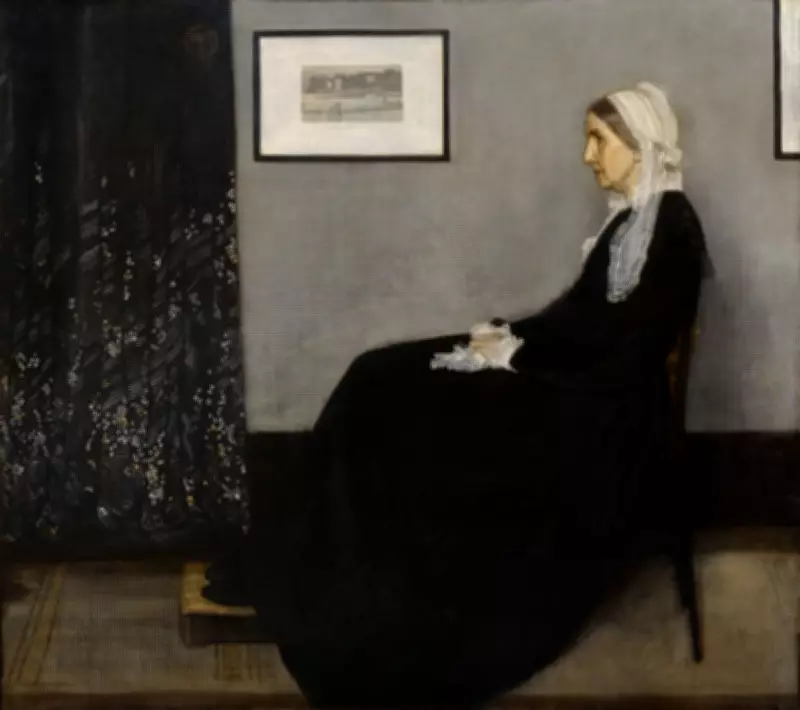
James Abbott McNeill Whistler once said, "One does like to make one's mummy just as nice as possible," referring to his iconic painting of his mother, Anna. Titled Arrangement in Grey and Black No 1, the work is now known globally as Whistler's Mother. Over the past 150 years, it has become America's equivalent of the Mona Lisa, traveling constantly across museums in the United States and beyond. This month, for the first time in nearly two generations, the painting returns to London, where it was created in Whistler's Chelsea studio, as part of Tate Britain's Whistler exhibition.
The Story Behind the Masterpiece
Restorer Sarah Walden spent months working on the painting for the Musée d'Orsay, commissioned by the Louvre. She notes that Whistler is the only artist whose portrait of his mother has achieved such superstar status. The painting's history is fascinating, rooted in a moment of despair for the artist.
In 1871, Whistler's life was at a low point. London critics panned his work, and he struggled to find his place in the art world. The portrait came about by chance: a 15-year-old model ran off, and Whistler asked his mother to sit instead. Painted on the reverse of a used canvas, the work features Anna seated on a footstool, a concession to her poor health. The minimalist background, dominated by greys and blacks, was a radical departure from the vibrant Victorian style of the time.
Whistler's Artistic Vision
Whistler was a larger-than-life personality, known for his wit and aphorisms. He pursued what he called "the poetry of sight," focusing on texture and color rather than narrative. His use of deep blacks, almost like ink, was experimental. The painting's simplicity was alien to the riot of colors and decorations fashionable in London.
When exhibited at the Royal Academy, critics were perplexed. One reviewer for the Examiner concluded "it is not a picture" due to the limited palette. Only when the French government bought it in 1891 did Britain recognize its value. The painting now returns to London, highlighting a revolution in art that occurred under Britain's nose.
Restoration Challenges
Walden reveals that Whistler used cheap paint, much like Andy Warhol would later. The blacks of Anna's skirt had already changed by the time the French state purchased the painting. Whistler had it relined too soon, soaking the paint into the canvas. This made restoration tricky, reminiscent of the decomposing Rothkos in museum cellars.
Despite these challenges, the heart of the painting remains indestructible. It is a touching portrait of the affection between mother and son. In a letter, Anna wrote that Whistler "had no nervous fears" and kissed her when the painting was done. She always dressed in a widow's plain black dress with a white bonnet, devoted to her Puritan religion as Whistler was to his art.
Whistler's Legacy
Whistler's Mother paved the way for America's great painters: Edward Hopper, Andy Warhol, Mark Rothko. Walden sees Whistler's creative energy as uniquely American. The painting, now on display at Tate Britain, continues to captivate audiences worldwide.
During restoration, the painting hung next to Ingres's portrait of Napoleon. The emperor struggled to overpower the widow from the Carolinas. As Walden notes, "If everyone's life had one empress, wouldn't it be one's mother?"