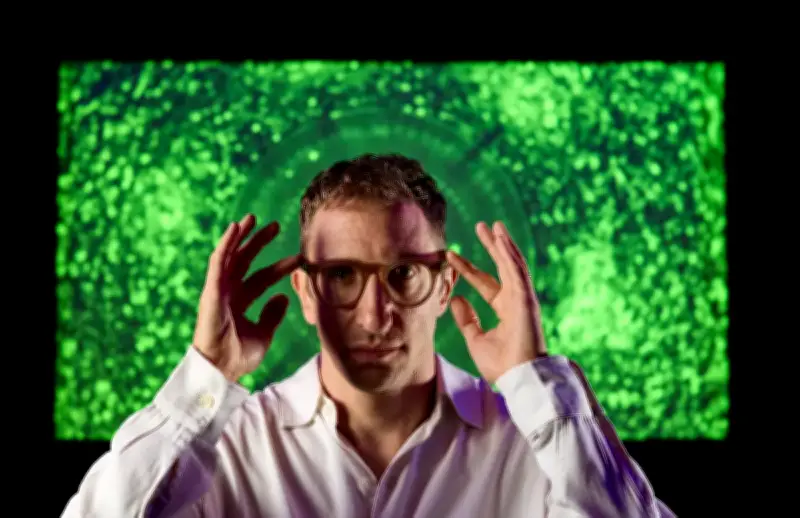
Lawrence Abu Hamdan, the Lebanese-British artist who jointly won the Turner Prize in 2019, is also the director of Earshot, a young NGO founded in 2023 that investigates human rights abuses using sound evidence. The organisation analyses audio recordings, witness testimonies, and open-source data to uncover the truth behind violent events, including killings in Gaza and the alleged use of a sonic weapon at a protest in Belgrade.
From Art to Activism: The Birth of Earshot
Abu Hamdan's dual identity as an artist and an audio investigator is not a contradiction but an interlocking whole. His art provides a sensory, aesthetic, and emotional expression of the hard-nosed research he conducts with Earshot. The foundational work in this field was a project with Forensic Architecture for Amnesty International, which involved interviewing survivors of Syria's Sednaya prison in 2016. In that prison, inmates were held in complete darkness and enforced silence, with listening as their only source of information and a tool for survival. Their acute sonic memories—of screams, keys turning in locks, bread being slapped down, even lice being snapped—helped build a picture of the prison's architecture and conditions, nearly a decade before it was opened after the fall of the Assad regime.
“There's the really fast, urgent stuff that we need to be doing,” says Abu Hamdan, “and then there's the stuff where we can say, 'OK, let's pause. Let's unfold it and reflect on what we did and what it meant.' It's a duality and it helps us sustain our ears. To keep us listening in as sharp a way as possible.”
Investigating Sonic Weapons and Political Assassinations
Earshot's office, part of a complex of artists' studios in south London, is a bright, tidy open-plan space. The team, mostly architecture school graduates, works on cases that result in formal written reports and sometimes artworks. One current investigation involves a cold case of a political assassination, where the victim's family provided recordings that hadn't been analysed at the time. The team is discovering that the person convicted of the shooting was likely a decoy, and the murder weapon was wielded by another hand.
Abu Hamdan describes the work as building the sonic equivalent of visual reconstructions seen in the news. They use open-source data, “earwitness” testimonies, and sound data gathered at the scene. One notable case involved the dispersal of a mass silent protest in Belgrade in March 2025, where a sonic weapon was allegedly used. The protest was one of many silent vigils held since a deadly accident at a railway station the previous year. As many as 300,000 people gathered, maintaining 15 minutes of silence, one minute for every person killed. Into that silence came an intolerable, frightening noise, which the Serbian government denied was caused by a sonic weapon.
“It was a really interesting case for us as an organisation because of the way we got pulled in,” says Abu Hamdan. “Generally we get requests from media organisations, or from NGOs. But this was the first one where we had multiple individual requests. We woke up and there were what felt like hundreds of emails.” The team amassed thousands of witness statements and concluded the sound was likely produced by a US-made device called an LRAD 450XL.
Art Exhibitions and Community Workshops
The Venice Biennale work, 450XL: The Story of a Fugitive Sound, will be shown at a “takeover” of the Barbican in London in September, with a live score. Earshot is also running workshops on gathering sound evidence, introducing film screenings, and hosting musicians. One work, Zifzafa, explores noise pollution from planned wind turbines near a village, and is on show in Glasgow until 17 October, with a live performance at the Edinburgh art festival on 29 August.
Earshot's investigations often involve distressing material. One of their most significant works was a year-long investigation into the killing of ambulance workers in Gaza. According to Earshot's analysis, Israeli soldiers fired at least 910 rounds in Tel Al-Sultan, near Rafah, on 23 March 2025, with at least 789 directly at aid workers. Evidence included a recording made by one of the killed people, his phone exhumed with 15 bodies from a mass grave. Abu Hamdan notes that the destruction around helped them map the shots, as only three walls were intact.
Working on the cases, taking an active role, is easier than passively staring at his phone in despair, he says. “Ambiently scrolling – that is so much more destructive.” He points out that there's always music to think about, not just gunshots, and there is so much in the world to listen to. The exhibition Zifzafa is at the Common Guild, Glasgow, until 17 October, with a live performance at Leith theatre as part of the Edinburgh art festival on 29 August. Lawrence Abu Hamdan: Repercussions is from 23-26 September at the Barbican, London. 450XL: The Story of a Fugitive Sound is on show in Canicula, at Complesso dell’Ospedaletto, Venice, until 22 November.