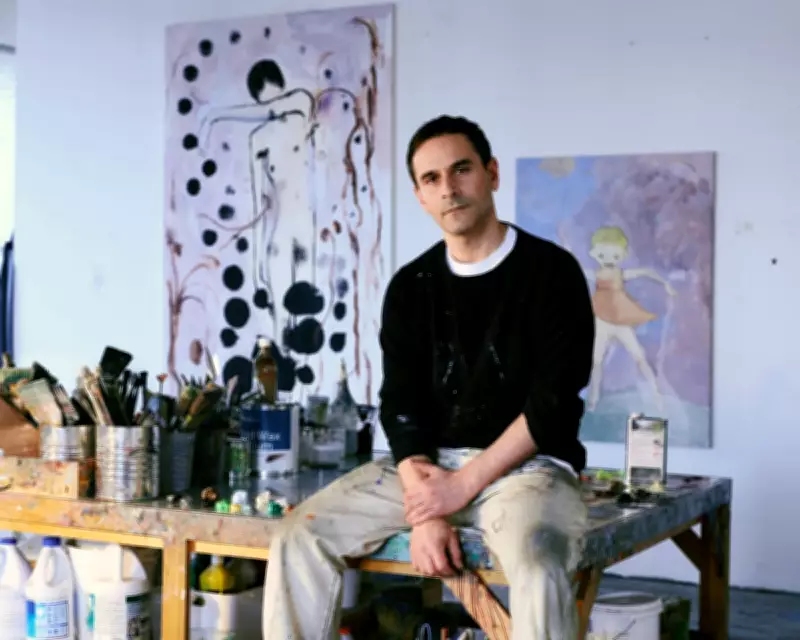
Russian-born artist Sanya Kantarovsky's paintings are filled with the dishevelled and the fallible: figures that bite and pin each other into submission, draw blood, appear hypnotised or sometimes transmogrify into a mushroom. The otherworldly intensity that has defined the 44-year-old's work to date is as strong as ever in his new show, Basic Failure, which recently opened in Venice to coincide with the Biennale.
Exhibition at the Institute of Sciences, Letters and Arts
Located at Venice's Institute of Sciences, Letters and Arts – a palazzo with high ceilings and a dark terrazzo-marbled floor, the walls lined with antique books – the exhibition opens with the diminutive portrait, Boy With Cigarette, in which the thickly painted, pallid, downturned young face of a boy, outlined in darkening blue brushstrokes, is seen caressing an unlit cigarette with tendril-like fingers. As Kantarovsky observes, his characters "feel both familiar and kind of alien at the same time". This saturnine image is counterbalanced by the giddy expression of innocence nearby – a child spins on the spot, her dress flying upwards, as if free from the weight of any embarrassment.
Rise to Prominence
The Russian-born, New York-based Kantarovsky has risen in prominence over the past decade following large exhibitions in Turin and Zurich, and a staggering solo show held at a 150-year-old machiya (a traditional wooden townhouse) in Tokyo, in which his artworks seemed to commune with the ghostly spirits that "resided" there. His paintings have the dark humour of a classic Russian novel, but reach kaleidoscopically out to artists such as Pablo Picasso, Giorgio de Chirico and Milton Avery. For Kantarovsky, the power of great art and literature lies in the way it can communicate, or as he puts it: "The way art can splinter and render aspects of someone's experience something that another can deeply identify with. And that becomes very interesting when those experiences are deeply problematic ones."
Basic Failure: A Dare Between Artist and Viewer
It is this tension that is fuel for his exhibitions, which arrive, he says, as a "dare between artist and viewer" by confounding our expectations of "what's allowed to be shown". For instance, in Basic Failure we see a scruffy painting of a toy panda, the kind of image that might be found at the back of a charity shop covered in dust, shortly before a spine-tingling encounter with the remarkable glass bust of a young boy – a recreation of Antonello Gagini's 16th-century sculpture – dimly glowing in a room by itself. On closer inspection, there is a disturbing shadow under his eye. At first it reads as a scribble or graffiti. In fact, it's the remains of a dead spider.
Homesickness and Memory
Kantarovsky moved to the US just four months after the collapse of the Soviet Union at the end of 1991. I ask whether that, too, has had an effect on his work. "Of course, I have homesickness," the artist says with some reluctance, "but it is just one of the many things that informs my work." If Kantarovsky paints the lives of those who have been sidelined, having lost the defining qualities that made them seem alive or valued, then his works are also often haunted by a sense of those who fled their country out of fear or necessity. This sense of uncertainty is heightened by the fact that he depicts his subjects from memory rather than directly from life.
Exploring the Unknown
Kantarovsky says that his work is a way of exploring the unknown, of "breaking a rule of reality in some way to produce a double take, where the road to take is unclear but leads to something generative". He agrees with the assertion by Philip Guston – an artist he admires – that "art is nourished by the common and ordinary". However, Kantarovsky probes what "ordinary" might really mean. "I almost put these barriers in place that prevent a literal narrative from being formed," he says. "I look at my paintings as narrative fragments."
Creative Process
In conversation, Kantarovsky is thoughtful and analytical. "My objective is to be surprised by what I'm doing," he says. "I often start drawing, but it is like a Ouija board type of thing, where I listen to the painting." His work seems to tap into our unconscious realm, and some people have offered psychoanalytical readings of it. "I'm very interested in a moment of over-identification with the thing we are looking at," he says. "Where something insists on a particular frequency so intensely that it renders it kind slightly comical, odd or strange."
Religious Imagery and Absurdity
This sense of how the absurd appears in the everyday is also found in the title of the exhibition, Basic Failure, a term inherent for Kantarovsky when making art – "the failure to translate something in your head but which you continue to do". It also has a meaning in psychoanalysis about the ultimate failure of a parent to fulfil the needs of a child. This is particularly resonant for Kantarovsky in the context of Italy, where religious imagery abounds. As he observes, in Christianity "we're born bad, born guilty, and we get to work on redeeming ourselves".
Indeed, walking through the labyrinthine streets of Venice, the innumerable churches, votive niches and altars are impossible to ignore – even when hordes of tourists block the view. One of his works made for Venice references Masaccio's c 1425 painting of the expulsion of Adam and Eve from paradise; Kantarovsky remakes the opulent Renaissance painting as something empty and sinuous, the anxious reworked outline of a figure crushed by neurosis. He sees the dilapidated figure as "someone leaving a party late at night remembering something awful or embarrassing they said".
Recurring Motifs
Throughout the exhibition, there is the recurring motif of figures shielding their faces with their hands – that childlike hope of becoming invisible by cutting off one's sight when caught. This is also found in the large new work Death of the Centaur, which sees the mythical half-human, half-horse creature appearing to have fallen from the heavens, the hoofs and body a smeared, vulnerable silhouette against a pale blue sky. Its colossal scale retains its physical charge even when in competition with the palazzo's grand fireplace.
Hope in Buddhism
Still, Kantarovsky ultimately counters such concepts of original sin, of falling from grace, by finding hope in Buddhism, a doctrine in which we are born inherently good before we are "crowded by life, and by different types of karma". It is perhaps this good karma that Kantarovsky has put out into the world that is finally coming back around.
Sanya Kantarovsky: Basic Failure is at Istituto Veneto di Scienze, Lettere ed Arti, Palazzo Loredan, Venice, until 22 November.