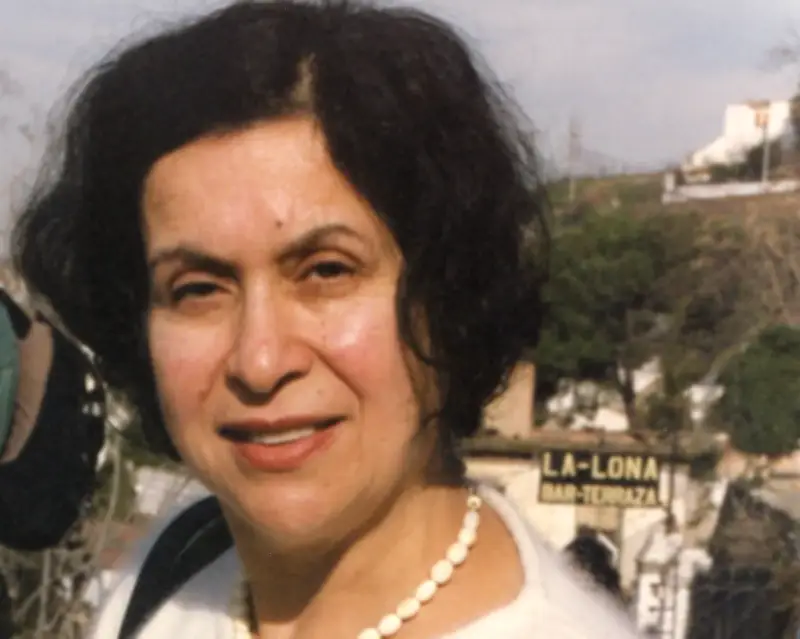
Samira al-Mana, an Iraqi novelist who wrote about exile and authoritarianism, has died aged 91. Her books were blacklisted by the Iraqi state from 1979 until 2003, and have frequently been blocked from official circulation in a variety of Arab states.
Life and literary beginnings
Samira al-Mana began writing in earnest after she came to the UK in 1965, aged 30. She subsequently wrote five novels, two collections of short stories and a play. Her work, which was written in Arabic, focused on the difficult choices faced by everyday citizens living within authoritarian settings, as well as the travails of people living in exile.
Samira was born in Basrah to Abdel al-Mana, a customs officer, and his wife, Bahia Murad. After attending al-Ashshar secondary school, in 1956 she studied Arabic literature at the University of Baghdad, where she met her future husband, the journalist and poet Salah Niazi. They married in 1959, after which she taught Arabic in secondary schools before the deteriorating political situation in Iraq prompted her and Salah to move to London in 1965.
Career and publications
In London, she worked diligently at learning English, partly by reading the Guardian, and became an administrative assistant, first at an electrical company and then at the Libyan embassy in London. Her debut novel, Al-Sabiqun wal-lahiqun (The First and the Last), was published in 1972, and a collection of short stories, Al-Ghinaa (Singing), in 1976.
That year she also obtained a diploma in librarianship from Ealing Technical College, after which she worked in libraries in Wembley and Ealing, and at the Iraqi Cultural Centre in central London, while also doing part-time work for the Al-Mada translation company.
With her husband, Samira also co-founded a quarterly Arabic magazine, Al-Ightirab al-Adabi (Literature of the Exiled), which from 1985 to 2003 gave a voice to Arab writers living away from their homeland. There was a gap in her writing activity as she concentrated with Salah on the running of the magazine, until her next novel, Habl al-Surra (The Umbilical Cord), was published in 1990. Tackling the pain of political exile, the contrast between western democracy and Middle Eastern totalitarianism, and the alienation experienced by displaced women, it was translated into English in 2005, allowing it to reach a wider audience.
Later years and legacy
Her last novel, Men lā yaʿrifun mādhā yurīd (The Undecided), was published in 2010, after which Alzheimer's disease curtailed any further creative writing. In 2018 she was honoured with a lifetime achievement award from the Humanitarian Dialogue Foundation in London.
For most of their time in the UK Samira and Salah lived in Kingston upon Thames, south-west London, where Samira pursued her interest in gardening, classical music and, of course, reading. She is survived by Salah, their daughters, and grandchildren, Renee, Cameron and Dani.