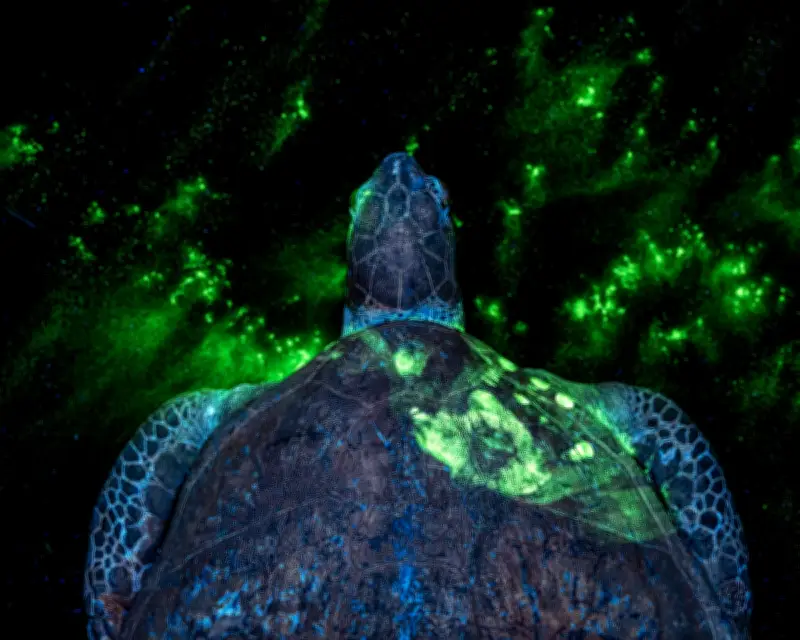
Britta Jaschinski's project "Every Crime Leaves a Trace" documents the illegal wildlife trade and the forensic science being developed to combat it. Using a newly developed magnetic powder, Mark Moseley, a forensic investigator at London's Metropolitan Police, dusts for and detects human fingerprints on an elephant tusk confiscated at Heathrow airport. The image of a green sea turtle (Chelonia mydas) with a visible human handprint demonstrates a method for securing forensic evidence that can help catch poachers and animal traffickers in a $23bn (£17bn) poaching industry. Shortlisted and award-winning works are on view at the Earth Photo 2026 exhibition at the Royal Geographical Society, London, until 24 July, with an interactive event Summit Photo running from 17-19 July.
Young photographer honors Indigenous herbalists
Filbert Minja's "Roots of Healing" won the David Wolf Kaye Future Potential award for photographers under 25. Minja documented Indigenous herbalists in the Kilimanjaro and Arusha regions of Tanzania, approaching herbalism not as symbolic or mystical but as a real, everyday practice rooted in environment and cultural tradition. Through portraits, quiet observation and landscape images, he asks what it looks like when knowledge is held in people, plants and land rather than in written records, honouring a form of healing passed between generations through touch, gesture and close attention to the natural world.
Permafrost thaw and stranded seals in the Arctic
Natalya Saprunova's long-term project "Shifting Seasons" documents permafrost thaw and coastal erosion across the Inuvialuit territories of Canada's Northwest Territories, winning the New Scientist Editors award. The migration of geese and ducks to the Canadian north traditionally occurs during the annual spring ice thaw, crucial for the Inuit people as the birds provide a vital subsistence food source for the entire year. One image shows a local hunter standing on the tundra in an area of snowmelt, using decoy geese to lure the birds. Another photograph captures a ringed seal resting on a sand spit on Banks Island, 15 miles from the Inuvialuit community of Sachs Harbour in the Canadian Arctic. Rapidly melting sea ice has left it stranded on the landward side. Thawing permafrost releases sediment carrying mercury into the ocean; traces of this toxic metal have been found in seal fat, threatening marine life and disrupting the ocean's chemistry and food chain. The health of humans who rely on marine animals for food is also at risk.
Indigenous resistance against coal mining in India
Payal Kakkar's series "Lives of Extraction" won the Royal Geographical Society Climate of Change award. It documents the Khairwar Indigenous community of Majhauli Path, Singrauli, as they lead a resistance movement against coal mining and land dispossession in India's so-called 'energy capital'. Kakkar uses a process of gum oil printing, collecting mining tailings and using them in the developing process itself, so that the stains of industrial contamination become part of the image. The prints are then hand-embroidered with green thread, evoking the community's lost forests and farmland. Kakkar embedded herself within the protest, photographing women who have staged Gandhi-style sit-ins demanding fair compensation for land consumed by the ever-expanding Suliyari mine waste dump. In December 2025, several families, including those photographed, were forcibly relocated by mining company operatives supported by armed forces, without resettlement or rehabilitation plans.
Toxic legacy of mining in Peru
Marco Garro's "Quiulacocha" is a long-term investigation into the environmental and human cost of mining at Cerro de Pasco, Peru, one of the world's most polluted places, situated at 4,300 metres above sea level in the Andes. Garro has documented this community for two decades. For this project, he collected samples of mining tailings from the former Lake Quiulacocha, now filled with toxic waste, and used them in the photographic development process. The resulting stains and textures echo the contamination that has entered the blood of local people, the soil and the water supply for generations, earning the Photoworks Digital Residency award.
Flood displacement and resilience worldwide
Gideon Mendel's "Drowning World" received the Moving Image award for his film work documenting communities around the world living through the consequences of flooding and climate displacement. Mendel began working as a photographer in South Africa during apartheid, and has since developed a long-term practice that sits between documentary, art and visual activism. His series uses precise, often unsettling compositions to frame people within their flooded homes and landscapes, portraits in which subjects meet the camera with dignity and resilience. Mohammad Rakibul Hasan's film "The Vanishing Childhood" follows Mohammad Saown, a teenage boy from the flood-prone haor wetlands of Kishoreganj, Bangladesh, whose family is forced to migrate to the brickfields of Narayanganj after intensifying monsoon floods destroy their farmland. Covered in dust and sweat, labourers balance stacks of bricks on their heads, their bodies bearing the weight of both labour and survival. Many workers migrated from flood-stricken wetland regions and endure grueling conditions to earn a living. Zillah Bowes' "Here Now There Then" won the Sidney Nolan Trust Residency prize. The Welsh/English multidisciplinary artist works across film, photography, poetry and installation. Her two-channel film uses analogue photographs animated by frame variation to explore traumatic memory and the healing effect of proximity to a river. The Earth Photo Awards is a partnership between the Royal Geographical Society, Parker Harris and Photoworks.