John Constable never left England. So much of how he painted and thought about the world can be explained by this basic fact. In 1803, aged 26, he went on a trip along the Kent coast – the closest he would get to going abroad – with the enthusiasm of a man stepping foot for the first time in the new world. “I saw all sorts of weather”, he wrote. “Some the most delightful, and some as melancholy.”
This trip was an exception. For most of his life he moved between three points: Suffolk, Hampstead and Brighton. While his great rival JMW Turner, one year his senior, travelled across France and Italy, Constable took pleasure in being parochial. “I am sure you will laugh”, he told his wife, Maria, but “I have found another very promising subject at Flatford Mill”.
Celebrating 250 Years
For fans of Constable – who today celebrate the 250th anniversary of his birth – this interest in England and Englishness is part of his charm. Just by looking at a field of grass, he could work out which part of the season he was in, almost to the day. If you’re drawn to that kind of thing, then you are bound to find Constable fascinating. Others (like me) may be put off by his somewhat patrician perspective: a landowner surveying a plot in which everyone is busy at work, driving cows or ploughing fields.
A New Perspective at Burgh House
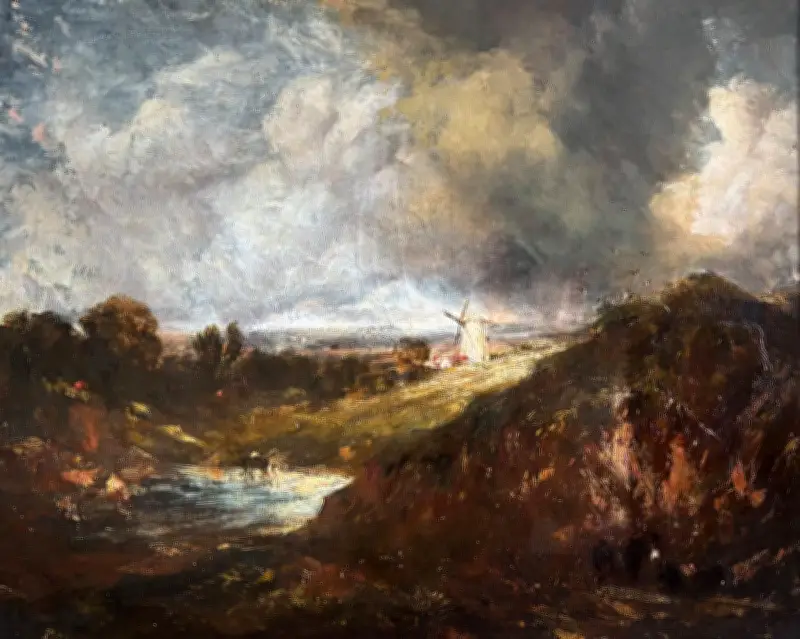
This small show at Hampstead’s Burgh House offers something like an olive branch to Constable haters. The main works on display are three mezzotint prints done with such delicacy that the black ink becomes translucent in sections where it is used to depict clouds, and an oil study for his painting Hampstead Heath With a Rainbow.
The finished work, which was on display at the Tate’s recent blockbuster Turner and Constable show, is disorientating for its scale and composition. In the foreground, a ridge looks as if it is about to crash, wave-like, on two donkeys beneath it. Just above them, a flock of birds whooshes beneath a mass of clouds from which light seeps as if from a sieve. At the centre of the painting is a slightly incongruous rainbow, at one end of which is a windmill that Constable – who loved the idea of industrial landscapes so much that he imagined them where he couldn’t find them – placed on the Heath.
I’ve always found the rainbow twee, and I felt some twinge of relief when I noticed its absence in the study at Burgh. With its thick impastos and blurring colours, the study almost looks like abstract expressionist paintings. If you’d had any hangups about Constable’s too-quaint scenes, it’s quite a perspective shift to look at it. The outlines of Branch Hill Pond – since dried up – are a splodge of blue around cascading sections of greens.
Mezzotints Offer Darker Tones
The mezzotints the artist commissioned from print-maker David Lucas also offer something for the Constable-curious. Noon from 1831 is spooky and noir-like. The shepherd parked on the hill overlooking the landscape has just enough detail to be mysterious, while the clouds look almost better in print than painted – although Constable often touched up Lucas’s work by hand.
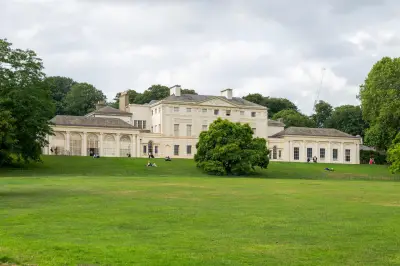
Here, again, those less enamoured, or familiar, with the English countryside might find some pleasure in how unsettling it looks when rendered ghostly grey. Noon looks as if Lucas has sucked the colour out of the original. You have to step outside Burgh House – located a few minutes from Constable’s home – to get it back by taking a look at the unspoiled view in real life.
At Burgh House, London, until 20 September