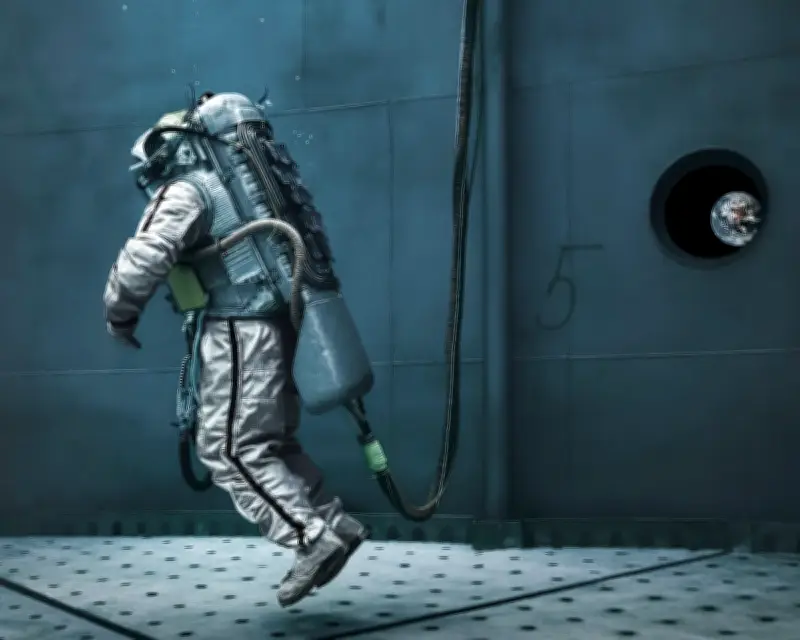
The Smithsonian National Air and Space Museum in Washington DC is celebrating its 50th anniversary with a revamped exhibition at the Flight and the Arts Center, highlighting the intersection of art and space exploration. The museum, one of the most visited in the world, holds over 8,000 artworks, including pieces by Alexander Calder, Annie Leibovitz, Norman Rockwell, and Alma Thomas.
Origins of the Art Program
The art program began in 1962 when NASA administrator James Webb saw a 1961 portrait of astronaut Alan Shepard by Bruce Stevenson and commissioned artists to document space exploration. Led by James Dean until 1974, the program transferred about 2,000 works to the Smithsonian. Curator Carolyn Russo explained, 'Flight originated from the imagination. It originated from the hands of artists.'
Norman Rockwell's Vision
Norman Rockwell, known for his Saturday Evening Post covers, was hired by Look magazine in 1964 to depict NASA's space program. His 1967 painting 'Man's First Step on the Moon' was based on a lunar module model, though it contains inaccuracies like an astronaut standing on the module. After the Apollo 1 fire in 1967, Rockwell questioned the space program's priorities, but his later work 'Apollo and Beyond' honored the workforce behind the missions.
Alma Thomas's Abstract Interpretations
Artist Alma Thomas, inspired by watching rocket launches on TV, created vibrant abstract works. Her 1970 painting 'Launch Pad' uses vertical lines to evoke the Kennedy Space Center gantry, while 'Blast Off' (1972) depicts a Saturn V rocket with a flame resembling an Egyptian pyramid. 'Astronauts' Glimpse of the Earth' (1974) reflects the 'blue marble' photo, with dashes of blue and bright colors symbolizing harmony.
Other Notable Works
Georgia O'Keeffe's 'Blue A' (1959) was inspired by her first commercial flight, transforming aerial views into abstract rivers. Catherine Stewart's 2020 fabric piece 'Katherine Johnson Dress' honors the NASA mathematician with celestial coordinates. Surrealist Man Ray's interpretation of the moon landing appears as chaotic scribbles, which Russo likens to 'the vortex of a tornado.'
Rauschenberg's Obsession with Flight
The temporary exhibition 'The Ascent of Rauschenberg: Reinventing the Art of Flight' features 30 works by Robert Rauschenberg. His 'Stoned Moon' series includes 'Trust Zone,' juxtaposing a spacesuit with the Wright brothers' flyer. Rauschenberg used bicycle wheels to honor the Wright brothers, who were bicycle mechanics. A highlight is the 'Moon Museum,' a ceramic wafer with drawings by Rauschenberg, Andy Warhol, and others, reportedly attached to Apollo 12's lunar module and still on the moon.
Conclusion
The exhibition, 'The Art of Air and Space: Interpretations of Flight,' runs at the National Air and Space Museum in Washington DC, showcasing the enduring bond between art and space exploration.