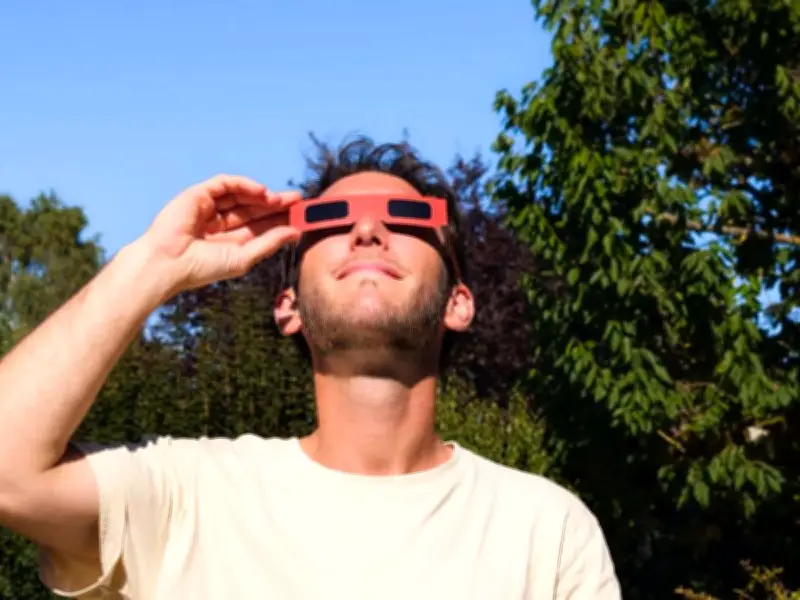
Londoners will witness a rare partial solar eclipse on August 12, with the Moon covering up to 90% of the Sun from the capital. This is the greatest coverage visible from the UK since 1999, according to Royal Museums Greenwich. The event begins at 6:17 PM for Londoners, peaks at 7:12 PM, and concludes by 8:06 PM, depending on exact location. However, experts stress that viewing the eclipse without proper protection can cause permanent eye damage.
Why Eye Protection Is Critical
The Sun's intense rays can scorch retinal cells at the back of the eye, and because the retina lacks pain receptors, damage occurs silently. This can lead to vision loss or permanent blurry patches. Standard sunglasses are insufficient, as they do not filter enough light. Therefore, only certified eclipse glasses or indirect viewing methods are safe.
Method 1: Use ISO-Certified Eclipse Glasses
The simplest and most recommended method is to wear eclipse glasses that meet the ISO 12312-2 safety standard. These glasses block out nearly all light, allowing only a safe fraction through. Genuine glasses will have the certification marked on the frames. Imo Bell, a planetarium astronomer at the Royal Greenwich Observatory, told the Press Association: "You can use solar eclipse glasses, which are very, very different from sunglasses - they block out so much light that you can't see anything through them except the Sun."
Method 2: Create a DIY Pinhole Projector
For a safe, indirect view, Royal Museums Greenwich recommends making a pinhole projector from a cardboard box, white paper, foil, and a pin. Alternatively, household items like colanders and tea strainers work just as well. Bell explains: "Point the colander towards the Sun with your back facing it, and in the shadow of the colander you'll be able to see the eclipse in the holes, which is really cool."
Method 3: Use a Solar Telescope
For the best experience, a solar telescope is ideal. While harder to obtain at short notice, it provides a detailed view. Bell suggests checking local astronomy societies for public viewing events. She added: "It's not a total eclipse, but over 90 per cent is really exciting. We're not going to get one this good for a really long time. So it's important not to miss it, and to be prepared."