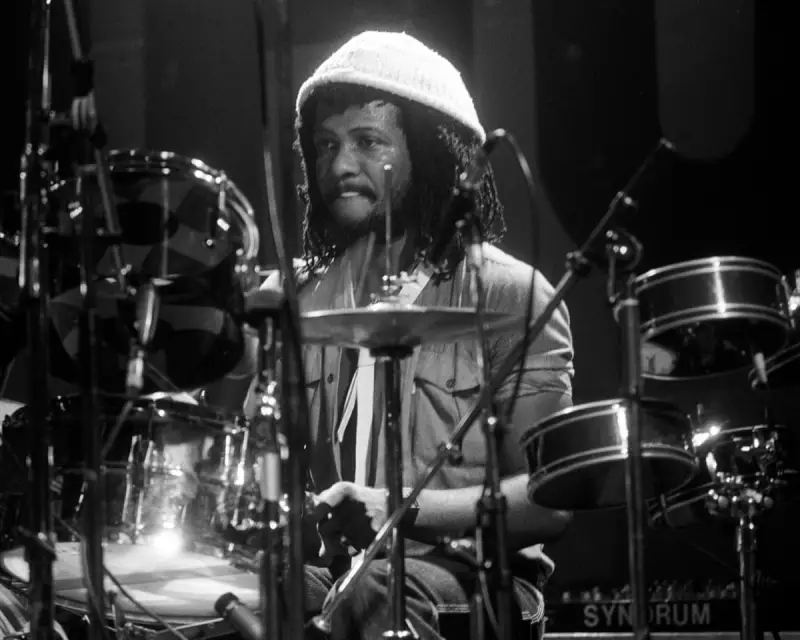
Sly Dunbar: The Innovative Drummer Who Redefined Reggae Rhythms
Sly Dunbar, the celebrated Jamaican drummer, has died at the age of 73 following a prolonged illness. He was widely recognised as one of the most influential figures in reggae music, admired globally for his impeccable timing and creative approach to drumming.
Pioneering a Unique Sound
Dunbar crafted distinctive reggae rhythms that incorporated elements from funk, soul, and disco. Alongside his bassist partner Robbie Shakespeare, he provided the rhythm section for nearly every major reggae artist and worked with an impressive roster of admirers. These included Bob Dylan, the Rolling Stones, Ian Dury, Joan Armatrading, Madonna, the Fugees, and Sinéad O’Connor. However, many will remember him most for the chart-topping hits that propelled Grace Jones to international fame.
His powerful, driving beats were the result of a dynamic and energetic performance across the drum kit, showcasing a controlled chaos that contrasted with his relaxed personality. A slender yet muscular man, Dunbar was known to keep garlic handy to fend off colds while touring. He served as a steady counterbalance to the more unpredictable Shakespeare, and together they left behind an extensive catalogue of enduring hits.

Early Life and Musical Beginnings
Born Lowell Dunbar, he was the youngest of three children. Both of his parents worked at Kingston’s airport. He spent his early years on Windward Road in east Kingston before moving to Waterhouse at the age of seven. Waterhouse was a former sugarcane estate that had been converted into a low-income housing scheme after Hurricane Charlie in 1951.
Fascinated by the Skatalites songs he heard on a jukebox during lunch breaks at Trench Town comprehensive high school, Dunbar would persistently tap out rhythms on his desk. He decided to pursue music professionally at 13 after seeing Ken Boothe and the Gaylads perform at his school.
He soon began approaching local acts to gain experience. After receiving guidance from Wailers drummer Carlton Barrett and Mikey Richards of Now Generation, he joined the emerging band the Yardbrooms. Following a rehearsal with the RHT Invincibles, he started recording with keyboardist Ansel Collins. His debut session produced a lively organ instrumental called The Night Doctor, which gained popularity with skinheads in Britain after Collins licensed it to Lee Perry’s Upsetter label in 1969.
Rise to Prominence
Dunbar then briefly played with the Supersonics, contributing to Justin Hinds’s track Say Me Say. A subsequent session for producer Winston Riley, featuring Collins and vocalist Dave Barker, resulted in the energetic dance groove Double Barrel, which topped the British pop charts in 1971.
Guitarist Bertram McLean later recruited Dunbar into the Volcanos, the resident act at the Colony Club in Discovery Bay on Jamaica’s north coast. It was here that he earned the nickname Sly, due to his admiration for the American funk band Sly and the Family Stone. After the Colony Club closed, the band reformed in Kingston as Skin, Flesh & Bones, which by 1974 became the resident act at the Stables nightclub on Red Hills Road.
Formation of a Legendary Partnership
Shakespeare, who was also active in the Aggrovators, saw Dunbar backing Cynthia Richards and asked producer Bunny Lee to bring him in for a session at Channel One studio. There, Dunbar drummed on John Holt’s adaptation of the Chi-Lites’ Too Good to Be Forgotten.
Simultaneously, Dunbar was redefining the dominant reggae beat as the leader of the Channel One house band, the Revolutionaries. Another early collaboration occurred in 1976 when Shakespeare played piano on the popular Revolutionaries instrumental MPLA.
The duo solidified their partnership when Shakespeare included Dunbar in the Word, Sound & Power band, which backed Peter Tosh on an overseas tour in 1977. Performing for international audiences and spending extended time on the road together fostered a creative exchange, leading them to incorporate funk, soul, and disco influences into their joint productions. Before this, Dunbar recorded two largely instrumental solo albums for Virgin: Simple Sly Man (1978) and Sly Wicked and Slick (1979).

Success with Taxi Label and Beyond
Sly and Robbie’s Taxi label achieved significant success with artists like Gregory Isaacs and Black Uhuru. The latter were signed to Island Records in 1979, and with Sly and Robbie’s involvement, they became the world’s most popular reggae act after Bob Marley’s death, culminating in the Grammy-winning album Anthem (1983).
Known as the Rhythm Twins, they played a similar role for Grace Jones as part of the Compass Point All Stars, the house band assembled by Chris Blackwell for his studio in Nassau, Bahamas. Dunbar’s intricate patterns provided memorable rhythmic hooks for Jones’s hits such as Private Life (1980), Pull Up to the Bumper (1981), and My Jamaican Guy (1982).
Genre Versatility and Later Career
In the early 1980s, albums like Gwen Guthrie’s self-titled debut (1982), Bob Dylan’s Infidels (1983), and Herbie Hancock’s Future Shock (1983) demonstrated Sly and Robbie’s seamless ability to switch between genres. As Jamaican production evolved mid-decade, Dunbar became a highly sought-after electronic rhythm builder, using drum machines and synthesisers on major hits for rising dancehall artists, including Chaka Demus & Pliers’ Murder She Wrote (1992) and Tease Me (1993).
A cover of Gregory Isaacs’s Night Nurse with Simply Red was another chart success in 1997. Following the Grammy-winning Sly and Robbie album Friends (1999), they contributed to two No Doubt singles in 2001-02: Hey Baby and Underneath It All.
Later Years and Legacy
Dunbar continued touring until Shakespeare’s death in 2021 and remained active in the studio until recently. In 2015, he was honoured with the Order of Distinction by the Jamaican government.
He is survived by his wife, Thelma, and their daughter, Natasha. Sly (Lowell Fillmore) Dunbar, drummer, was born on 10 May 1952 and died on 26 January 2026.