For those who enjoy a mental workout, a set of three geometrical puzzles recently challenged readers to think outside the box. The puzzles, sourced from mathematician Ian Stewart, tested skills in tiling, dissection, and fair division. Let's delve into the problems and their ingenious solutions.
The Impossible Tiling Challenge
The first puzzle, named 'Bonnie Tiler', presented a square grid with 33 cells, missing its three corner cells. The task was to cover this irregular grid using 11 identical tiles, each made of three cells in a straight line.
The solution reveals this is impossible. A clever colouring argument proves why. If you colour the grid in a repeating pattern of three colours, every possible placement of the three-cell tile covers one cell of each colour. For a perfect covering to exist, the grid would need exactly 11 cells of each colour. However, a count shows there are 12 red cells and only 10 yellow ones, creating an imbalance that makes the task unsolvable.

A Square Assembly Problem
The second puzzle involved a shape that could be cut into four identical pieces along the black lines and reassembled into a square, as shown. The challenge was to find a different way to cut the same shape into four identical pieces that would also form a square.
The solution requires a different dissection. Instead of the obvious cuts, the shape can be divided into four identical L-shaped pieces. These pieces can then be rotated and reflected to fit together perfectly, forming the required square. This puzzle highlights the importance of perspective in spatial reasoning.
The Efficient Pizza Party
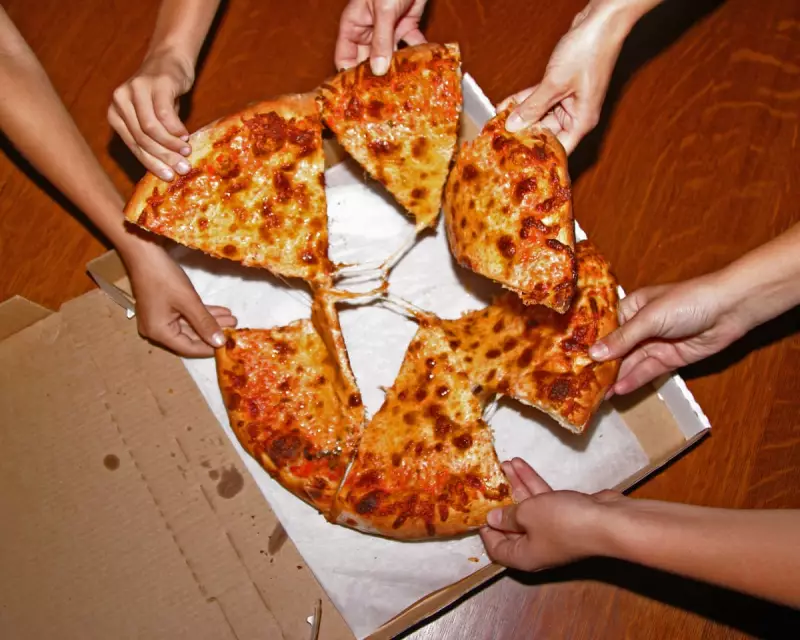
The final conundrum was a practical one: dividing three identical pizzas equally among five people. One method is to cut each pizza into five equal slices, giving each person three slices. Another is the illustrated method using a mix of 3/5, 2/5, and 1/5 slices.
The puzzle asked for the smallest number of total pieces so that each person gets exactly the same amount of pizza in identical pieces. The optimal solution is just ten pieces in total. Each person receives one half of a pizza and one tenth of a pizza. This is achieved by cutting two pizzas into halves (4 pieces) and the third pizza into fifths (5 pieces), then combining one half and one tenth for each of the five diners.
These puzzles were provided by Ian Stewart, whose new book Reaching for the Extreme is published on 12 February and is available for pre-order. They serve as a brilliant reminder of the elegant logic and unexpected beauty found in mathematical thinking.