Looking for a new reading recommendation? Here are some great new paperbacks, from a much-awaited memoir to a climate crisis novel from a literary giant.
Fiction
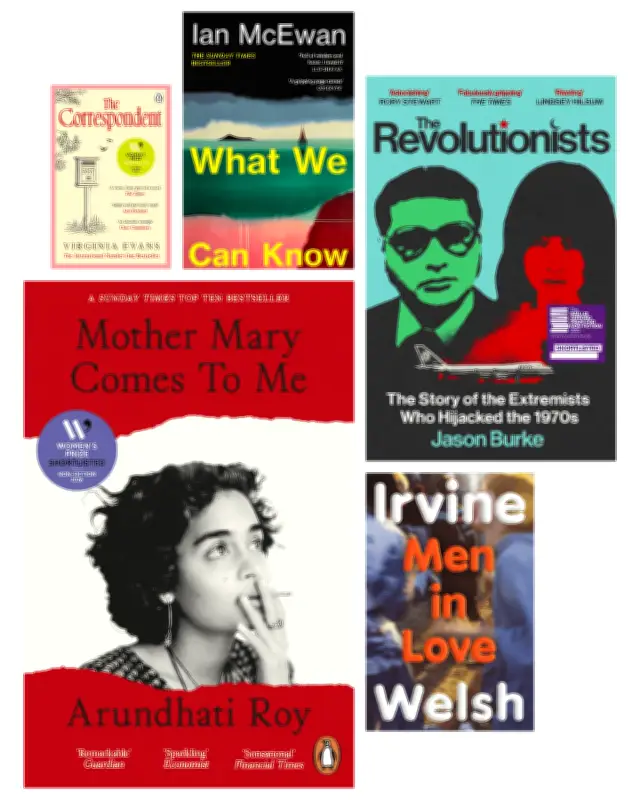
What We Can Know by Ian McEwan
McEwan's future-set new novel describes the "Inundation" of Britain after a Russian warhead goes off accidentally in the middle of the Atlantic, causing a tsunami that, combined with rising sea levels, wipes out everything but a Europe-wide archipelago of mountain peaks. The novel is set a century hence, in 2119. Part one is narrated by Tom Metcalfe, who teaches literature at the University of the South Downs, located on a 38-mile-wide island in the "sleepy ahistorical" republican archipelago that is all that remains of the UK. The world is post-catastrophe. The 21st century has unfolded as we all fear it will. The US is now run by rival "warlords"; Nigeria is the hegemonic power. But this is all offstage stuff. As the novel begins, Tom catches various boats to the Bodleian Library, now occupying a Snowdonian peak and accessible by "water-and-gravity-powered funicular". Here, he trawls the archive of Francis Blundy, a poet of our own time, and allegedly the equal of Seamus Heaney. Tom is in search of a lost poem, the improbably named A Corona for Vivien, which Blundy wrote for his wife Vivien's 50th birthday in 2014. Read aloud once at Vivien's birthday dinner, the sole copy, on vellum, which scholars know of only from contemporary accounts of the dinner, vanished into a credulity-stretching afterlife as the great lost poem of the climate crisis. Alone on the island of his obsession, Tom builds a portrait of the missing masterpiece, and alongside it, a portrait of the early 21st century.
The Correspondent by Virginia Evans
Virginia Evans's The Correspondent has been one of those word-of-mouth sensations that puts a spring back into publishers' steps, a bestseller on both sides of the Atlantic, and now winner of the Women's prize for fiction. It's easy to see why, given that it's such an immensely enjoyable read. Three times a week, 73-year-old Sybil Van Antwerp sits down at her desk in her Maryland home to write her letters. Her correspondence has been, as she puts it, "the mainstay of my life". Recipients include her best friend Rosalie, her brother Felix, the unhappy young son of a former colleague, and an unnamed correspondent to whom Sybil writes much more emotionally raw letters, which remain unsent. The novel never feels static, despite its form. Covering a span of several years, the narrative packs in the emergence of two separate suitors for Sybil, glimpses of her formidable legal career, a DNA testing kit, and the painful backstory of the death of her son, Gilbert, as a child. Another source of tension is the fact that Sybil is losing her sight, and the correspondence that has formed her "manner of living" will soon be brought to an end. The book is, of course, a paean to the art of correspondence. By the time I finished it, I found myself composing letters in my head to all my friends and acquaintances, God help them.


Men in Love by Irvine Welsh
Men in Love displaces 2002's Porno as Trainspotting's most direct sequel, taking place in the immediate aftermath of the drug deal/betrayal that closes it out. We meet the boys again, scattered to the winds – Renton forging a new life in Amsterdam, Sick Boy climbing the social ladder in London, Spud attempting a quieter life and Begbie pinballing between prison and his old haunts in Leith. In alternating first-person chapters, we follow each of the characters as they begin to feel out what adult life might have in store for them. And it all rattles along reasonably enough. Renton attempts to come to terms with his past behaviour, Spud walks the line between a sincere desire to change and the siren call of addiction, Sick Boy sharpens his sociopathic charm into a weapon of class warfare, and Begbie remains trapped by his impulsivity and taste for violence. There are plenty of moments that showcase Welsh at his best, impertinent and loose and attuned to the poetic cadence of everyday speech. When his writing hits these heights, most often during flights of knowing, referential, rhetorical fancy, it is hard not to be charmed by its flair and insolence. Elsewhere, Men in Love is tough going. Throughout, there is a tendency to grope for edgy and transgressive sentiment in a way that lands closer to juvenile and embarrassing. Clocking in at well over 500 pages, there is also the sense that Men in Love could have done with a more rigorous edit. The reasons why Welsh is still writing Trainspotting lore seem evident enough; these are well-loved, iconic characters and there is apparently still an audience appetite for their adventures. But it is hard to shake the feeling that we are in need of a new story altogether.
Universality by Natasha Brown
Proofs of Assembly were fashioned to look like bars of gold, in reference to the fact that the first 49 pages are delivered in the style of a magazine feature about a young man who uses one to bludgeon the leader of a group called The Universalists, a faction of political activists (or squatters, depending on who you ask) attempting to form a self-sustaining "microsociety" on a Yorkshire farm during the Covid-19 pandemic. It's the sort of story that would set social media alight for days, or rather, as Brown wryly notes in the book's second chapter, two weeks: "a modern parable [that exposes] the fraying fabric of British society". The Universalists share DNA with Extinction Rebellion, and do just as good a job at polarising the great British public. Brown creates, in a mere 156 pages, an impressive matryoshka doll of a story, where each established fact is progressively re-rendered with increasing detail and nuance. Pronouncements on "wokeism", on meritocracy, on race and culture wars fall from characters' mouths like bombs. Thanks to the novel's ingenious structure, the more you hear them, the more you realise how inhibiting they are, and how soul-crushingly tiring it is to spend your one precious life negotiating their deployment in a rigged and utterly useless system: a realisation only one character profits from, though dangerously so. Brown is one of our most intelligent voices writing today, able to block out the short-term chatter around both identity and language in order to excavate much more uncomfortable truths. And despite how genuinely satisfying it is to watch her deconstruct the world as we know it now, Universality arouses in me an excitement over what could happen should she ever choose to stray from social realism. What should we be doing with language? How might things look otherwise?
We Pretty Pieces of Flesh by Colwill Brown
This lacerating, exhilarating debut novel, written almost entirely in South Yorkshire dialect, spans nearly 20 years in the lives of its protagonists Kel, Shaz and Rach, from the Spice Girls to the drug spice. It manages to be both boisterous and bleak, life-enhancing and life-denying, familiar and yet wholly original. It feels essential. You will probably read nothing else like it this year. The novel begins as a chorus, musing and retrospective, forcefully acerbic. Each chapter relays a separate, nonlinear, intensely involving incident. It's impossible to know where these stories will lead, and that is what makes the book fresh and exciting; just as it is occasionally unclear who is speaking. Where does the group end, and individual autonomy begin? One moment the three are loyal to the death, a tight-knit gang; the next fractured, angry and isolated. Brown lays bare what it is like to grow up a working-class girl in a small northern English city that has seen decades pass with little notion of "levelling up". Rach is the better-off one, with a traditional family, house, car; Kel and Shaz are from single-parent homes, scraping by. Kel never knew her dad; Shaz grieves over the early death of hers. Shaz lives in the "rougher" end of town. Rach and Kel are firmly set on getting out, away, to university. For Shaz, the options are narrower. Brown, who now lives in the US, writes starkly about the lack of dignity for those forever trapped in the gig economy or worse. It's these subtle differences, and the terrible secret one of the girls withholds from the others, that will determine their life choices and the gripping course of the novel.
No Friend to This House by Natalie Haynes
Considerations of culture and bias have been central to the recent wave of mythic retellings focused on women, from Madeline Miller's Circe and Pat Barker's Iliad trilogy to Haynes's own triad of novels set within the classical Greek world (The Children of Jocasta, A Thousand Ships and Stone Blind). This latest is a reimagining of the myth of Jason and the Golden Fleece and, true to form, it centres the women. Those familiar with Apollonius's Argonautica – a key source text for Haynes – remember the sorceress Medea; few, however, recall the other women in the story. The tale, as Apollonius tells it, is an adventure epic about Jason and his men, who make the treacherous voyage to Colchis aboard the Argo, in order to bring the Golden Fleece to Iolcus. Most of Haynes' narrative is given over to a chorus of women, often absent in previous retellings. The result is an illuminating and often thrilling work of feminist reclamation that also enacts structural subversion, disrupting the familiar narrative's linear momentum and its fixation on male heroism. Medea is many things: sorceress, disloyal daughter, woman in love, woman wronged, and mother; Haynes pays meticulous attention to each of these many facets. Making changes to some episodes while also proffering insights into Medea's marriage to Jason and her life as a "barbarian" foreigner in Greece, Haynes creates an account of her maligned protagonist that is powerfully affecting in its complexity.
TonyInterruptor by Nicola Barker
As TonyInterruptor begins, musician Sasha Keyes is in the middle of an improvised trumpet solo. A man stands up in the audience and says, "Is this honest? Are we all being honest here?" He points at Sasha and adds, "You especially." Soon a video of the episode appears online, with a companion clip of Sasha's vitriolic reaction: "Some random fucking nobody … some dick-weed, small-town TonyInterruptor." Given the times we live in, this naturally leads to Sasha's trial by social media for artistic fraudulence and abusive conduct. But the shockwaves soon extend to everyone adjacent to the event: Fi Kinebuchi, the self-styled "Queen of Strings", who was playing with Sasha at the time; India Shore, the teenager who posted the first video; India's father, Lambert, an architecture professor with a secret crush on Fi Kinebuchi; his wife Mallory, who divides her time between parenting her daughter, Gunn, who has special needs, and venting intellectual spleen; and even to TonyInterruptor himself, real name John Lincoln Braithwaite, an otherworldly outsider. The prose is a profusion of thoughts and associations, and shadings of the thoughts, and metaphors extending from the associations. Midway, the book takes a turn into romantic comedy, with a series of scenes where unlikely characters fall for each other. The honesty they've been pursuing, it turns out, consists not in improvised jazz, but in becoming besotted with an inappropriate person and blowing up your life. In a pivotal scene, a bewildered Sasha Keyes sums up all we've learned by citing the "Buddhist Lineage of Mis-steps", in which it is the seeker's mistakes and failings, not their spiritual achievements, that lead to enlightenment. It is a somehow fitting climax to a book in which Barker seems incapable of putting a foot wrong. This is satire that sees right through you, but forgives you and teaches you to forgive yourself. It's that rare thing, a serious work of art that is also a giddy confection: a vehicle of pure delight.
History
The Revolutionists by Jason Burke
No one knew what to call them. For some they were "skyjackers", for others "air bandits". Neither name stuck, but by 1970, these figures were fixtures of the western political landscape. It helped that hijacking planes was easy. Bag checks, metal detectors and frisking at airports were proposed, only to be dismissed as overkill. The result was a lethal carnival of transnational terrorism that peaked in the 70s, when commandeering a plane was as much a rite of passage as backpacking to Kathmandu for some countercultural types. Spanning four continents and drawing on sources in a dozen languages, Jason Burke's survey of this set combines a flair for period detail – sideburns and aviator shades, berets and Beretta pistols – with impressive digests of Arab and Iranian history. Burke, the Guardian's international security correspondent, writes with amused detachment, sketching militants less as ideologues than oddballs. Kōzō Okamoto of the Japanese Red Army, for instance, was an eccentric with two obsessions: cherry blossom and DDT. The German women of the Red Army Faction mixed dialectical materialism with topless sunbathing in Amman, to the chagrin of their Palestinian hosts. But there is a darker undertow. A male Berlin commune member likened women to horses: "One guy has to break her in, then she's available for everyone." And this is how Carlos the Jackal, a Venezuelan Marxist who abandoned his studies at Moscow's Patrice Lumumba University to join the Palestinian cause, summed up his training: "I've been in the Middle East, learning how to kill Jews." If ideology sometimes recedes from these pages, it is because many of Burke's antiheroes were functionally illiterate when it came to theory. What counted was the excitement of the escapade, not the utopia it was meant to bring about. That doesn't mean there isn't an interpretative thread running through the disparate material: the failure of the left, Burke argues, left a vacuum that was swiftly filled by Islamism. The Soviet Union is noticeably absent in The Revolutionists. It remained cautious during détente and therefore reluctant to endorse leftwing terrorism. So, ironically, it was Islamist revolutionaries who ended up reshaping the west.
Murderland by Caroline Fraser
In 1974, the year Caroline Fraser turned 13, Ted Bundy committed his first confirmed murders. Bundy was handsome, charming, extremely intelligent and sociopathic – "a sexual virus masquerading as a person". Fraser lived on Mercer Island, Washington, near Bundy's first hunting grounds. Recalling the moment he was first charged with murder in October 1976, she writes: "Everybody knows somebody who knows somebody who almost went out with Ted Bundy." Bundy was one of at least half a dozen serial killers active in Washington in 1974. Within a few years, the state would produce the similarly prolific Randall Woodfield, known as the I-5 Killer, and Gary Ridgway, the Green River Killer. Its murder rate rose by more than 30% in 1974 – almost six times the national average. In Tacoma, the city where Bundy grew up, Ridgway lived and Charles Manson was incarcerated for five years before starting his Family, murder was up 62%. It was as if a malevolent cloud had enveloped the region. Fraser argues that the epidemic was related to a real cloud, containing sulphur dioxide, arsenic and lead, which emanated from the smokestack of a smelting facility in Ruston, outside Tacoma. Nobody knows what cursed constellation of genes, upbringing, social circumstances, brain chemistry and plain old evil makes serial killers do what they do, but Fraser advances the lead-crime hypothesis. Lead in the blood has been shown to deplete brain volume in the part of the prefrontal cortex that regulates behaviour, especially in men. Murderland sets its sights much higher than true crime. Like Prairie Fires, Fraser's Pulitzer prize-winning 2017 biography of Laura Ingalls Wilder, it's a big, ambitious story about the United States and the people it breeds. Then again, wasn't it a work of true crime, Truman Capote's In Cold Blood, that kickstarted literary nonfiction 60 years ago? Murderland is as hauntingly compulsive a nonfiction book as I have read in a long time. It gets into your blood.
Memoir
Mother Mary Comes To Me by Arundhati Roy
Arundhati Roy's memoir is partly an account of her life with her mother, who she describes as "my shelter and my storm". A Christian from Kerala, Mary Roy escaped her parents by marrying a member of the Bengali bourgeoisie, before leaving him when he became an alcoholic. She took her children to a "cottage that belonged to our maternal grandfather" in Tamil Nadu, but came up against her family's invocation of a law governing inheritance in her community: "daughters had no right to their father's property". Finally they came to Aymanam, a village in Kerala (spelled "Ayemenem" by Roy, recognisable as the village in The God of Small Things), staying first with their family before once more falling out with them. Mary then set up her own home and, eventually, a school that developed a national reputation. Mary Roy's years of doing battle allowed her to leave two remarkable legacies: her school, but also the case she eventually fought against her family, which went all the way to the supreme court, and resulted in the annulment of the discriminatory inheritance law. In the meantime, she seemed to be perpetually at war, often for no clear reason, with her children, especially her daughter. An attempt to understand the compulsion to love what seems hostile transforms Roy's writing, lending her prose, especially in the first 130 or so pages, an unprecedented freedom. The world described in the first part of the book provides much of the material for The God of Small Things. But these pages aren't significant for giving us access to Roy's inspiration, or as a preamble to her life as a bestselling writer who would go on to become an oppositional political voice. Even if she were none of these things or had never written her novel, they would be utterly absorbing. They have a wonderful, self-assured self-sufficiency. In the late 1970s, Roy escaped her mother, arriving in Delhi and enrolling in the School of Planning and Architecture there. At this point the memoir also bears witness to a world-historical shift: the receding of a kind of modernity and politics which had given rise to experimental lives and ways of thinking. Even before the precipitous slide towards the far right now evident almost everywhere, there was the feverish globalisation that engendered a liberal elite just as bizarre as any of its political opponents. These changes are the subject of the second half of the book. They are woven into Roy's continual, courageous confrontations with the nation-state, including her criticism of its nuclear policies and opposition to Sardar Sarovar dam. Roy loves India deeply, but the nation-state isn't India, and it doesn't love her back. The conflict is comparable to, albeit profoundly different from, her relationship with Mary Roy.
Science
Going Nuclear by Tim Gregory
There is something biblical about the fraternal relationship between the atomic bomb and the nuclear reactor. Both were made possible in the same instant, at 3.25pm on 2 December 1942, when the Manhattan Project's Enrico Fermi orchestrated the first human-made chain reaction. "The flame of nuclear fission brought us to the forked road of promise and peril," writes Tim Gregory. The bomb came first, of course, but atomic dread coexisted with tremendous optimism about what President Eisenhower dubbed "atoms for peace": the potential of controlled fission to generate limitless energy. Nuclear optimism was shattered by the 1986 Chornobyl disaster but, as the subtitle of his book advertises, Gregory is determined to bring it back. Writing in a Promethean spirit of "rational and daring optimism", this self-proclaimed "nuclear environmentalist" believes nuclear energy is the only viable route to net zero by 2050. "The nucleus could power the world securely, reliably, affordably, and – crucially – sustainably," he declares. Gregory is an excellent popular science writer: clear as a bell and gently humorous. If you want to understand the workings of fission or radioactivity, he's your man. But he is also an evangelical pitchman whose chapters on the atom's myriad wonders can read rather like high-end sales brochures. Radiation? Not a problem! Less dangerous, in fact, than radiophobia, "the irrational fear of radiation". But safety concerns demand more space and consideration. Oddly, Gregory doesn't mention Serhii Plokhy's 2022 book Atoms and Ashes, which explains how the Fukushima disaster could have been much worse if not for the courage and judgment of a few key officials. More offputtingly, he attacks renewable energy with roughly the same arguments used by rightwing critics of net zero, warning of "energy scarcity, industrial wind-down, and food insecurity" if we choose wind and sun over good old uranium-235. But surely it is not a zero-sum game?