Whuppity Scoorie: Lanark's Centuries-Old Spring Celebration
As the evening light fades at Lanark Cross, a hush falls over the gathered crowd. Suddenly, the small bell in St Nicholas's church tower begins its six o'clock chimes, breaking the silence that has persisted since autumn. This moment signals the start of Whuppity Scoorie, a unique Scottish spring ritual that brings together generations in celebration.
A Burst of Movement and Tradition
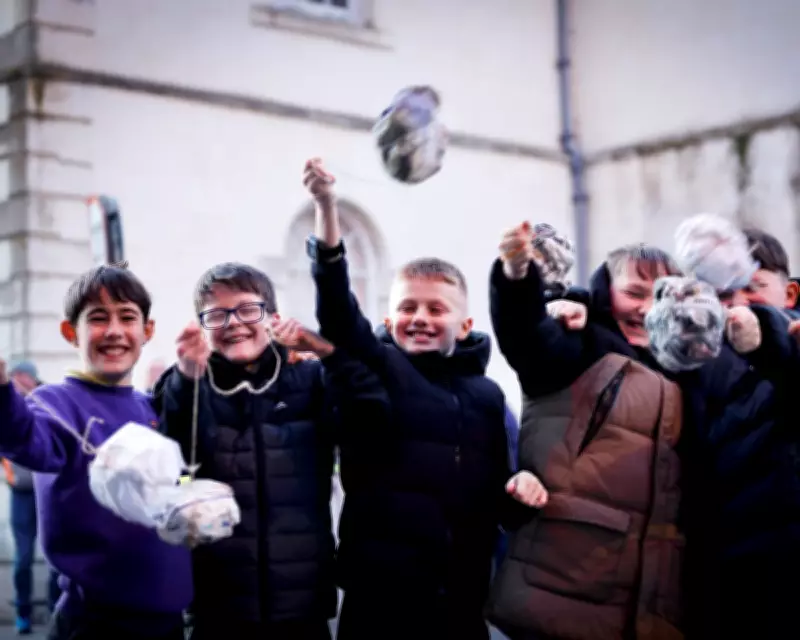
Approximately one hundred children, assisted by adults, immediately spring into action. They make three clockwise laps around the historic church, swinging homemade balls of paper attached to strings above their heads as they run. This vibrant display marks the annual Whuppity Scoorie event, a tradition whose precise origins remain shrouded in history but whose continued practice demonstrates a remarkable cultural resilience.
"It's about heralding spring and banishing the winter woes," explains Eleanor McLean, secretary of the Royal Burgh of Lanark community council. The organization has hosted the event in recent decades, which typically occurs every March 1st, except when that date falls on a Sunday—as happened this year, prompting a shift to March 2nd.
Historical Roots and Modern Interpretations
Local historians offer various theories about the tradition's origins and its unusual name. First documented in the Hamilton Advertiser in 1893, the newspaper claimed Whuppity Scoorie was already 150 years old at that time. Since the mid-19th century, it has been recognized as a children's festival celebrating the end of dark winter nights through spirited street play.
The colorful paper balls are believed to chase away winter's dull spirits, though earlier versions involved children using caps tied with long strings to ward off young apprentices returning from New Lanark mills. Some theories suggest even earlier connections to religious penitents who were whipped ("whupped") around the church before being washed ("scoored") in the nearby river.
"There are a lot of old traditions in the Royal Burgh—like the Lanimer processions in June—and there's a commitment to keeping them alive," McLean emphasizes, attributing the tradition's survival to Lanark's strong community spirit.
Engaging New Generations
The community council actively involves younger residents through primary school poster competitions. Six-year-old Freddie Stirling, who proudly swings a substantial brown paper ball, represents this year's winners. His detailed drawing of the church tower with its small bell inside earned recognition, though he expressed disappointment about not having time to color the stained glass window.
Freddie's mother, Janet, notes: "He's half Chinese, half Scottish, and Lanark is a very welcoming place; a nice place for kids to grow up." This sentiment is echoed by Julie Cox, who brought her two-year-old grandchild Anna to experience Whuppity Scoorie for the first time. "It's important to keep up the traditions," Cox affirms, recalling how she previously brought her own sons to the event.
Folklore's Contemporary Resurgence
Allison Galbraith, a Lanarkshire-based storyteller and author of Lanarkshire Folk Tales, observes that such traditions fulfill a fundamental human need. "It brings people out of their houses on the first day of spring, and that's a need held by our ancestors and still felt the length and breadth of the country—and indeed the world over," she explains.
Galbraith notes that rural towns like Lanark, historically organized around agricultural calendars, have better preserved ancient ceremonies compared to cities where industrialization and migration disrupted continuity. "But there's still a great appetite for it. People want to be out with their community in a safe and happy environment," she adds.
In an era dominated by screen-based, segregated entertainment, Whuppity Scoorie offers valuable intergenerational connection. "And it's also brilliant for newcomers to the area, and New Scots, because everyone is welcomed equally," Galbraith emphasizes.
A Broader Cultural Revival
David Clarke, an associate professor at Sheffield Hallam University and leading authority on British folklore, confirms this represents part of a larger trend. "Without a doubt" folklore is experiencing a resurgence, he states, pointing to both calendar customs and the growing popularity of folk horror genres.
"We're seeing this now as a reaction to all the horrible, nasty things going on in the world and people needing something that feels safe and familiar," Clarke suggests. He is currently spearheading the National Folklore Survey of England to better understand this revival within multicultural contexts.
Clarke concludes: "There's not many things in the present day that get people worked up in a good way, where everyone is enjoying themselves and even people who are not part of the community are welcomed. It provides the glue that is missing in other areas of life."
As children complete their third lap around St Nicholas's church, their paper balls creating swirling patterns against the darkening sky, Whuppity Scoorie demonstrates how ancient traditions can foster contemporary community cohesion, connecting past and present through shared celebration.