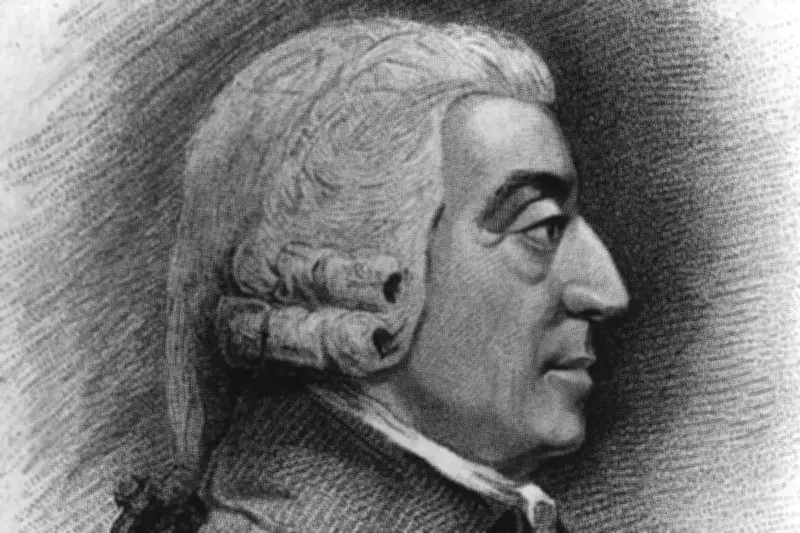
Adam Smith's Semiquincentennial: Celebrating 250 Years of Economic Insight
On this day in 1776, exactly 250 years ago, William Strahan and Thomas Cadell published An Inquiry into the Nature and Causes of the Wealth of Nations, a groundbreaking work by Adam Smith that fundamentally reshaped economic thought. Rather than inventing new concepts, Smith discovered and articulated the principle that free trade and efficient division of labour drive general prosperity, enriching societies worldwide. This monumental publication, spanning over 1,100 pages in two quarto volumes, emerged from more than a decade of Smith's rigorous thinking, correspondence, and writing, establishing him as the father of modern economics.
From Kirkcaldy to Global Influence: Smith's Intellectual Journey
Adam Smith was 52 years old when The Wealth of Nations was released, having spent much of the preceding decade in his hometown of Kirkcaldy, Fife. Born to a father who served as Comptroller of Customs in a town known for linen weaving and shipbuilding, Smith's ambitions extended far beyond Scotland's coast. He studied moral philosophy at the University of Glasgow under Francis Hutcheson, who pioneered moral sense theory and lectured in English, a departure from the traditional Latin. After winning a Snell Exhibition for postgraduate study at Balliol College, Oxford, Smith found the environment stifling compared to the vibrant Scottish Enlightenment.
Returning to Scotland, he delivered lectures at the University of Edinburgh in the late 1740s, covering rhetoric and "the progress of opulence," and formed a lasting friendship with philosopher David Hume. In 1752, Smith succeeded Hutcheson as Professor of Moral Philosophy at Glasgow, dedicating himself to academia. His first book, The Theory of Moral Sentiments, published in 1759 and reaching six editions in his lifetime, solidified his reputation among Scottish intellectuals. After tutoring the future Duke of Buccleuch, Henry Scott, Smith returned to Kirkcaldy in 1766 to begin work on his magnum opus.
The Core Principles: Free Trade and the Invisible Hand
The Wealth of Nations presented a revolutionary economic model, challenging the prevailing mercantilist and physiocratic systems. Smith argued that free trade, guided by the undisturbed laws of supply and demand, fosters a productive economy. He introduced the concept of "the invisible hand," suggesting that individual self-interest naturally promotes public good, even unintentionally. The foundations of his vision included efficient division of labour, opposition to protectionist tariffs, and a tax system based on proportionality, transparency, convenience, and efficiency.
Smith was critical of special interest groups, such as exclusionary guilds, warning that "People of the same trade seldom meet together, even for merriment and diversion, but the conversation ends in a conspiracy against the public, or in some contrivance to raise prices." The book's immediate impact was profound, with the first edition selling out within six months. It influenced policymakers like Lord North, who consulted Smith for the 1777 Budget, introducing taxes on manservants and auctioned property to fund the American war, followed by house duty and a malt tax in 1778.
Enduring Legacy and Global Relevance
Four more editions of The Wealth of Nations were published before Smith's death in 1790, with revisions in 1778, 1784, 1786, and 1789. The work's influence extended globally, cited by James Madison in 1791 to oppose a national bank in the United States and praised by Thomas Jefferson in 1807 as "the best book to be read" on money and commerce. Today, as the global economy in 2026 grows more complex and interdependent, Smith's principles remain relevant, demonstrating that free trade and division of labour continue to drive prosperity.
While economic models evolve with slips and stumbles, Smith's ideas have endured, often seen as outlasting those of Karl Marx and John Maynard Keynes in the "Big Three" of economic thought. The battle for economic understanding persists, but Smith's legacy is secure, promising to inspire for another 250 years. Eliot Wilson, a writer and historian, reflects on this milestone, highlighting Smith's role in shaping national security and global prosperity through his timeless insights.