Backlash Erupts as US National Monuments Conform to Trump's Historical Rewrite
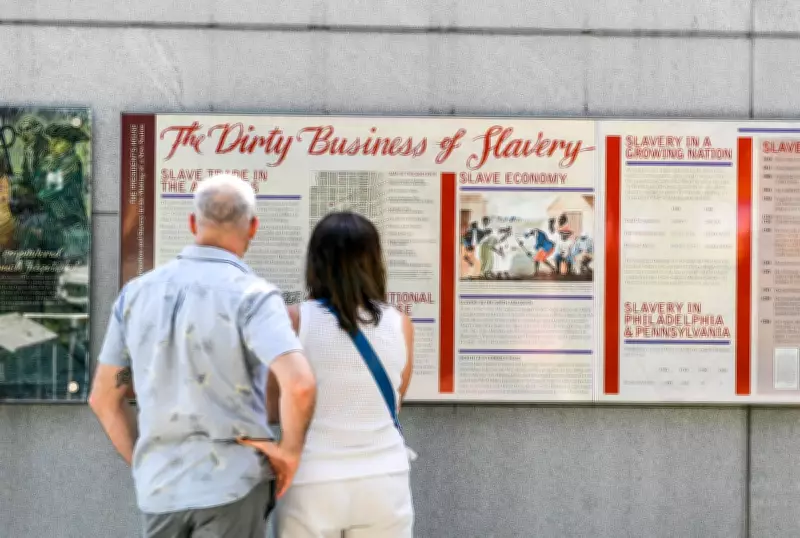
Tourists gathered at the President's House in Philadelphia on 9 August 2025, examining a display titled 'The Dirty Business of Slavery' that would soon become a focal point of national controversy. This historic site, which commemorates the residences of George Washington and John Adams, has undergone significant changes following a presidential directive aimed at reshaping America's historical narrative.
Philadelphia Landmark Stripped of Slavery Panels
Blank spaces now mark the walls where thirty-four educational panels once detailed the lives of people enslaved by George Washington during Philadelphia's tenure as the nation's capital in the 1790s. On 22 January, National Park Service workers used hand tools to remove these installations that had informed visitors for over a decade. The dismantled materials now reside in storage, their removal representing just one instance of a nationwide initiative.
The action complies with President Trump's executive order "Restoring Truth and Sanity to American History," issued on 27 March 2025. This directive has identified numerous public markers, monuments, and statues across more than a dozen national parks that the administration considers disparaging to past or present Americans.
Nationwide Impact on Historical Interpretation
Beyond Philadelphia, the executive order has triggered alterations at multiple significant sites. At Montana's Little Bighorn battlefield national monument, two exhibits discussing Indigenous history and the famous battle have been targeted as noncompliant. In California, signage addressing climate change at Muir Woods national monument has disappeared, while visitor brochures at Mississippi's Medgar and Myrlie Evers Home national monument that described Evers's killer as racist have been withdrawn.
Ed Stierli of the National Parks Conservation Association expressed profound concern about these developments. "The National Park Service has made tremendous strides in recent decades in teaching the facts, the truth about difficult topics like slavery," Stierli stated. "By removing this exhibit and removing signs, not just from this exhibit, but from parks around the country, visitors are going to miss out on the full picture of our nation's history that deserves to be told in national parks."
Legal Challenges and Government Response
Following the removal of both panels and accompanying videos, the city of Philadelphia initiated legal action against the federal government. The lawsuit, filed in the US district court for the eastern district of Pennsylvania, seeks to reinstate the exhibit and obtain an injunction against further alterations. On 2 February, Judge Cynthia M Rufe issued a ruling blocking additional changes to the President's House pending further review.
A Department of Interior spokesperson defended the actions in an email statement: "Following completion of the required review, the National Park Service is now taking appropriate action in accordance with the Order. We encourage the City of Philadelphia to focus on getting their jobless rates down and ending their reckless cashless bail policy instead of filing frivolous lawsuits in the hopes of demeaning our brave Founding Fathers who set the brilliant road map for the greatest country in the world – the United States of America."
Historical Perspectives Under Threat
Dr Leo K Killsback, a Northern Cheyenne descendant of Chief Dull Knife and professor at University of Arizona Law, personally experienced the impact of these changes. Having researched and designed panels about the Cheyenne at Little Bighorn in 2014, Killsback views the executive order as fundamentally divisive, contradicting the monument's theme of "peace through unity."
"When done correctly, history is based on facts, supported by evidence, and presented objectively without an agenda or as propaganda," Killsback asserted. "Native voices have been ignored, marginalized or devalued for so long. I think the removal of well-researched facts is desperate and unintelligent and it destroys the hard work of dedicated scholars."
Dr Rasul Mowatt, a sociology and anthropology professor at North Carolina State University, contextualized these developments within broader patterns of American memorialization. "The United States has a long history of either no memorialization, late memorialization, contested memorialization or even memorialization removal," Mowatt observed, noting that the first monument dedicated to a Black person wasn't established until 1943.
Broader Implications for Historical Education
Stierli emphasized the particular significance of learning history at its actual locations. The Philadelphia exhibit's position near the Liberty Bell Center entrance ensured substantial visitor engagement. "There's a particular power that comes with learning about these stories in the place that they happened, in the place where it was," he remarked. "And it's just a completely different experience than what it would be if you're reading it on your phone, on a website or in a book."
As America approaches its 250th birthday on 4 July, with visitors flocking to national parks, Stierli finds the government's actions particularly troubling. "I find the government's action so shameful and unfortunate at a time when we should be acknowledging and celebrating our history, while acknowledging the good parts and the bad," he concluded, highlighting concerns about declining NPS morale and staff retention amid these interpretive challenges.