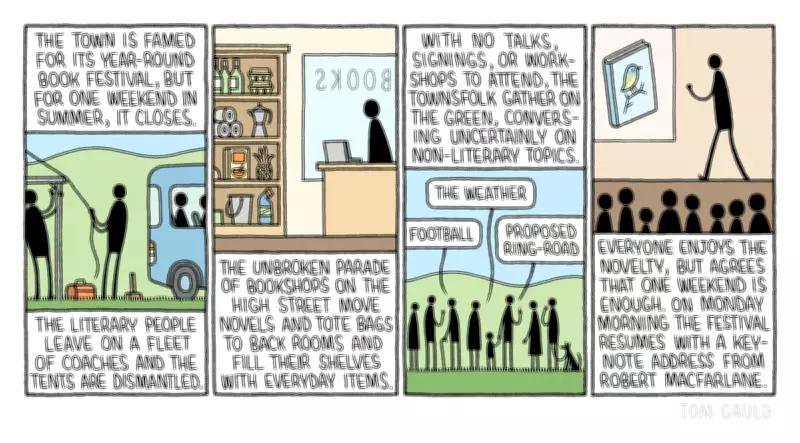
Cartoonist Tom Gauld has turned his witty eye to the literary geography of Britain, creating a new cartoon that maps out towns and cities famous for their connections to writers and books. Published in the Guardian, the illustration playfully highlights how certain places have become synonymous with literary greats, from the birthplace of William Shakespeare in Stratford-upon-Avon to the Edinburgh that inspired J.K. Rowling's Harry Potter series.
A Whimsical Tour of Britain's Literary Landscape
Gauld's cartoon, titled 'Literary Towns,' offers a satirical take on the way literature has shaped the identity of various locations. The drawing features a map of Britain dotted with iconic landmarks and characters, each representing a different author or book. For instance, the Lake District is marked with a nod to Beatrix Potter, while Haworth in Yorkshire is associated with the Brontë sisters. The cartoon also includes references to more contemporary literary figures, such as Philip Pullman's Oxford and the London of Charles Dickens.
Humor Meets Literary History
Known for his minimalist style and sharp humor, Gauld has a knack for distilling complex ideas into simple, engaging visuals. In this cartoon, he combines his love of literature with his signature wit, poking fun at the sometimes exaggerated reverence for literary heritage. The illustration includes humorous details, such as a signpost pointing to 'The Olde Tea Shoppe' in every literary town, and a tourist taking a selfie with a statue of a fictional character.
Gauld's work often appears in the Guardian's Saturday Review section, where he has been a regular contributor for years. His cartoons frequently explore themes of literature, science, and everyday life, earning him a loyal following. This latest piece is likely to resonate with book lovers and anyone who appreciates the quirks of British cultural identity.
Reactions and Interpretations
The cartoon has sparked discussion among readers, with many sharing their own interpretations of the literary towns depicted. Some have noted that Gauld's map is not exhaustive, leaving out certain regions or authors, but this seems intentional, as the cartoon is meant to be a playful overview rather than a comprehensive guide. Others have praised Gauld for capturing the essence of each location with just a few strokes, making the cartoon both accessible and thought-provoking.
In an era where tourism and place branding often rely on cultural references, Gauld's cartoon serves as a gentle reminder of the enduring power of literature to shape how we see the world. Whether it's the moors of Yorkshire or the streets of London, the places we read about become part of our collective imagination, and Gauld's work celebrates that connection with humor and charm.