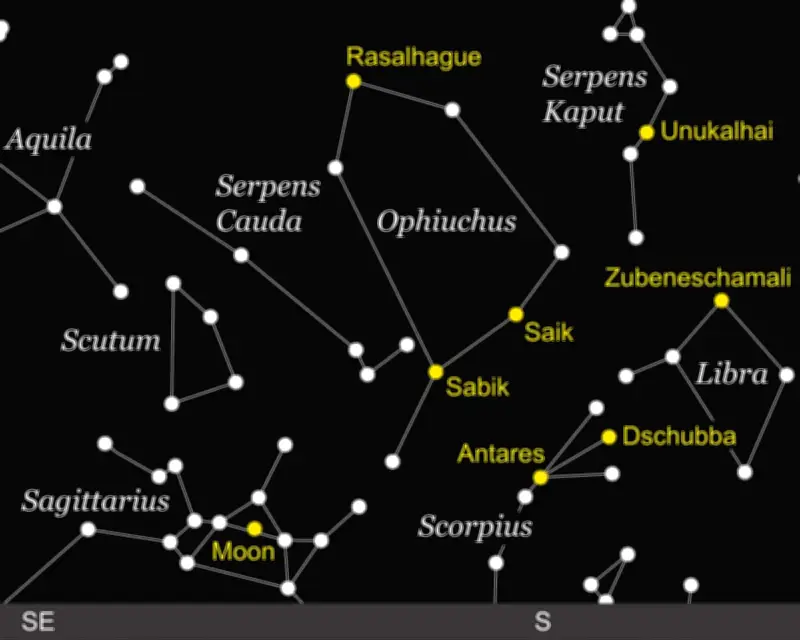
This week, stargazers are directed to find another large but faint constellation: Ophiuchus, the serpent bearer. One of the original 48 constellations listed by Ptolemy in the 2nd century, it sits in the sky on the opposite side to Orion, the hunter. The chart shows the view looking south from London at 11pm BST on 29 June 2026.
Moon in Sagittarius
Although the view will remain essentially unchanged all week, on this particular evening a nearly full moon sits squarely in the teapot asterism of Sagittarius, the archer.
Mythological origins
In classical Greek mythology, Ophiuchus represents Apollo wrestling with the serpent that guarded the Oracle at Delphi. The Roman version is completely different: Ophiuchus is Asclepius, who learned the secrets of immortality by watching a serpent treat another with healing compounds made from herbs. To stop humans from gaining this godly power, Zeus killed Asclepius with a bolt of lightning.
Serpens the serpent
The constellation bisects the constellation Serpens, the serpent: to the west of Ophiuchus is Serpens Caput, the head of the serpent; to the east is Serpens Cauda, the serpent's tail.
Visibility from both hemispheres
Straddling the celestial equator, Ophiuchus is easily visible from both hemispheres. From Sydney, for example, it is well placed in the northern sky at this time of year.