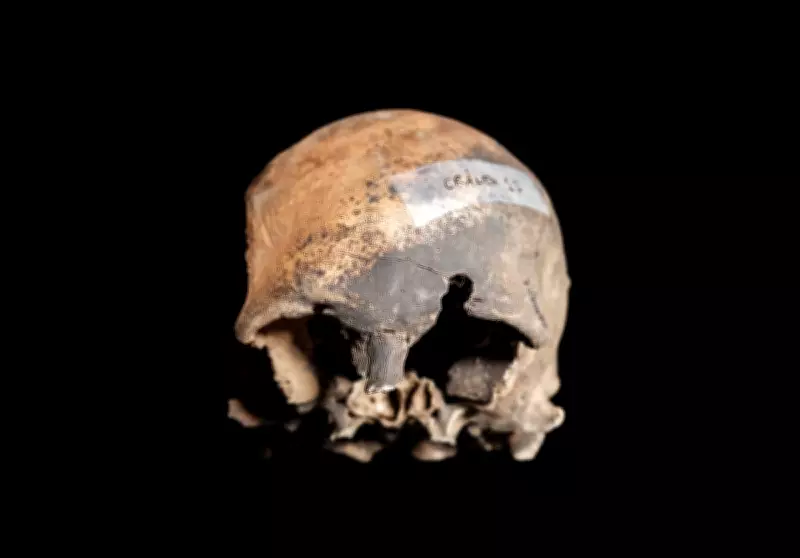
A skull recovered from a well in southwestern Spain bears a clear bullet wound on the forehead, evidence of an execution. The skeleton was disarticulated, making identification impossible. Photographer Roberto Palomo wonders if it belongs to his great-grandfather, Silvestre Indias Carvajal, who disappeared 87 years ago.
The Francoist uprising and its legacy
2026 marks the 90th anniversary of the Francoist uprising that sparked the Spanish Civil War. An estimated 120,000 to 150,000 people disappeared during Franco's repression, their remains scattered across 2,567 mass graves. The far right's entry into regional governments, such as in Extremadura, is dismantling historical memory laws that allow reparations for victims.
Silvestre's story
Silvestre Indias Carvajal was a municipal clerk in Feria, Extremadura, a town of barely 4,000 inhabitants in 1936. When Franco's forces occupied the town, the repression was swift. Silvestre, who had guarded imprisoned Franco sympathisers, fled but was captured days later. He was 39 years old.
His daughter Silvestra, then three, later recalled: 'I was three years old when they took my father, and my sister was born seven months later. My mother would say, “Oh my little ones, I don’t know where your father is.”' Silvestre's wife María was left widowed and pregnant, forced to pull their children out of school to work.
The well and the exhumation
In October 2021, Palomo learned that archaeologists were searching a well on a country estate near Feria. Backed by the Extremaduran government, the Aranzadi scientific society pumped out water and dug through five metres of rock, uncovering a tangle of bones. Rising and falling water levels had disarticulated the skeletons, making identification difficult.
After sorting and analysing the remains, experts determined that 20 people had been thrown into the well. DNA samples from descendants eventually identified one thigh bone as belonging to Silvestre.
The return of remains
On 18 November 2023, Silvestra, then 90, received her father's remains in a ceremony. She was finally able to hug him through the small coffin. Her sister María died a month before, never seeing her father but knowing the wound was closed.
Silvestre's remains now rest in a burial niche with his wife, daughter, and son. Silvestra joined them in July 2024, at age 91.
Historical memory under threat
The Extremaduran regional government, now run by the conservative People's Party and far-right Vox, has repealed the regional historical memory law and plans to replace it with a 'coexistence law' that critics say will whitewash the dictatorship and equate victims with torturers.
To date, about 1,000 mass graves have been excavated, recovering remains of about 13,000 people. But experts believe only 20,000 to 25,000 more bodies can be found, as construction has destroyed many sites. An entire generation of victims' children is disappearing.
Palomo hopes his story reaches his five-year-old niece and her generation: 'They need to know what happened so that this tragedy is never repeated.'