Peter Aldington, the architect and gardener known for his modernist houses that combined meticulous attention to materials with a sensitivity to indoor and outdoor spaces, has died at the age of 93. His following and influence far exceeded the relatively modest quantity of his buildings over a career spanning just over 20 years. The relationship between quantity and quality stemmed largely from his refusal to compromise. His attention to detail, his use of materials, and his ability to imagine how people would live or work, coupled with his stubborn integrity, meant he never accepted second best. This approach, however, did not make for an easy working life and led to him quitting architectural practice at the age of 53.
Early Career and First Solo Project
Aldington’s first solo project was a small village house at Askett, Buckinghamshire, commissioned in 1961 by Michael White, a timber specialist he met while on a climbing holiday in Scotland. The house featured robust pine woodwork on white painted brick walls, a palette he would use in several later houses. Aldington and his wife Margaret, a nursing sister, occupied the unfinished shell and finished the interior in lieu of rent.
The Vale of Aylesbury and Turn End
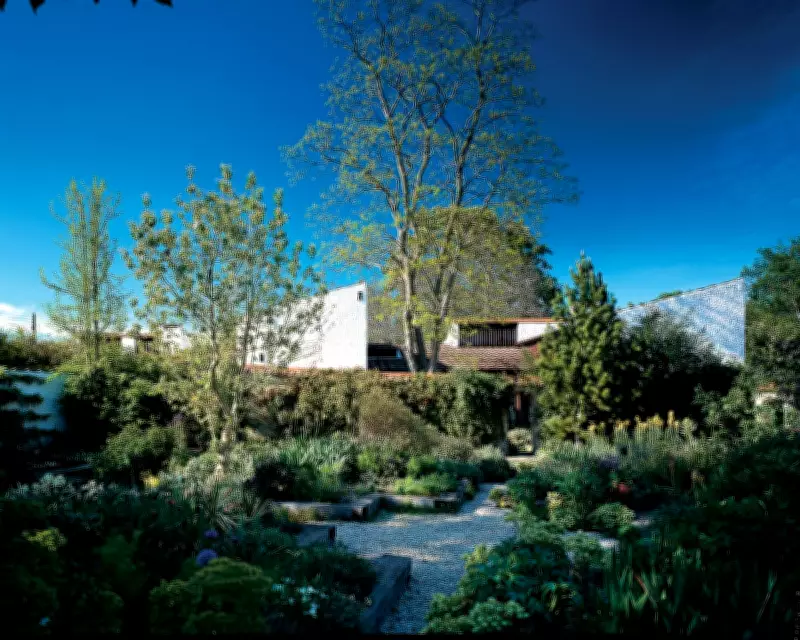
The Vale of Aylesbury became Aldington country. Peter and Margaret bid at auction for a site in nearby Haddenham and between 1964 and 1970 built a group of three houses. One of these, Turn End, became their home, with an expanding garden created around existing trees. The building was literally a family effort: together Margaret and Peter cleared the site, with Margaret heavily involved in the physical construction while also serving as clerk of works for Turn End, supported by occasional specialist contractors. Wichert walls, made of chalk, clay earth, and straw, thread through the heart of the village, acting as both building and property boundaries, and the design incorporates this local feature.
Turn End remains a domestic paradise and an object lesson in modest village development in a modern style. It is accessible to visitors on occasional open days. In the Channel Four TV series Grand Designs in April 2022, Kevin McCloud described it as a masterpiece, "a place of pilgrimage for architects and self-builders in the Buckinghamshire countryside," and interviewed the couple.
Further Projects and Design Philosophy
The Quilter House at Prestwood, nearby (1965-66), further developed Aldington’s ideas about open planning and inside-outside relationships, with a bold brick stair turret rising from a moat-like pool. It took until 1978 for his practice to outgrow a single room in his house. He was joined by John Craig, not an architect but a versatile artist, in a unique partnership of differing skills and shared intentions.
A local doctor, Barry Reedy, wanted a surgery at Chinnor and outlined how it could fulfill a combination of practical and emotional needs. This gave the partners the template for Craig’s brief-taking method, which involved probing the client’s likes, dislikes, and habits to create a word picture of the building that they could never have articulated unaided. Only when this abstract brief was agreed did Aldington begin designing.
At Barnstaple, in Devon, for a retired couple who were friends of the family, a cubicle between the kitchen and living room accommodated a home study, allowing Ian Anderton to spread out his papers and enjoy the scenery and garden while also being able to talk to his wife, May, and meeting her need for tidiness. In 2000, Anderton House joined the Landmark Trust’s distinguished roster of historic buildings for holiday lets, the first acquisition by the trust of a house by a living architect.
More difficult to handle were the 17 individualist GPs in Wellingborough, Northamptonshire, who came together in a group surgery (1972-73, now demolished). They were masterfully led into harmony of purpose by Craig and housed by Aldington beneath a single space frame roof.
Later Works and Retirement
Identified early in his career as a "hairy" architect, because of his liking for rough-textured materials, and devoted to Frank Lloyd Wright, Aldington was keen not to be typecast. Harold and Joan Wedgwood agreed to a steel and glass house inspired by Mies van der Rohe’s Farnsworth House on a tennis court site at Higham, Suffolk (1975-78). The apogee of this hi-tech tendency was the Mechanised Letter Office for Royal Mail at Hemel Hempstead, Hertfordshire (1981-83, demolished), where complex processes were streamlined beneath a single large roof. The architect John Winter wrote: "Architects do not always sail so smoothly through the first big building test." Sadly, this was also the last.
Craig and Aldington both retired in 1986, after suffering years of difficulty and disappointment as multiple schemes were scuppered by officialdom, client timidity, or inflation in the 1970s, followed in the 80s by increasingly obstructive regulations and procedures. The practice was continued by Paul Collinge, their former partner, who retained the name Aldington, Craig and Collinge.
Once Aldington ceased practice as an architect, he executed a number of garden schemes. He was consultant for the Inverie Pier shelter on the Knoydart peninsula in western Scotland, where he and Margaret had a small and much-loved cottage.
Personal Life and Legacy
Born in Preston, Peter was the son of John Aldington, a research chemist and lighting engineer, and later vice-chairman of Amalgamated Electrical Industries, and his wife, Edna (nee Entwisle), a piano teacher before her marriage. They attended the Baptist church, and Peter was a lifelong teetotaller. His first ambition was to become a gardener, but a family friend and neighbour, the architect George Grenfell Baines, suggested studying architecture at Manchester University. After graduating and starting work at the London County Council, Aldington did national service on the German-Dutch border. Returning to the LCC, he worked on Morris Walk prefabricated housing in Woolwich. The Askett commission then launched his career.
In retirement, Aldington became chief curator of his own work, taking a close interest in the fate of his buildings and initiating listing requests. Following the listing of the three Haddenham houses at Grade II in 1998 (upgraded to Grade II* in 2006), the Turn End charitable trust (now the Turn End trust) was established, aiming to "promote the integration of building and garden design." The garden at Turn End was later listed at Grade II under the Register of Historic Parks and Gardens by Historic England.
Aldington also initiated the publication of A Garden and Three Houses (1999), with text by Jane Brown and photographs by Richard Bryant; my book Aldington, Craig and Collinge (2009); Houses: Created by Peter Aldington (2016); and a film on Turn End by Murray Grigor (2017). Aldington was recorded for Architects’ Lives in the National Life Stories programme, and the practice archive that he carefully preserved was given to the Royal Institute of British Architects.
Aldington was burly and bearded, obsessive and yet able to make fun of himself. He is survived by Margaret and their daughters, Clair and Rachel. Peter John Aldington, architect, born 14 April 1933; died 15 April 2026.