Peter Ahrends, a founding partner of the architectural firm Ahrends, Burton and Koralek (ABK), has died aged 93. He co-founded ABK in 1961 with Richard Burton and Paul Koralek, whom he met as students at the Architectural Association in London in 1951. The trio practiced together for over 50 years, remaining lifelong friends.
Early Projects and the Berkeley Library
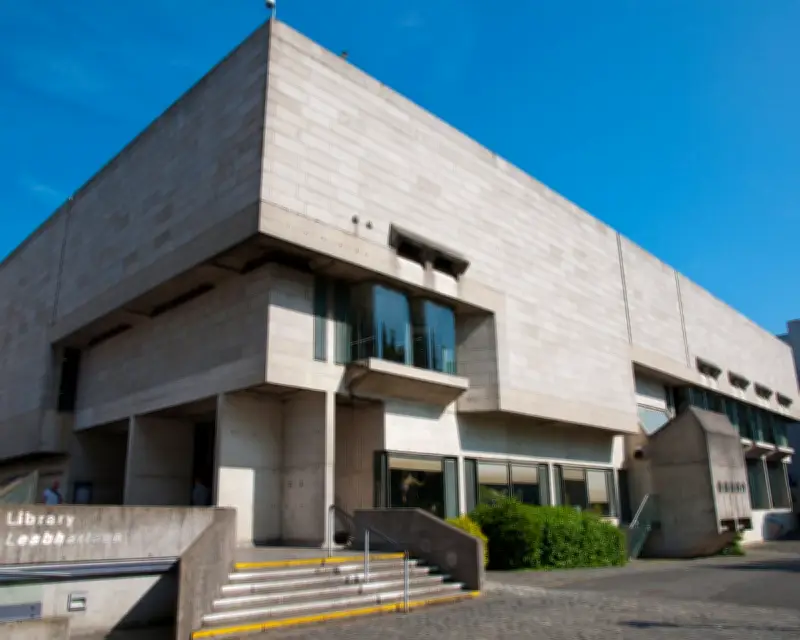
ABK's early work included a Bond Street gallery for art dealer John Kasmin, hailed by Forbes as "London's swingingest 60s art gallery," and a competition win for the Berkeley Library at Trinity College Dublin. Completed in 1967, the library was described by a critic as "sitting like a mooring stone at the edge of Trinity's green, its surfaces pale and pitted, its geometry lucid as a theorem." Made of concrete and Wicklow granite, it was designed to stand its ground against neoclassical neighbors. In 2025, it was renamed the Eavan Boland Library after the Irish poet.
Notable Buildings and Design Philosophy
Other significant projects included Chichester Theological College, a brutalist composition in brick and concrete; Templeton College (Oxford University's business school), built in seven phases between 1967 and 1990; and a serpentine addition to Keble College, Oxford (1980), a modern riff on William Butterfield's Victorian original. ABK also designed housing in Basildon, Essex; a factory for Cummins in Lanarkshire; and a warehouse complex for Habitat with bright green walls and play structures by artist Eduardo Paolozzi.
The firm's design approach was described by Paul Finch in the Architects' Journal in 2002 as "one getting ready to sound the drum," while another "ponders on the nature of the drum" and the third "wonders whether actually a trumpet may be more appropriate." Ahrends stated: "Architecture should not be a question of whether or not we put Corinthian capitals on our facades. It is about people and their lives; about making spaces that will have a living, dynamic and significant relationship with the life and activity they will contain."
The 'Carbuncle' Speech and Aftermath
In 1984, ABK's winning competition design for a National Gallery extension was famously called a "monstrous carbuncle on the face of a much-loved and elegant friend" by the then Prince of Wales at a Royal Institute of British Architects (Riba) gala dinner. The partners noted that a carbuncle is also a rare gemstone, but the scheme was abandoned. The National Gallery later commissioned a postmodern design from Robert Venturi and Denise Scott Brown.
The adverse publicity impacted ABK's fortunes, but existing clients remained loyal. Subsequent projects included the British embassy in Moscow (1988), St Mary's hospital on the Isle of Wight, and an experimental timber workshop at Hooke Park in Dorset with Frei Otto. Speculation persists about what ABK might have achieved without the carbuncle speech.
Background and Activism
Born in Berlin on 30 April 1933, Ahrends was a third-generation architect. His grandfather Bruno Arons (who Germanised his surname to Ahrends) designed the Weisse Stadt housing estate in Berlin, now a Unesco World Heritage site. His father, Steffen, studied at the Weimar Bauhaus and worked in Moscow under Ernst May before fleeing to South Africa in 1937, where he designed over 500 houses. Peter wrote about them in A3 Threads and Connections (2015).
Ahrends grew up in Johannesburg, but after his parents' divorce in 1944, he was sent to boarding school in East London. At age 11, he traveled without a ticket to Johannesburg and noted the different treatment by railway police compared to a young black man, which made him sensitive to racism. He served apprenticeships as a carpenter and plumber before studying at the Architectural Association, where he was influenced by Le Corbusier and Frank Lloyd Wright.
After graduation, Ahrends, Burton, and Koralek took a road trip through Europe and Turkey to Isfahan. In 1954, Ahrends married Liz Robertson, who had accompanied him; they had two daughters, Jacqui and Jane. He returned briefly to South Africa but became an impassioned anti-apartheid campaigner. From 1986 to 1994, he chaired UK Architects Against Apartheid, which included around 200 practices lobbying for boycotts and de-recognition of the Institute of South African Architects by Riba.
Later Career and Legacy
Ahrends was a professor at the Bartlett School of Architecture (1986-89), a visiting professor at Kingston Polytechnic (1984-85), and a member of the Design Council (1988-93). ABK ended in 2012 when Ahrends and Koralek retired; Burton had left in 2002 due to illness and died in 2017. Koralek died in 2020, but ABK's Dublin office continues. Ahrends observed: "If our architecture is 'social', it's because it's about people and the way they really live, not just aesthetics."
Liz died in 2007. Ahrends is survived by his daughters, two grandsons, two great-grandchildren, and his partner, Marlene Rolfe. He died on 30 May 2026.