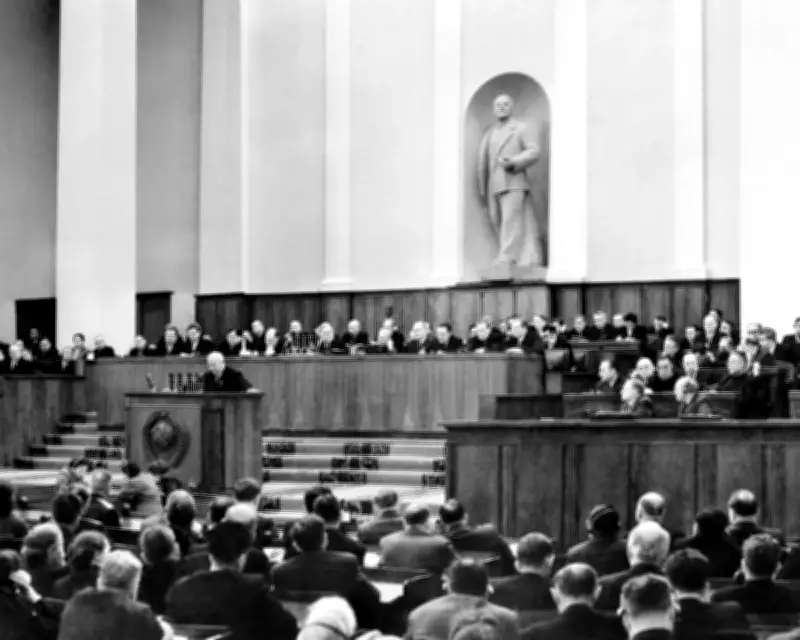
The Secret Speech That Shook the Soviet Union
On February 25, 1956, in a closed-door session at the 20th Congress of the Communist Party of the Soviet Union in Moscow, Nikita Khrushchev delivered a groundbreaking address that would reverberate through history. Known as the "secret speech," titled On the Cult of Personality and Its Consequences, it was initially kept from public view but leaked to the West three weeks later, exposing a dramatic shift in Soviet ideology.
Condemning Stalin's Reign of Terror
In his speech, Khrushchev denounced Joseph Stalin as a brutal despot, accusing him of leading a regime built on "suspicion, fear, and terror." He painted a vivid picture of Stalin's 30-year rule, highlighting massacres, torture, and economic mismanagement that weakened the Soviet Union, particularly during World War II. Khrushchev argued that Stalin's cult of personality had distorted Marxist-Leninist principles, elevating one individual to a god-like status that stifled party democracy and revolutionary legality.
Emphasizing Leninist Principles
While vigorously condemning the personality cult, the speech did not explicitly blame Stalin in all aspects. Instead, it coupled this critique with a renewed emphasis on Vladimir Lenin's teachings. A resolution passed by the congress endorsed Khrushchev's report, instructing party and government organs to adhere to the five principles of peaceful coexistence. This move signaled a strategic pivot, aiming to win allies in colonial and neutral countries by challenging Western nations to formally subscribe to these principles, thereby exploiting any hesitation to portray the West as inherently wicked.
Impact and Aftermath
The speech marked a significant "unrewriting" of Soviet history, debunking the Stalin myth without immediate public disclosure in the Soviet press. Pravda, the official newspaper, made oblique references, praising steps to reintroduce Leninist principles and eliminate the cult of the individual. Western reports from reliable Communist sources detailed Khrushchev's accusations, including crimes never before mentioned in the Soviet Union, such as responsibility for pre-war purges that damaged morale and economy. This event struck a blow at the totalitarian system, as later noted by figures like Mikhail Gorbachev, and reshaped global perceptions of Soviet leadership.
Khrushchev's secret speech remains a pivotal moment in 20th-century history, highlighting the internal struggles within the Communist Party and the ongoing reevaluation of Stalin's legacy. It underscored the tension between maintaining ideological purity and confronting past atrocities, setting the stage for future reforms and diplomatic maneuvers in the Cold War era.