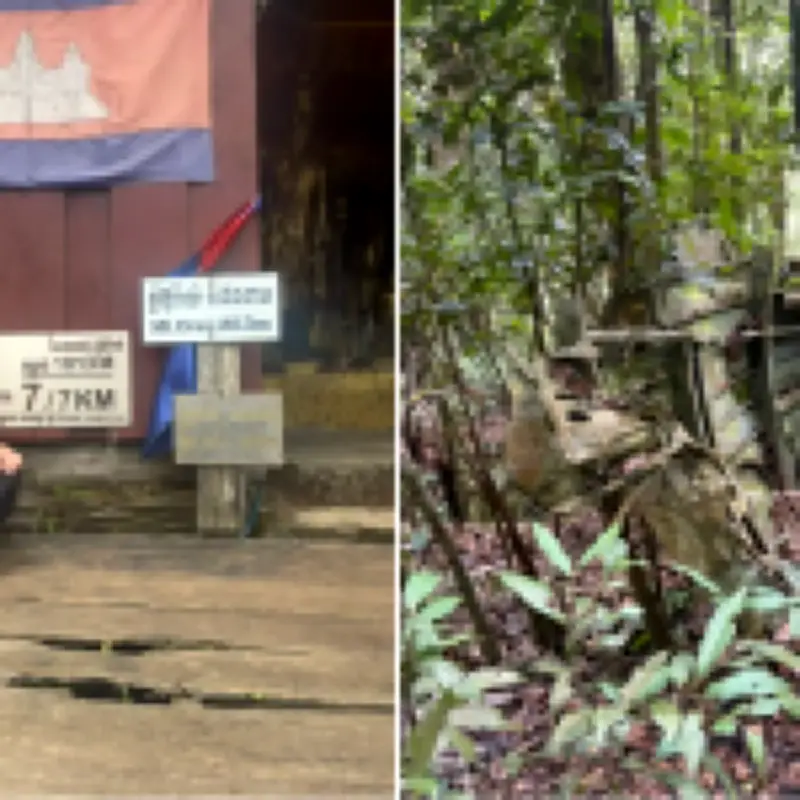
A trekker exploring Cambodia's highest mountain, Mount Aural, stumbled upon a remarkable piece of history: a military transport plane that crashed in 1974 during the country's civil war. The wreck, believed to be a Curtiss C-46 Commando, lies wedged between boulders in the remote Cardamom Mountains, largely preserved by the jungle that has reclaimed it over five decades.
A Unique Journey to the Summit
While millions of tourists flock to Cambodia annually for the ancient temples of Angkor Wat, the writer, Sadie Whitelocks, chose a different path. Driven by a personal quest to climb the highest peak in every country she visits, she hired a local guide, Pu Makara, from a nearby village and set off into dense rainforest. The trail, marked only by small metal altitude markers nailed to trees, wound through humid jungle for hours, with no crowds, souvenir stalls, or other hikers in sight.
After five hours and covering 15 kilometers, they reached the summit of Mount Aural, which rises more than 1,800 meters above sea level. The descent, however, took an unexpected turn when another guide, Lina Seanglay, who remained at base camp due to illness, suggested a different route back. Through a walkie-talkie, she hinted at something special, prompting the group to detour through the forest.
A Startling Discovery
Emerging from the trees, an enormous aircraft appeared, seemingly frozen in time. The military transport plane, wedged between giant boulders, had moss and lichen slowly consuming its aluminum shell, with vines wrapped around broken wings. For 30 minutes, the hiker and guide took in the sight, careful not to trip on the undergrowth. When the guide offered a photo opportunity, the hiker declined, feeling it was more a memorial to those who lost their lives than a tourist attraction.
Back at camp, Lina explained the local lore: the aircraft is believed to be a Curtiss C-46 Commando that went down on Christmas Day 1974, during the conflict between the Lon Nol regime and the Khmer Rouge. Local guides believe 11 people were on board—one pilot, one flight crew member, and nine military passengers—and that no one survived, though some might have escaped the wreckage only to be lost in the jungle.
Investigating the Mystery
The crash site, discovered by villagers years later, began attracting adventurous hikers in the early 2000s. Despite its preservation, official information is scarce. Aviation accident investigator David Gleave, Chief Investigator at Aviation Safety Investigations, told Metro that the wreck could hold crucial clues. 'The bending of the propellers could indicate how much engine power was being produced before impact—or whether they had failed altogether,' he said. Investigators would also examine evidence of fuel starvation, mechanical failure, or navigational errors, noting that the lack of post-impact fire suggests valuable physical evidence may remain.
The aircraft's age adds to the mystery. Built in 1943 as a World War II transport, the C-46 predates flight data recorders and cockpit voice recorders, so investigators would rely on the wreckage itself. The mountainous location also raises questions, as David explained: 'Mountains generate turbulence and powerful wind effects that can make climbing difficult. If you're flying visually and cloud suddenly drops, you can lose all navigation references very quickly.' Older navigation equipment could also be distorted by terrain, making accurate positioning harder.
Survival and Recovery Challenges
Whether anyone could have survived the impact is unknown. David noted that dense forest can sometimes improve survival chances by absorbing impact energy, but mountainous jungle is different. 'Trees may slow the aircraft before it strikes rock,' he said. The C-46's fragile nose section would have reduced the crew's chances, though passengers seated further back and restrained might have fared better. Even if someone survived, the jungle posed enormous challenges, and recovering the aircraft would have been difficult, especially during a civil war. 'Today you might send specialist teams in by helicopter. But in the middle of a civil war, with dangerous terrain and active fighting, investigators may simply have concluded there was little they could safely do,' David added, questioning whether an accident investigation authority even functioned effectively in Cambodia at the time.
Unlike modern aircraft with satellite tracking and emergency beacons, 1970s planes could vanish without a trace. Today, such historic wrecks are increasingly rare, making this site a unique window into the past. Standing beside the aircraft, surrounded by rainforest that has slowly reclaimed it, the hiker reflected on the secrets still hidden within its battered fuselage. Most visitors to Cambodia marvel at ancient temples, but few realize that deep inside its highest mountain lies another monument to history—one that may never fully reveal the mystery of what happened on Christmas Day, 1974.