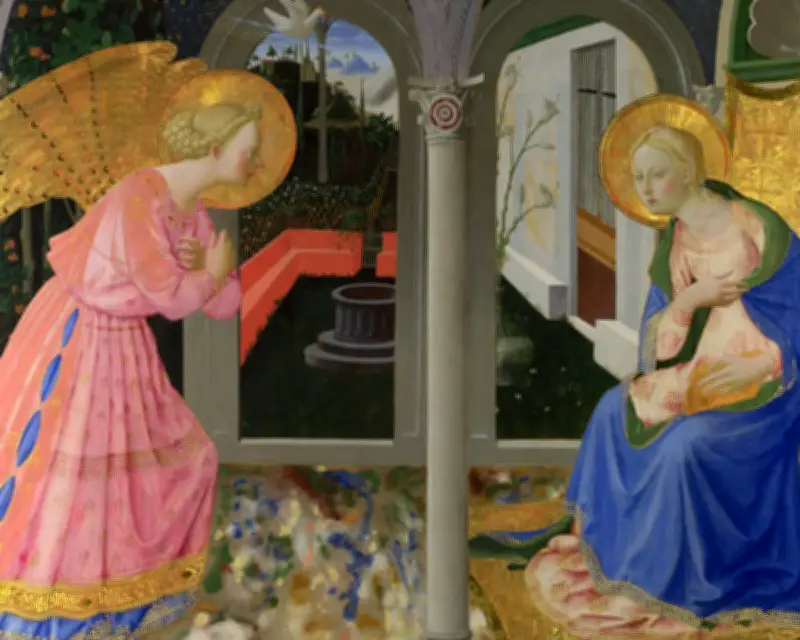
In his new book Divine Presence: Depictions of Marble in Late Gothic and Early Renaissance Painting, creative director and author Karl Kolbitz explores how marble was depicted in art as a mysterious, living structure with spiritual properties, long before the scientific understanding of geology emerged.
Marble as a Mystical Substance
Kolbitz argues that in Greco-Roman and medieval science, divinity permeated all matter, including stone. Marble's etymology traces back to the Latin "marmor," derived from the Greek verb "marmairein," meaning "to glisten." Aristotle considered marble to be the solidification of the living planet's "breath" or vapours. Theories from Vitruvius suggested the Earth actively generates marble at a perceptible rate, while astrological and alchemic ideas led one bishop in Brittany to claim that ingesting lapis lazuli could cure excessive sweating, aid escape from prison, or reconcile sinners to God.
Abstract Depictions in Renaissance Paintings
Kolbitz identifies compelling instances where marble depiction defies pictorial rules, evoking transcendence. In Zanobi Strozzi's The Annunciation (c. 1440), a wildly abstract marble floor contrasts sharply with the controlled treatment of figures and architecture. Piero della Francesca's Annunciation (c. 1467-69) features solid blue marble in the space delineating sky, evoking both hard earth and heaven. In Andrea Mantegna's The Lamentation Over the Dead Christ (c. 1483), fictive marble patterns suggest the blood-red morbidity of Christ's body. Giotto's Scrovegni Chapel (c. 1303-05) mimics "book-matching," where cut marble is deliberately arranged to create a desired pattern.
Versos and the Illusion of Preciousness
A fascinating practice is painting the backs of pictures (versos) as fictive marble, elevating humble wood into pseudo-precious items, much like books and reliquaries adorned with gems. Kolbitz mimics this by binding his cloth-covered book with a gilded top edge and selecting the verso of Albrecht Dürer's Christ as the Man of Sorrows (c. 1492-93) for its cover. He comments that it is "a spectacular example … because both sides of these objects were venerated, so the versos could function as meditations on the divine creation, Christ's suffering and resurrection, or luminous visions of paradise."
Inspiration and Contemporary Relevance
The idea for the book originated during research for Kolbitz's previous work on entryways in Milan, many featuring gorgeous marbles. He notes that painting marble patterns offered artists opportunities to evoke gateways to the cosmos or divinity. Part of marble's attractiveness is how it straddles the legible and illegible, drawing the eye while confusing it with natural chaos. Kolbitz writes, "We are far removed from the realities of people living in the 14th and 15th centuries. On the other hand, traces of their ways of thinking still persist in contemporary life," citing ongoing fascination with crystals, stones, and astrology.
The book encourages readers to "turn their attention to subjects that are right in front of our eyes, yet have largely gone unnoticed … things that, once pointed out, seem almost obvious, but which until then remained overlooked." It may prompt deeper contemplation next time one crosses a marbled entryway.