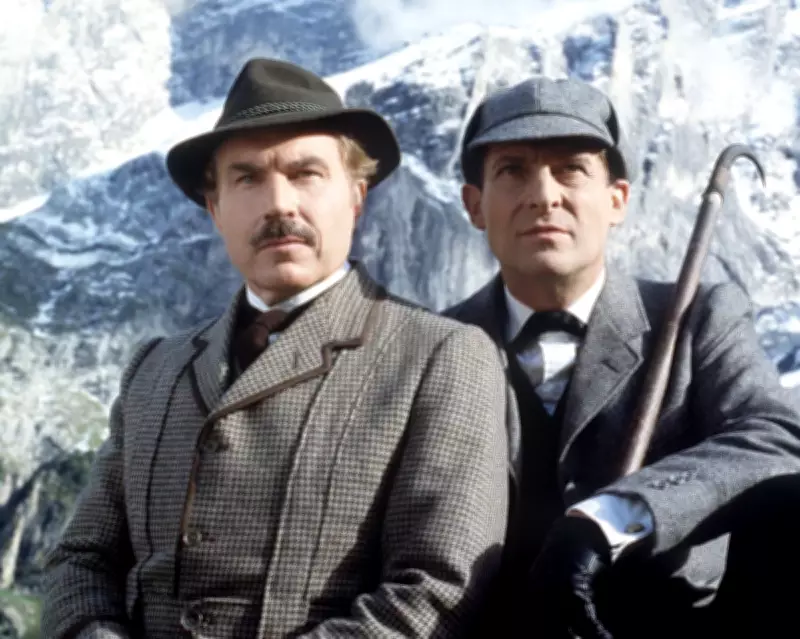
David Burke, the character actor who brought a fresh, intelligent take to Dr. John Watson in ITV's acclaimed series The Adventures of Sherlock Holmes (1984-85), has died at the age of 91. His portrayal transformed the sidekick from a bumbling fool into a lively and capable companion to Jeremy Brett's definitive Holmes.
A New Kind of Watson
Burke's Watson was a far cry from the "dozy doc" of earlier screen versions. Producer Michael Cox aimed to recreate the dark, dramatic tone of Arthur Conan Doyle's original stories, as illustrated by Sidney Paget in the Strand magazine. This vision included a haunted, cocaine-addicted Holmes and a loyal, mischievous Watson. The Victorian Baker Street set, built at Granada's Manchester studios, enhanced the atmosphere.
Cox was determined to cast Burke, having worked with him on the psychological thriller Holly (1972). However, Burke initially hesitated, questioning how to play such an ordinary character. His wife, actor Anna Calder-Marshall, joked that Watson was his perfect portrait, adding that it takes an extraordinary man to play an ordinary one.
Once filming began, Burke discarded the inept image popularized by Nigel Bruce opposite Basil Rathbone in the 1930s and 40s. Despite scriptwriters adding texture to Watson, Burke grew frustrated by his sparse lines—in The Speckled Band, he counted only 43 words. He left after two series (13 adventures), declining to appear in The Return of Sherlock Holmes.
Stage Success
Burke chose instead to perform with the Royal Shakespeare Company (RSC) alongside his wife, preferring that to filming in Manchester while she stayed home in Kent with their young son Tom, who later became an actor. Burke felt he had exhausted ways to convey Watson's amazement, famously tiring of repeating "Good heavens, Holmes!" in every tone. He recommended Edward Hardwicke as his replacement.
Born in Liverpool to Irish parents, Burke studied English at St Catherine's College, Oxford, intending to become a writer. But acting beckoned, and he trained at RADA (1958-60) on a scholarship, winning the Ronson award for most promising male actor. After repertory work in Bristol and Farnham, he made his West End debut in Alan Ayckbourn's Absurd Person Singular (1973), playing opposite Calder-Marshall, whom he married in 1971.
Classical roles followed at the Young Vic and the National Theatre (1980-2009), where his parts included the Ghost in Daniel Day-Lewis's Hamlet (1989) and Kent in King Lear (1997), described as "impressively pugnacious." His standout National Theatre role was as physicist Niels Bohr in Michael Frayn's Copenhagen (1998). Burke, a known prankster, posed as a Chiswick housewife to correspond with Frayn, leading to the book Celia's Secret (2001).
With the RSC, he played Hector in Troilus and Cressida (1985-86 and 1994-95), earning praise for a "beautifully poised and weighted" performance.
Television Career
On television, Burke appeared in crime and adventure series such as Z Cars, The Avengers, and Dixon of Dock Green. He first performed Conan Doyle in the BBC's Sherlock Holmes series (1965) and had roles in Coronation Street as a teacher and as factory boss Jack Benjamin. Other notable roles included Giles Winterborne in The Woodlanders (1970), Joseph Stalin in Reilly: Ace of Spies (1983), and Lord Reith in Bertie and Elizabeth (2002). He appeared with his son Tom in The Musketeers (2014).
Burke is survived by his wife and son. David Patrick George Burke, born 25 May 1934, died 10 May 2026.