The Enduring Struggle for Justice: The Cradock Four Legacy
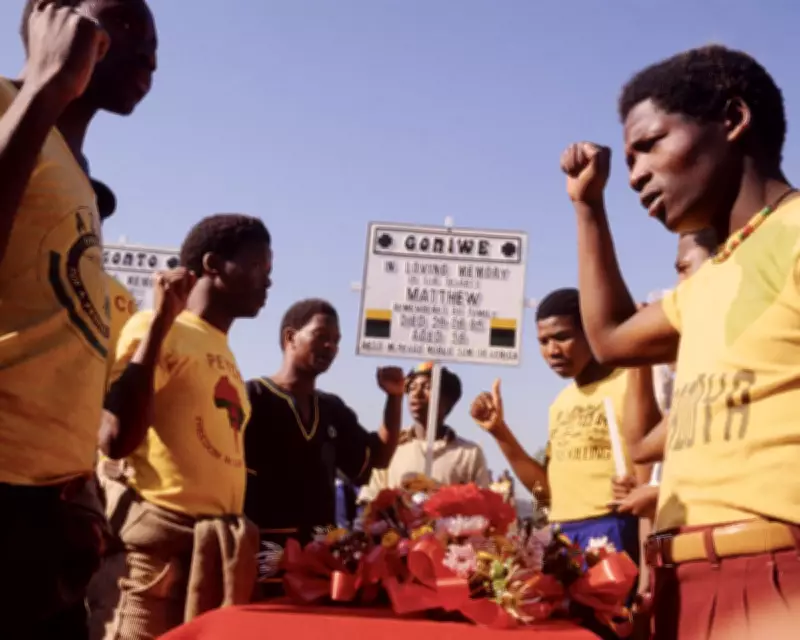
On the evening of June 27, 1985, four black anti-apartheid activists embarked on a fateful journey home from Port Elizabeth, now Gqeberha, to their Eastern Cape town of Cradock, currently known as Nxuba. Fort Calata, Matthew Goniwe, Sicelo Mhlauli, and Sparrow Mkonto, collectively known as the Cradock Four, were pulled over by white security police officers about an hour into their 150-mile drive. They were handcuffed, taken back towards Gqeberha, and brutally murdered in a staged vigilante attack.
A Gruesome Crime and a Symbol of Apartheid Violence
The details of their deaths are harrowing. Mkonto was shot during a struggle, while the other three were struck from behind. Their bodies were then stabbed multiple times by three black officers who had joined the scene, before being set ablaze. When Mhlauli's remains were discovered, one hand was missing. This atrocity became a stark symbol of the cruel and systematic violence perpetrated by the apartheid regime.
Their funeral on July 20, 1985, in Cradock drew massive crowds of mourners, reflecting the deep community impact and the men's roles as civic leaders. Yet, despite the advent of democracy in 1994, their families received neither the justice they sought nor clear answers about whether the murders were sanctioned at the highest government levels.
The Truth and Reconciliation Commission's Promise and Failure
More than four decades later, the families' ongoing fight has come to epitomize the deficiencies of the Truth and Reconciliation Commission (TRC), whose hearings commenced 30 years ago on April 15, 1996. Led by the late Nobel laureate Desmond Tutu, the TRC was designed to uncover human rights violations by the apartheid state and its opponents, offering amnesty to perpetrators who confessed fully.
In the case of the Cradock Four, a 1987 inquest concluded they were killed by "unknown persons." A 1993 inquest pointed to "members of the security forces" but named no individuals. It was only at the TRC that three white police officers admitted to the murders in a bid for amnesty, with three others confessing to planning or ordering the killings. All were denied amnesty and have since died. The three black officers involved were killed in a 1989 car bombing, allegedly to prevent them from revealing the truth.
Political Interference and Unfulfilled Prosecutions
Successive African National Congress (ANC) governments have failed to pursue hundreds of cases referred to prosecutors by the TRC. Families have accused former presidents Thabo Mbeki and Jacob Zuma of striking a deal with apartheid generals to bury these cases, allegedly in exchange for not prosecuting ANC members for atrocities committed during the liberation struggle.
Mbeki, president from 1999 to 2008, has denied halting TRC cases. Both he and Zuma (president from 2009 to 2018) have attempted to obstruct a judicial inquiry into potential political interference with prosecutions. In January 2025, Lukhanyo Calata, son of Fort Calata, led 25 families in suing the government for this failure. In response, President Cyril Ramaphosa announced a judicial inquiry led by retired judge Sisi Khampepe in May 2025.
The Human Toll: Families' Decades of Anguish
The emotional scars run deep. Nomonde Calata, widow of Fort Calata, famously broke down during the TRC hearings, her cries broadcast nationwide. "I thought the enemy will laugh at me when they see my sadness," she recalled. "So when I went to the TRC, I just couldn't hold the cry in me and the pain."
Lonwabo Mkonto, who was six when his father Sparrow was killed at 33, remembers the absence keenly. At 18, during a Xhosa initiation rite, "other initiates are getting visits from their fathers," he said, voice faltering. "And you just sit there and wait for nobody, knowing that your father will never come."
The Broader Critique of the TRC's Legacy
While the TRC provided moments of catharsis and truth-telling, its limitations have become increasingly apparent. Yasmin Sooka, a TRC commissioner, noted that the commission failed to properly expose apartheid's systemic nature, as politicians like former president F.W. de Klerk refused to take responsibility.
Investigative journalist Zanele Mji, who grew up with an idealized view of the TRC, later recognized its shortcomings. "The violence was how [apartheid] was enforced," she said. "But what it actually was, no one was ever tried for that. Land, education, housing – all these things that still really hold South Africa back today."
A Third Inquest and the Search for Answers
A third inquest into the Cradock Four killings opened in June 2024 after years of family pressure. Key testimony included that of Eugene de Kock, the former Vlakplaas commander known as "Prime Evil," who confirmed that the signal to "remove permanently from society" meant murder. De Kock, who received amnesty for advising on disposing of the murder weapon, testified in March 2025.
Lukhanyo Calata, while acknowledging De Kock's assistance, emphasized he is "not a hero by any spectre of the imagination." The families seek not just legal accountability but recognition of their loss. Nombuyiselo Mhlauli, widow of Sicelo Mhlauli, who never remarried, poignantly stated, "If my husband was here, we would be having our house, reading newspapers, sharing spectacles."
A Legacy of Unresolved Trauma
Cyril Adonis, a psychology professor, notes that poverty is the biggest predictor of intergenerational trauma for apartheid victims and their descendants. "The main thing is material deprivation," he explained, especially when linked to concrete apartheid-era injuries or losses.
As the Khampepe inquiry continues, with former prosecutors testifying about obstruction, and the third inquest awaits its conclusion, the Cradock Four's legacy endures. Their families' struggle underscores the unfinished business of South Africa's transition, where truth has often been revealed, but justice remains elusive. The final report to President Ramaphosa is due on July 31, 2025, potentially offering new insights but unlikely to fully heal wounds that have festered for over 40 years.