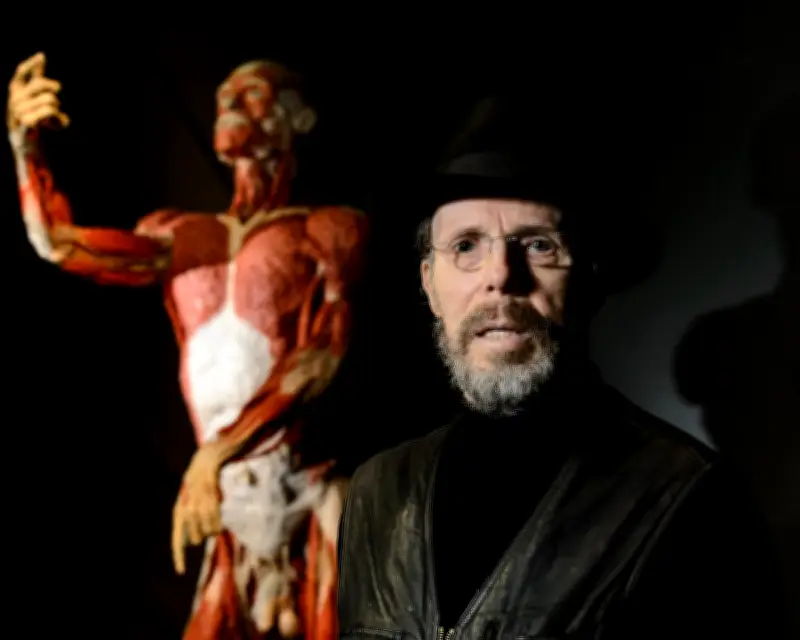
Gunther von Hagens, the German anatomist who created the controversial Body Worlds exhibition, has died at the age of 81 from a cerebral haemorrhage, following nearly two decades of living with Parkinson's disease. Known by some media as 'Doctor Death', he invented plastination, a technique that replaces bodily fluids and fats with plastics to preserve human corpses for display.
Plastination and Body Worlds
Von Hagens developed plastination between 1977 and 1982 at the University of Heidelberg. The process preserves tissues intact, allowing corpses to be manipulated into lifelike poses—such as a basketball player or trapeze artist—or sliced into cross-sections. The first Body Worlds exhibition opened in Japan in 1995. By the time of his death, over 58 million people had visited the exhibition worldwide, and more than 20,000 individuals had pledged to donate their bodies for plastination.
Controversy and Criticism
The exhibition drew sharp criticism from religious and secular figures. The Catholic archbishop of Miami suggested von Hagens would face retribution in the afterlife. The Nobel laureate Günter Grass reportedly compared him to Nazi eugenicist Josef Mengele. In 2002, journalist Jasper Gerard wrote in the Sunday Times that 'the moral problem is not how Von Hagens treats the dead, it's what [his exhibition] says about his view of the living.'
Despite the backlash, others praised him. The Akron Beacon Journal stated he 'illuminated physiology and helped us grasp the anatomical elegance of our species.' One visitor who had attempted suicide said the exhibits convinced her never to harm herself again.
Legal Challenges
Von Hagens faced numerous legal battles over corpse acquisition. In 2002, he was accused of receiving 56 corpses from a Russian pathologist without approval; the bodies were impounded and returned to Russia, but no charges were filed. That same year, he performed the first public autopsy in the UK since the 1830s at the Atlantis art gallery in London, broadcast by Channel 4. Critics argued it breached the Anatomy Act of 1832, but again no charges were brought.
Early Life and Education
Born Gunther Liebchen on 10 January 1945 in Alt-Skalden, then Germany (now Skalmierzyce, Poland), he was the third of five children. His father, Gerhard, was a sergeant in the Nazi SS; his mother, Gertrud, was a homemaker. The family fled the Soviet army, living in Berlin before settling in Greiz, East Germany. A haemophiliac, von Hagens spent much of his childhood in hospital, sparking his interest in medicine. After witnessing his first autopsy at 17, he studied medicine at Jena University. He participated in protests against the 1968 Soviet invasion of Czechoslovakia and attempted to escape to the West twice in 1969, leading to his arrest and nearly two years in prison. The West German government bought his freedom, and he completed his degree at Lübeck University, earning a doctorate from Heidelberg in 1975.
Personal Life and Legacy
He married fellow medical student Cornelia von Hagens in 1975, taking her surname; they had three children—Rurik, Bera, and Tona—before divorcing in 1989. His second wife, Angelina Whalley, a German anatomist, managed his business and curated his exhibitions after their marriage in 1992. Von Hagens, an avowed agnostic, insisted his goal was education: 'It's an honour to cause this controversy. Yes, some specimens are difficult to look at. But it has helped people discover new respect for their bodies,' he told the Guardian in 2002. He divided his later years between Berlin and Guben, Poland, where he ran a plastination lab. He is survived by Angelina and his children.