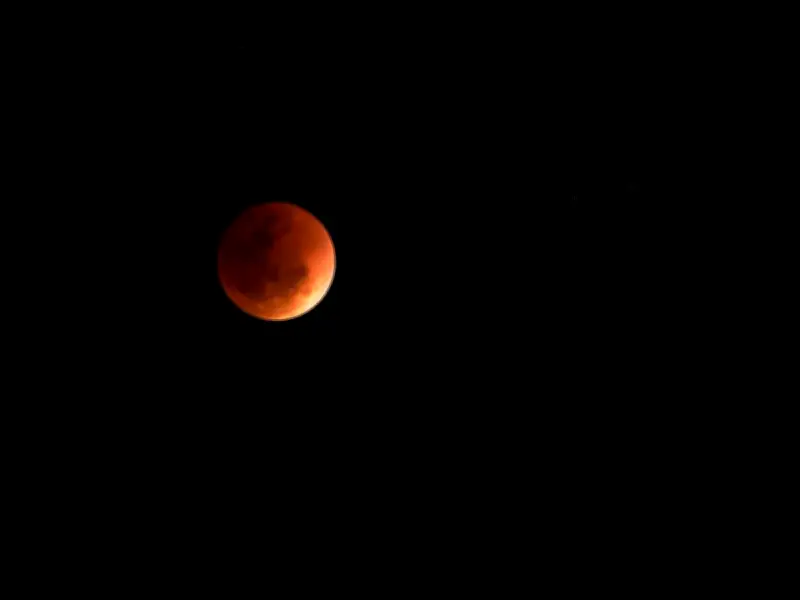
The Met Office has issued its forecast for Friday morning's deep partial lunar eclipse, indicating that stargazers in southern and eastern England, including parts of London, will have the best – though still uncertain – chance of witnessing the so-called 'blood moon'. According to the national weather service, conditions will be variable across the UK during the eclipse period, with cloud cover expected to increase as the event progresses.
Forecast Favours South and East England
The eclipse begins at 2:23am on Friday, August 28, when the penumbral shadow first contacts the Moon. At this early stage, southern and eastern England are expected to remain largely clear, offering some Londoners a potential view between the clouds. In contrast, widespread cloud cover is predicted across Cornwall, Wales, the Midlands, northern England, Scotland, and Northern Ireland from the outset.
As the night moves toward the partial phase at 3:33am and the maximum eclipse at 5:12am, cloud cover is forecast to increase considerably nationwide. This could obscure visibility even in the more favourable southern and eastern areas before the eclipse reaches its peak.
Horizon Clouds and Viewing Tips
Forecasters caution that the eclipse reaches its peak magnitude while the Moon sits low on the horizon, ahead of setting at around 6:15am. Even where clear skies exist overhead, banks of cloud hugging the horizon could obstruct the view. The Met Office recommends finding a hilltop, stretch of coastline, or other exposed location for a better vantage point, provided local conditions are favourable.
Unlike a solar eclipse, a lunar eclipse can be viewed safely with the naked eye. No specialist protective eyewear is needed, though binoculars may enhance the experience should skies remain clear.
What Is a 'Blood Moon'?
Friday's event is technically classified as a deep partial lunar eclipse. No part of the world will witness the Moon becoming entirely engulfed by Earth's umbra, yet roughly 93 per cent of its visible surface will pass through the darkest portion of the shadow at peak.
The term 'blood moon' describes the reddish or copper hue that the eclipsed section of the Moon may adopt. This occurs as sunlight passes through Earth's atmosphere, where it is scattered and redirected toward the Moon. Shorter blue wavelengths are dispersed more intensely, while a greater proportion of red light ultimately reaches the lunar surface.