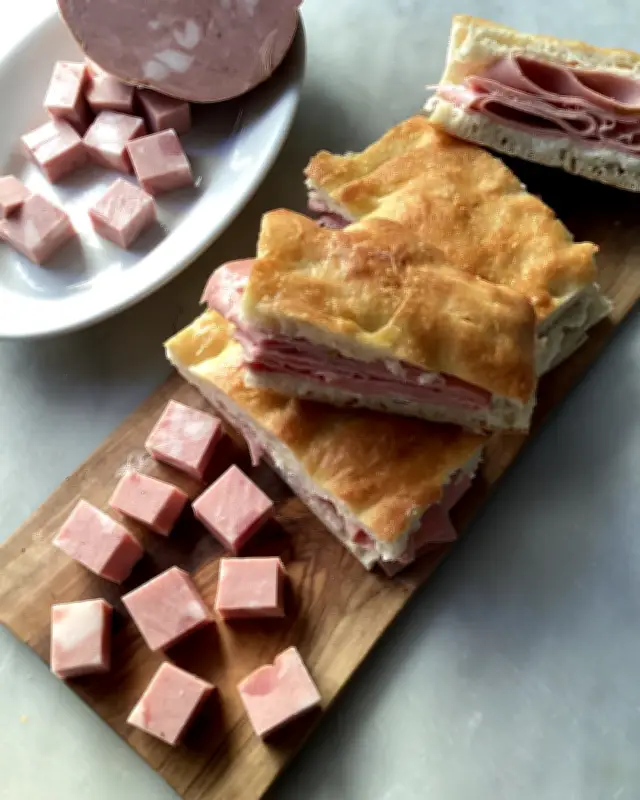
It is that time of year when the television, perched on an Ikea unit with castors and its feet supported by wooden splints, is wheeled between the kitchen doors to face the terrace. In the absence of a barbecue or outdoor shower, the TV becomes our seasonal shift—an indoor object moved outside, made slightly more exciting. As a result, TV dinners are transformed, gaining an extra layer of soundtrack: birds chirping, neighbors chatting in the bar below, and the honk of an articulated lorry blocked by a double-parked car. We also have a table outside, but that changes the nature of a TV dinner too much. Instead, the table is moved aside for wooden chairs, tea towels, and plates on laps, with focaccia sandwiches featuring mortadella and parmesan cream for meat eaters, and parmesan cream, tomato, and green leaves for those who don't.
The History of Mortadella
Mortadella is considered an insaccati parzialmente cotti, or partly cooked sausage. Its origin is debated: some believe the name derives from il mortaio (the mortar) in which it was pounded; others trace it back to the Romans and a sausage flavored with myrtle berries called farcimen murtatum. The first mention of mortadella appears in 12th-century cookbooks, though that version was likely made of veal or donkey. A better starting point is the 1600s, when nobleman and agronomist Vincenzo Tanara described meat preparation: two-thirds lean pork from shoulder and leg, cut into large cubes, then transformed through "sharp pounding," stuffed, and cooked at moderate temperature. Strict edicts regulated the labor-intensive processes for luxury products affordable only to the wealthy.
Industrialization in the 1900s changed production, demand, and exportation, leading to changes in meat quality and additives required for travel and preservation—including tripe, flour, rinds, emulsified ice, egg white, sugar, dried milk, polyphosphates, and synthetic flavorings, all noted on packaging. However, many producers adhere to traditional methods.

Artisanal Mortadella
Artigianquality, a small producer in Bologna, uses high-quality cuts of pork from 100% Italian pigs raised semi-wild. Half the mix is shoulder, a quarter minced ham and trimmings, pounded to a paste, then mixed with neck fat (lardelli). Seasoning includes mace, cardamom, nutmeg, black and white pepper, garlic, and whole sea salt flakes. The mixture is extruded into casings, tied by hand, and cooked in dry air ovens at low temperature for 24-28 hours. The resulting mortadella is antique pink, firm-textured, and delicately spiced. It is best served cut into cubes, though also wonderful sliced thin and folded on focaccia with parmesan cream.
Recipe: Focaccia Sandwiches with Mortadella and Parmesan Cream
In a bowl, beat 60g finely grated parmesan with four tablespoons of soft cheese or ricotta until well blended and creamy. Add a dash of milk to loosen if desired. Season with white or black pepper, salt, and nutmeg to taste, then mix again. Split four squares of focaccia or four bread rolls (or eight slices of bread). Spread both sides thinly with the parmesan cream. Lay two slices of mortadella on one half of the bread, top with the other half, and repeat.
Ever since visiting Max Halley's shop in north London, I can't make a focaccia sandwich without thinking of his crisp suggestions. He recommends ready salted Kettle Chips. I suggest putting the crisps in a bowl on a small table with wheels so everyone can add as much as they wish.

Ingredients
- 60g parmesan, finely grated
- 4 tbsp soft cheese or ricotta
- Black or white pepper, salt, nutmeg to taste
- 4 squares focaccia, or 4 bread rolls, or 8 slices of bread
- 8 slices mortadella
Method
- Beat parmesan and soft cheese or ricotta until creamy; add milk if needed. Season and mix.
- Split bread and spread both sides with parmesan cream.
- Layer two slices of mortadella on one half, top with the other half. Repeat.