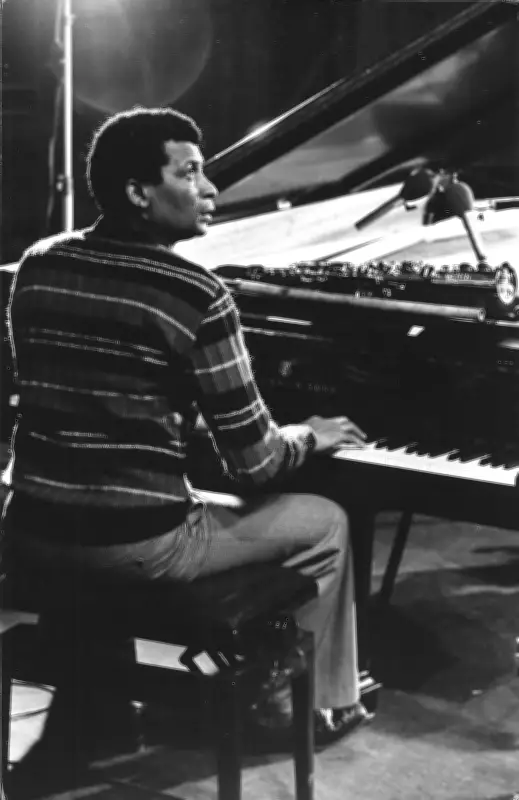
South African jazz pianist and bandleader Abdullah Ibrahim, who has died aged 91, defined the heartfelt sound of South African jazz with an inimitable style blending bright, guileless melody with fearless improvisation. Here are 10 of his best recordings spanning his six-decade career.
Scullery Department (from Jazz Epistle Verse 1, 1960)
Born Adolph Johannes Brand in Cape Town in 1934, Ibrahim made his professional debut at 15 as Dollar Brand. Co-founding the Jazz Epistles in 1959, South Africa's first Black jazz group, their only album Jazz Epistle Verse 1 showcases his nascent skills. The closing number, Scullery Department, features heavy-swinging over a bluesy motif, with Ibrahim's playing artfully skipping through polyrhythms and refiguring Thelonious Monk's motifs into an earthy groove.
Jumping Rope (from Duke Ellington Presents the Dollar Brand Trio, 1964)
After fleeing apartheid South Africa for Europe, Ibrahim's future wife Sathima Bea Benjamin encouraged Duke Ellington to hear him play. The resulting album displays Ibrahim's fast-developing chops. Jumping Rope explores his virtuosity, speeding up Monkisms into modernist bursts of fire, a fragmentary delight on an album that gained wider release in the 1990s.

Mannenberg (Mannenberg – Is Where It's Happening, 1974)
After converting to Islam and changing his name, Ibrahim wrote his most famous composition, Mannenberg, named after a Cape Town township where Black families were forcibly relocated. The song finds resistance in persistent joy, featuring an ebullient top-line melody and a roaring solo from tenor saxophonist Basil Coetzee. Recorded in one take, it became an unofficial civil rights anthem, a favorite of Nelson Mandela's.
Jabulani (Joy) (The Journey, 1977)
Ibrahim's friendship with Don Cherry encouraged avant-garde exploration. On The Journey, a nine-piece ensemble produced upbeat melodies with free improvisation. The 17-minute suite Jabulani (Joy) opens with a cheerful lead line before a barrage of free improvisation, with Cherry and Carlos Ward soaring while Ibrahim's tender phrases keep listeners grounded.
Just You, Just Me (African Dawn, 1982)
This delicate solo outing features tributes to jazz forebears. Ibrahim's interpretation of the 1929 standard Just You, Just Me employs a heavy left-hand bass drone, stride rhythm, gospel phrasing, and bluesy improvisation, turning his 88 keys into a symphony of sound.
Mandela (Water from An Ancient Well, 1985)
With his septet Ekaya, Ibrahim used three saxophones, trombone, bass, and drums for a big-band feel. The opening track Mandela features one of the deepest swinging feels in modern jazz, with joyous solos from each horn section member while Ibrahim gently pushes the rhythm.
The Wedding (African Suite, 1998)
On African Suite, Ibrahim paired his piano trio with a 17-piece string section. The yearning love song The Wedding receives luscious orchestral treatment, with melismatic strings and precision piano notes containing wistful emotion. Ibrahim also used orchestral settings in his film scoring for Claire Denis.
Joan Capetown Flower (Emerald Bay) (Sotho Blue, 2010)
This welcome return to the Ekaya format features a down-tempo, swaying melody that sets up an interweaving duet between tenor saxophonist Keith Loftis and Ibrahim, trading finely-woven lines into a complex, nuanced dialogue.
Dreamtime (The Balance, 2019)
At 85, Ibrahim delivered a late-career surge with The Balance. The opening composition highlights his capacity for creative journeying, featuring Cleave Guyton on flute. Eschewing his typical upbeat tone, the track moves through a mysterious mood with precision-engineered improvised lines, an unexpected foray into new territory.
Nisa (Solotude, 2020)
On one of his final solo recordings, Ibrahim embraced physical limits to create a 20-track suite replacing frenetic energy with ruminative, introspective emotion. His version of Nisa is particularly affecting, taking ample time between phrases as if recounting his life's experience. The swinging feel, blue notes, and aching melody are unmistakably his—a touch that will never be fully imitated.